What's fueling the interest in 2026 isn't just the revenue potential—it's the operational simplicity that modern machines deliver. Lower startup costs for used equipment, combined with advanced digital machines featuring touchscreen interfaces and remote inventory tracking, have made vending accessible to operators with zero prior experience. But accessibility doesn't guarantee success. Location quality, product-market fit, and operational discipline separate profitable routes from money-losing ones.
This guide walks you through every practical step: choosing your niche, validating demand, acquiring the right machine, and building toward scale. It's written for people who want a clear, honest picture of what starting a vending machine business actually involves—not just the highlights.
Key Takeaways
- A vending machine business involves buying machines, securing placements, stocking products, and earning margin between wholesale cost and retail price
- Location quality determines success or failure—secure placement before buying equipment
- Startup costs range from under $2,000 for a used machine to $15,000+ for smart digital models
- Most operators don't earn meaningful passive income in the first 3–6 months. Expect hands-on work early.
- Digital machines with touchscreen interfaces, cashless payments, and remote monitoring cut restocking trips and boost sales in 2026
What Is a Vending Machine Business?
A vending machine business works like this: you purchase one or more machines, secure placement in high-traffic locations, stock them with products, and earn the margin between your wholesale cost and what customers pay. Execution hinges on location quality, product selection, and operational efficiency — three variables that separate profitable routes from underperforming ones.
Common machine formats include:
- Bulk vending (gumballs, toys) — lowest barrier to entry, but thin margins and limited growth potential
- Traditional snack and beverage machines — the most common starting point for new operators
- Specialty machines (coffee, fresh food, OTC items) — higher margins in the right settings
- Smart/digital machines — touchscreen interfaces, cashless payments, and remote monitoring built in; the fastest-growing segment in the industry
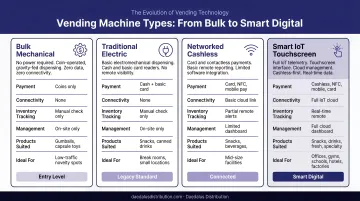
The type of machine you choose shapes every downstream decision — pricing strategy, location requirements, restocking frequency, and how quickly you can scale. A single machine can work as a side income with minimal time commitment. Add more machines, establish a route, and bring on part-time stockers, and the model grows with you. The entry point is low; the ceiling depends on how well you run the operation.
What to Know Before You Start a Vending Machine Business
Set honest expectations: a vending machine business is not passive at the start. Early-stage operators typically spend considerable time scouting and securing locations, learning which products sell, adjusting pricing, and physically restocking machines—often weekly or more. While specific operator hour data varies, expect to invest 5–10 hours per week per machine during the first three months as you validate location performance and refine your product mix.
The most common early-stage mistakes are:
- Buying a machine before securing a location — new operators who skip this step often end up paying for equipment that sits idle
- Underestimating commission costs: property owners typically charge 5–15% of gross sales, sometimes up to 20% in high-traffic locations
- Choosing locations based on gut feeling rather than observed foot traffic and demographic fit
Timeline to consistent income varies significantly by location quality and machine type. A strong location can generate meaningful revenue within weeks; a weak location may never break even. According to Nav.com, most operators recommend starting with trial periods of 3–6 months to demonstrate value before committing long-term. Get one machine consistently profitable before adding a second — that data tells you exactly what to replicate.
Why Start a Vending Machine Business in 2026?
Starting a vending machine business makes sense under specific conditions—it's not a guaranteed opportunity for everyone. The U.S. convenience services industry is projected to grow at approximately 6.5% annually, with demand for convenient, 24/7 access to snacks, beverages, and specialty items remaining consistent. Cashless payments have reshaped machine economics: 77% of all vending transactions were cashless in 2024, and cashless consumers spend an average of $2.24 per transaction versus $1.78 for cash—a 37% higher transaction value.
Structural advantages of the business model:
- No storefront or employees required at launch, keeping startup costs low
- Test one location before committing more capital; scale only when it's working
- Machines hold resale value, and established routes can be sold as a packaged asset
That said, the picture isn't uniformly positive. IBISWorld analysts noted that vending operators face pressure from loyalty apps, delivery options, and shifting consumer behavior. Revenue CAGR from 2021-2026 was -1.6% for traditional operators, and the number of vending businesses declined at a CAGR of -3.8% during the same period. Operators succeeding in 2026 invest in better locations, smarter machines, and product mixes that genuinely serve the people in that space.
How to Start a Vending Machine Business – Step by Step
This section follows the execution sequence experienced operators recommend. The most common ordering mistake: buying a machine before any groundwork is done. Follow these steps in order.
Step 1 – Choose Your Niche and Define Your Location Type
Decide what type of vending best fits your goals, budget, and opportunity in your area. Traditional snack and beverage machines are the lowest-risk starting point; specialty or smart machines can offer higher margins in the right settings.
Work backward from location:
- Identify what types of locations you can realistically access (offices, warehouses, apartment complexes, gyms, urgent cares)
- Determine what products those locations' customers would actually buy
- The product-location match drives sales—not the machine itself
Step 2 – Validate Demand and Secure a Location Before Buying
Research your shortlist of locations in person. Visit them, observe foot traffic, check for existing machines (a poorly maintained machine is an opportunity), and assess whether nearby food options compete directly with what you'd stock.
Look for locations with:
- 100+ people per day minimum
- Limited food alternatives
- Extended access hours (early morning, evenings, weekends)
- Captive audiences (warehouses, office buildings, gyms)
Approach property managers, office managers, or business owners directly (in person where possible) with a simple one-page summary of what you offer: machine installation, restocking, maintenance, and no cost or hassle to them. Be prepared to discuss a commission arrangement (typically 10–15% of gross sales) or a flat monthly fee.
Step 3 – Set Up Your Business and Handle Legal Requirements
Register a business entity (most operators use an LLC) to separate personal and business liability, obtain an EIN from the IRS, open a dedicated business bank account, and set up basic bookkeeping from day one.
Licensing and compliance requirements:
- Research whether your state or municipality requires a general business license, seller's permit (for sales tax collection), or health department permit for food and beverage machines
- Requirements vary significantly by location—VendSoft's 50-state vending law directory is a useful starting point, but always confirm current requirements directly with state/local authorities
Federal compliance:
- Operators with 20 or more machines must comply with FDA calorie labeling requirements
- All machines placed in covered public or private facilities must meet ADA accessibility standards
Step 4 – Choose and Acquire the Right Machine
Compare the three main acquisition paths:
| Acquisition Method | Cost Range | Pros | Cons |
|---|---|---|---|
| Used | $1,000–$3,000 | Lower upfront cost | Higher breakdown risk, outdated payment tech |
| New Traditional | $3,000–$6,000 | Warranty, modern features | Higher upfront cost |
| Smart/Digital | $6,000–$15,000+ | Touchscreen, remote tracking, cashless | Highest upfront cost |
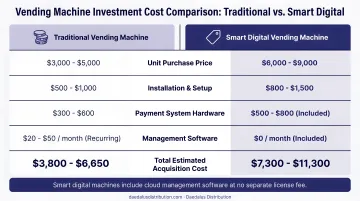
Warranty coverage matters: a compressor failure on a used machine can wipe out months of profit. Research shows cashless transactions boost sales by as much as 35% over 18-month periods — which makes cashless payment capability worth prioritizing from day one.
Modern all-digital machines (such as those offered by Vendekin Technologies through Daedalus Distribution) come with built-in touchscreen interfaces, remote inventory tracking, and sales data reporting. For new operators, that visibility into what's selling — and what isn't — makes early decisions considerably less costly.
Match machine type to confirmed location:
- Smart cooler or digital combo machine → high-traffic apartment complex or corporate office
- Used traditional machine → validating a new, unproven location before committing more capital
Step 5 – Stock, Price, and Launch Your Machine
Start with proven bestsellers for the location's demographic — drinks, snacks, and energy bars in most settings — and avoid overstocking on day one.
Simple markup framework:
- Target roughly 2–3x wholesale cost on most items
- Check local convenience store pricing as a ceiling reference
- Factor in location commission (10–15%) and card processing fees (2–3%) before finalizing prices
Set up cashless payments (card reader or NFC-capable hardware if not built in), confirm the machine is ADA-compliant for the placement, stock it conservatively, and treat the first 30–60 days as a data-gathering period. Track what sells, what sits, and what the actual gross margin looks like before making decisions about expanding.
Step 6 – Monitor Performance, Refine, and Build Toward Scale
Track key metrics from the first week:
- Gross sales per machine per week
- Gross margin (revenue minus cost of goods)
- Spoilage rate
- Net profit after commission and processing fees
Use this data—not assumptions—to adjust your product mix, pricing, and restocking frequency. Before adding more machines, stabilize the one you have: make sure the location is performing consistently, your service schedule is sustainable, and your margin is healthy.
Growth in vending is primarily a location acquisition challenge. Once the operational model is working on a single machine, it scales.
Understanding Vending Machine Costs and Profit Potential
Typical startup costs for a single machine:
- Machine purchase: $1,000–$3,000 (used); $3,000–$6,000 (new traditional); $6,000–$15,000+ (smart/digital)
- Initial inventory: $200–$500 per machine to start
- Delivery and installation: $150–$500
- Permits and insurance: $300–$600/year for general liability
- Contingency reserve: At least $500
According to Nav.com, a single used machine with initial inventory can be launched for under $3,000.
The profit formula:
A machine grossing $1,000/month with 50% COGS, 10% location commission, and standard card fees nets approximately $300–$400/month. NAMA data shows average annual sales per vending machine are $6,284 (approximately $524/month), but this varies dramatically by location type.
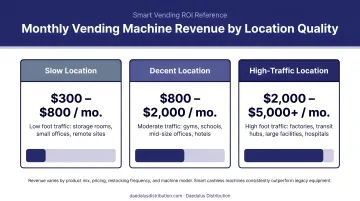
Revenue ranges by location quality:
- Slow location: $50/week ($200/month)
- Decent location: $100–$300/week ($400–$1,200/month)
- High-traffic locations (hotels, hospitals): $500+/week ($2,000+/month)
Financing options for first-time operators:
- Personal savings — lowest risk for a first machine
- Equipment financing — machine as collateral, $0-down options available
- Business credit cards with 0% intro APR periods — useful for covering initial machine and inventory costs
- Seller financing — for route acquisitions
For amounts under $5,000–$6,000, a 0% intro APR business card or personal savings is often the simplest and most accessible path.
One more thing worth setting straight: vending is not truly passive income at the start. It becomes closer to semi-passive once your routes are organized, remote monitoring is in place, and part-time stockers are hired — but that typically takes 6–12 months of hands-on work to reach.
Brandon Schlichter, an Ohio operator running 24 machines generating $3,000–$3,500 in monthly revenue, noted that "the biggest difficulty is finding a good location and negotiating with the owner" — not the day-to-day operation of the machines themselves.
Frequently Asked Questions
How much does it cost to start a vending machine business?
Startup costs range from under $2,000 for a single used machine with initial inventory to $10,000–$15,000+ for a new digital or smart machine. Ongoing costs—inventory, commissions, insurance, and card processing fees—are what most first-timers underestimate.
Are vending machines a profitable business?
Vending can be profitable, but profitability depends entirely on location quality, product mix, and operational efficiency. A machine in the wrong location will underperform regardless of how well it's stocked.
How much can a vending machine make per month?
A decent location might net $100–$400/month from a single machine after costs. High-traffic locations with smart machines can generate significantly more—$500–$1,000+ per month. Early machines often earn less as operators are still learning their locations.
What's changing for vending machine operators in 2026?
Cashless payment is now the baseline expectation—machines without it lose sales. Smart machines with remote monitoring are increasingly common, reducing wasted service trips. Operators who differentiate on product selection and machine quality are pulling ahead of those still running older equipment in saturated spots.
Do I need an LLC to run a vending machine business?
An LLC is not legally required to operate vending machines, but most operators choose one for liability protection and professional credibility. At minimum, a seller's permit or sales tax ID is required in most states, and a local business license may also be needed.
What are the best locations for a vending machine business?
Offices, warehouses, apartment complexes, urgent care clinics, and gyms consistently outperform low-dwell, high-competition spots. What they share: 100+ daily visitors, limited nearby food options, extended access hours, and a captive audience with few alternatives.