Introduction
Vending machine businesses are gaining serious traction across Massachusetts, fueled by the state's dense network of 100 colleges and universities, 199,000 hospital employees, and high-traffic corporate campuses along the Route 128 corridor. This concentration of institutional foot traffic makes Massachusetts one of the strongest markets in the Northeast for automated retail.
The appeal extends beyond full-time entrepreneurs. Side-hustlers, recent graduates, and career-changers in Boston, Worcester, and Springfield are exploring vending as a path to flexible, recurring income — one that doesn't require a storefront or full-time staff.
The barrier to entry is low, but success depends on understanding Massachusetts-specific licensing rules, securing quality locations, and tracking performance from day one.
This guide walks through MA licensing requirements, location strategy, daily operations, and compliance — so you can launch with a clear plan rather than costly guesswork.
Key Takeaways
- Massachusetts requires business registration, Form TA-1 sales tax registration, and a local health permit for food vending
- Startup costs range from a few hundred dollars for a basic bulk machine to $3,000-$10,000+ for a new digital unit with cashless payments
- Location quality determines revenue — expect $300-$1,500/month per machine depending on foot traffic and product fit
- Solo-operable early on, but restocking, maintenance, and route planning demand consistent time
- Realistic break-even timeline: 6-12 months depending on location quality and number of machines
What Is a Vending Machine Business?
A vending machine business means owning and operating one or more automated retail machines placed in high-traffic locations. You stock the machines with products, customers buy directly from the machine, and you earn the markup on each sale with minimal staffing required once they're up and running.
Operators earn from the spread between wholesale product cost and retail sale price, while location hosts get a convenient amenity at no cost — or a modest revenue share. Your revenue depends entirely on where you place machines and what you stock them with.
You can run this as a one-machine side hustle or scale to a multi-machine route across several locations as a full-time operation. What determines success is matching your machine type and product selection to locations you can actually secure.
Is Starting a Vending Machine Business in Massachusetts Right for You?
Massachusetts is a strong vending market. The state's college-dense cities, large healthcare infrastructure, and high-traffic business districts along Route 128 create consistent, predictable demand. The real question is whether your timing and circumstances align with what the business actually demands.
What the early stage actually looks like:
- Scouting and negotiating locations with property managers
- Physically restocking machines weekly or bi-weekly depending on volume
- Handling machine maintenance or breakdowns when they occur
- Tracking sales manually or via software to identify top sellers
- Adjusting product mix based on actual performance data
This is hands-on before it becomes passive. Operators who treat vending as a "set it and forget it" business typically underperform or lose their locations.
Income timeline:
First-year revenue depends heavily on securing good locations. Industry sources cite average revenue of $300 to $1,500 per month per machine, but that range exists for a reason — location quality is the dominant variable.
A machine in a busy hospital corridor will outperform one in a low-traffic office lobby by multiples. Operators who rush placement without validating foot traffic or negotiating fair commission terms (typically 5-25% of revenue) often end up on the lower end of that range.
Who this works for:
This model suits operators who:
- Can commit to managing a local route consistently
- Handle restocking and logistics without a dedicated team
- Can weather a 6-12 month ramp-up before revenue stabilizes
- Don't require immediate cash flow to stay solvent
Massachusetts Licensing, Permits, and Compliance Requirements
Massachusetts has specific requirements that differ from national generalizations. Here's what you actually need to operate legally — across six main compliance areas: state licensing, business registration, sales tax, health permits, placement rules, and product restrictions.
State Vending Operator License
MGL Chapter 94, Section 309 is active law requiring a vending machine operator license from the Commissioner of Public Health. Key requirements:
- License issued by the Massachusetts Department of Public Health
- Annual renewal required
- A label bearing the operator's license number must be displayed on each machine
- Application must state business structure, name, address, and commissary locations
- Fees determined annually by the Commissioner of Administration
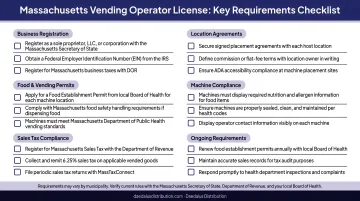
Source: MGL Chapter 94, Section 309
Business Registration
Operators must register with the Massachusetts Secretary of the Commonwealth. Options:
- LLC formation: $500 filing fee + $500 annual report fee
- DBA/Business Certificate: $30-$65 depending on municipality (Boston charges $65)
LLC formation is not legally required, but recommended for liability protection and cleaner tax reporting as you scale.
Sales Tax Registration
Massachusetts charges 6.25% sales tax on most vending sales. Register via MassTaxConnect (Form TA-1 has been replaced by online registration). Key exemptions:
- Snacks and candy sold from machines that exclusively sell those items are exempt
- Sales of 10 cents or less are exempt
- Soft drinks and carbonated beverages remain taxable
Source: MA DOR Technical Information Release 00-11
Health Permits (Location-Specific)
You need a food service permit from the local board of health for each location where you operate food vending machines. This applies to pre-packaged snacks, beverages, and temperature-controlled items — and each placement site requires its own separate permit.
Massachusetts has adopted the 2013 FDA Food Code with state modifications under 105 CMR 590.000. Annual inspections are required.
City-Level Variation
- Boston: Requires a Food Manager License for food vending operations in addition to the state health permit
- Worcester: Requires a business certificate from the City Clerk plus a coin-operated device license through the License Commission
Contact the city clerk's office directly before placing machines — requirements update frequently and vary by district.
ADA and Placement Rules
Massachusetts follows the Architectural Access Board's standards under 521 CMR 17.9, which can be stricter than federal ADA minimums. All machines must:
- Be located on an accessible route
- Comply with zone-of-reach standards for wheelchair users
- Have operable controls within reach ranges defined in 521 CMR 5.00
School Vending Rules
Machines in school settings must comply with USDA Smart Snacks standards:
- Foods limited to 200 calories per package
- Maximum 200mg sodium
- Maximum 35% total fat
- 0g trans fat
Beverages restricted by grade level (water, unflavored low-fat milk, 100% juice for elementary/middle school; low-calorie options permitted for high school up to 20 oz).
Tobacco and Alcohol Restrictions
- Tobacco: MGL Chapter 64C, Section 10 prohibits persons under 21 from using tobacco vending machines; signage required
- Alcohol: Prohibited in vending machines in Massachusetts
Penalties for Operating Without Permits
Violations under MGL Chapter 94, Section 305C carry fines of up to $1,000 per violation.
How to Start a Vending Machine Business in Massachusetts — Step by Step
Step 1 – Choose Your Machine Type and Product Category
Identify the main vending categories relevant to Massachusetts:
- Traditional snack/beverage machines: Highest demand in offices, colleges, hospitals
- Bulk candy machines: Low-cost entry point, minimal maintenance
- Specialty/digital machines: Higher margins, cashless payments, growing consumer preference
Match your machine type to locations you can realistically secure. Common mistake: choosing a machine based on margin potential before confirming there's a viable location for it.
Modern digital machines with touchscreen interfaces and cashless payment systems are increasingly preferred in competitive Massachusetts markets because they support Apple Pay, Google Pay, credit cards, and remote inventory tracking. According to industry data, approximately 71% of vending transactions are now cashless nationwide — making cashless capability essential rather than optional.
Step 2 – Research and Secure Locations in Massachusetts
High-value location types in Massachusetts:
- University and college campuses (Boston, Cambridge, Worcester have 49+ colleges in Greater Boston alone)
- Hospital waiting areas and staff corridors (199,000 hospital employees statewide)
- Corporate office parks along Route 128 and downtown Boston
- Apartment complexes
- Auto service waiting areas
How to approach location hosts:
- Come with a placement proposal that includes a revenue-sharing arrangement (typically 5-25% of revenue) or flat monthly fee
- Get agreements in writing
- Confirm any internal procurement or vendor approval processes
Public buildings note: Massachusetts public buildings may require contracts through the Operational Services Division. The Massachusetts Commission for the Blind has priority for vending facility operations in state buildings under the Randolph-Sheppard Act.
One trap to avoid: placing machines without a written agreement leaves you vulnerable to sudden removal with no recourse.
Step 3 – Register Your Business and Obtain Required Permits
Follow this sequence:
- Register business entity with MA Secretary of the Commonwealth (LLC or DBA)
- Register for sales tax via MassTaxConnect
- Apply for vending operator license from MA Department of Public Health
- Apply for food service permit from local board of health for each food vending location
- Check municipal requirements (Boston Food Manager License, Worcester coin-operated device license)
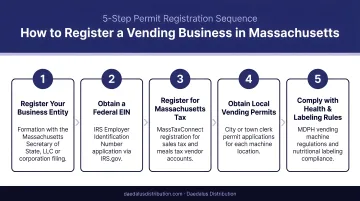
Permits must be in place before machines go live. Operating food vending without a health permit can result in fines up to $1,000 per violation.
Step 4 – Purchase Your Vending Machine(s)
Sourcing options:
- Used machines: $1,000-$3,000 for basic refurbished units; cost-effective but may have outdated payment tech
- New digital machines: $3,000-$10,000+ for touchscreen units with cashless payments and remote inventory tracking
Modern all-digital machines — such as Daedalus Distribution's Vendekin line (Omnivend Combo 22, Omnivend Combo 10, Elevend Multivend 22) — include built-in touchscreen interfaces, cashless payment systems, and cloud-based software for remote inventory tracking and sales reporting. These features justify higher upfront costs with better long-term ROI, especially in high-traffic Massachusetts locations where cashless transactions dominate.
Financing note: Seller financing and business loans are options for first-time operators not paying upfront.
Step 5 – Set Pricing, Source Products, and Launch
How to price products:
- Cover wholesale cost
- Cover location commission (5-25% of revenue)
- Cover restocking time and transport
- Include reasonable profit margin (operators typically target 20-25% net margin)
Product sourcing:
- Wholesale clubs (Costco, BJ's)
- Local distributors
- Direct supplier relationships for specialty items
Align product selection with location type:
- Healthy options for gyms/hospitals
- Convenience snacks for offices
- College-friendly items for campus locations
Be careful about underpricing to win a location — once a price is set, raising it later risks losing the contract entirely.
Step 6 – Track Performance and Scale Your Route
What a stable operation looks like:
- Regular restocking runs on a set schedule
- Tracking which products sell and which sit
- Monitoring machine performance and handling jams promptly
- Reviewing revenue per machine monthly
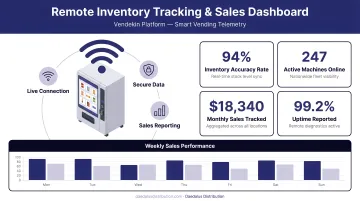
Remote inventory tracking — available through machines with built-in connectivity like the Vendekin platform — allows you to see stock levels and sales trends without a physical visit, reducing unnecessary trips and improving route efficiency.
When to scale: Stabilize one route before adding new locations. Scaling before operations are consistent leads to service failures and unhappy location hosts.
Running and Growing Your Vending Business in Massachusetts
Day-to-Day Management (1-5 Machines)
At small scale, most operators handle everything solo. Typical weekly tasks include:
- Restocking machines based on sales patterns
- Performing basic maintenance and cleaning
- Logging revenue and reconciling commissions
Expect roughly 2–4 hours per week per machine, depending on volume and how spread out your locations are.
How Growth Happens in Massachusetts
Once your day-to-day operations run smoothly, growth follows a predictable pattern:
- Add machines to existing location partners first — expand from one machine to two in a high-performing building
- Add new locations in adjacent areas — minimize travel time between stops
- Build reputation for reliability — responsiveness and machine uptime drive referrals from location hosts
Full-time operators typically manage 15–40 machines, depending on geographic spread and servicing model.
Track Financial Health Early
Track revenue per machine, product cost, and location commissions from the start. That data tells you which machines to keep, which to move, and which locations aren't worth renewing.
With average revenue ranging from $300–$1,500/month per machine, location quality is the single biggest driver of profitability — and your numbers will confirm it fast.
Conclusion
Starting a vending machine business in Massachusetts is accessible — but success depends on a few non-negotiables: validating locations before investing, getting compliance right from day one, and tracking route performance consistently.
Massachusetts's dense population, heavy foot traffic in key sectors (colleges, hospitals, corporate campuses), and relatively clear (if locally variable) regulatory environment give operators more location options than most states. What determines profitability is how well you execute on the fundamentals:
- Accepting cashless payments to capture the growing share of card- and app-paying customers
- Stocking healthier product options to meet demand in health-conscious locations like gyms and hospitals
- Using route management software to monitor sales data and restocking needs remotely
- Reinvesting early revenue into additional machines once a location proves its volume
The NAMA Foundation estimates the U.S. convenience services industry at $31.1 billion in 2025, reflecting 8.1% average annual growth. Operators who modernize their equipment and product mix are positioned in that growth segment. Those relying solely on cash-only machines are not.
Frequently Asked Questions
How much money do I need to start a vending machine business in Massachusetts?
Startup costs range from a few hundred dollars for a basic bulk machine to $3,000-$10,000+ for a new digital unit with touchscreen and cashless payments. Add initial product inventory ($200-$500 per machine), MA business registration fees ($500 for LLC, $30-$65 for DBA), sales tax registration (free), and local health permits.
How many vending machines do I need to make $100,000 a year?
At the reported average of $300-$1,500/month per machine, reaching $100,000 annually requires approximately 6-28 machines depending on location quality. At $750/month (midpoint), you'd need about 12 machines — though that's gross revenue. After product costs (30-50%), commissions (5-25%), and operating expenses, net income will be much lower.
Do I need an LLC to run a vending machine business in Massachusetts?
An LLC is not legally required, but business registration with the MA Secretary of the Commonwealth is mandatory. Most operators form an LLC ($500 formation fee, $500 annual report) for liability protection and simplified tax reporting as the business grows.
Do I need a food service permit for every vending machine location in Massachusetts?
Yes. A health permit from the local board of health is required for each location where food vending machines operate, even for pre-packaged snacks and beverages. Permits are location-specific and must be obtained before machines go live.
Are food items taxable in Massachusetts vending machines?
Most food and beverage items are exempt from MA's 6.25% sales tax, but soft drinks and non-food items like personal care products are taxable. Register for a sales tax permit via MassTaxConnect and track which products fall into each category.
What are the best locations for vending machines in Massachusetts?
High-performing locations include college campuses (Boston and Worcester metro areas have 100+ colleges statewide), hospital corridors (199,000 hospital employees), Route 128 office parks, apartment complexes, and auto service waiting areas. Consistent foot traffic and a captive audience are the key criteria.