Introduction
Modern vending operators managing machines across multiple locations face a persistent operational challenge: without real-time visibility into inventory, sales, and machine health, they're stuck running expensive, reactive service routes that are difficult to scale. A 2025 industry report found that 73% of vending operators now use cloud-connected data collection systems, reflecting growing recognition that guesswork-based scheduling drives up costs while limiting growth potential.
Remote vending management translates directly into fewer wasted trips, machines that stay stocked and operational, and pricing decisions based on actual transaction data rather than intuition. For operators running more than a handful of machines, it quickly becomes a baseline requirement for running a profitable route.
This article breaks down the specific, measurable advantages remote management delivers to vending operators, including the real costs operators absorb when they go without it.
Key Takeaways
- One dashboard gives you live visibility into inventory, sales, and machine health across every location you operate
- Data-driven restocking cuts route costs by 25-40% compared to fixed-schedule visits
- Transaction-level analytics enable product optimization that increases revenue per machine
- Proactive fault alerts reduce downtime and prevent lost sales
- Operators managing 20+ machines see the highest ROI from remote vending management
What Is Remote Management for Vending Machines?
Remote management lets vending operators monitor and control their machines through a centralized software platform using internet-connected hardware. It's an operational tool built for visibility and fast action without requiring a trip to the machine.
The typical setup involves a telemetry device (a modem or sensor unit) installed on or inside the vending machine. According to NAMA's industry terminology guide, telemetry is "the recording and reading of vending machine information off-site," transmitting data via cellular or Wi-Fi connection to a cloud-based dashboard accessible from a phone or computer.
What data gets transmitted:
- Sales transactions (products sold, price, time, payment method)
- Real-time inventory levels by product slot
- Machine status alerts (product jams, payment errors, compressor issues)
- Coin/bill validator diagnostics
- Temperature deviations (critical for refrigerated machines)
The system relies on two communication standards established by NAMA. DEX (Digital Exchange) transmits audit files covering sales totals, coins, pricing, card swipes, and errors. MDB (Multi Drop Bus) handles communication between the machine controller and cashless payment systems.
Together, these standards feed into what NAMA defines as a Vending Management System (VMS): software that aggregates and analyzes machine data, enabling route scheduling, inventory management, and sales reporting. The 2025 State of the Industry report found that 27% of operators now actively use a VMS, while another 27% still rely on manual paper-and-pencil collection — a gap that represents a significant profitability opportunity for operators willing to modernize.
Key Advantages of Remote Vending Machine Management
The three advantages below directly impact the operational metrics vending businesses track most closely: cost per route, revenue per machine, and machine uptime.
Real-Time Inventory Visibility and Smarter Restocking
Remote management systems track how many units of each product remain in each machine in real time, automatically generating restocking alerts when specific items fall below set thresholds. This transforms the restocking process: instead of driving a fixed route on a fixed schedule regardless of stock levels, operators can prioritize visits to machines that actually need attention, and skip those that don't.
Why this reduces costs:
Traditional fixed-schedule routing forces operators to visit machines whether they need restocking or not. Parlevel Systems reports that operators using its platform with connected machines experience approximately 13% fewer machine visits per route compared to offline operations. The prekitting process (packing inventory at the warehouse based on real-time machine data before dispatching drivers) resulted in a 30% improvement in service time per stop.
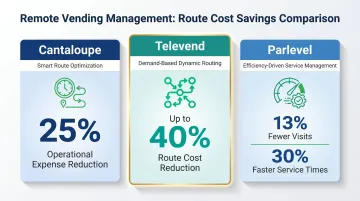
Route cost reduction varies by provider but shows consistent directional alignment:
- Cantaloupe: 25% operational expense reduction from smart scheduling
- Televend: Up to 40% route cost reduction from demand-based routing
- Parlevel: 13% fewer visits plus 30% faster service times
Without telemetry, operators average 4-5 location stops per day. With pick-to-light warehouse systems (which depend on telemetry data to generate pick lists), operators achieve 10-12 stops per day, a 100-150% increase in route efficiency.
Route costs are typically one of the top two operating expenses in vending, so cutting unnecessary trips has an outsized effect on margins. Fewer visits also mean the same team can manage a larger fleet without adding headcount.
KPIs impacted:
- Cost per service visit
- Stockout rate
- Inventory waste
- Labor hours per machine per month
When this advantage matters most:
Operators running 20+ machines across a city or region see the biggest ROI from data-driven routing versus fixed-schedule routes. Below 10-15 machines, route efficiency gains are modest; above 50 machines, they become essential to profitability.
Sales Analytics and Revenue Optimization
Remote management platforms record every transaction: product sold, price, time of day, day of week. This gives operators a detailed performance picture for each machine without manual DEX data collection.
How operators use this data:
- Identify which products sell fastest at which locations
- Spot underperformers to remove from planograms
- Adjust pricing remotely to match location demand
- Run time-limited promotions without a site visit
- Track seasonal trends and consumption patterns
The difference between a profitable machine and a breakeven machine often comes down to product selection and pricing. Neither is possible to optimize without transaction-level data.
Cashless payment creates measurable revenue lift:
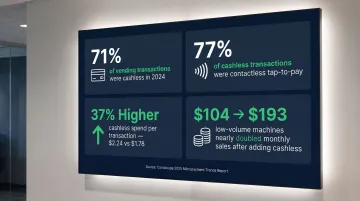
According to Cantaloupe's 2025 Micropayment Trends Report, 71% of all vending transactions were cashless in 2024, a 17% increase over 2023. Of those, 77% were contactless (tap-to-pay). More importantly, consumers spend 37% more per transaction when paying cashless ($2.24 average) versus cash ($1.78 average). A USA Tech study of 84,000 machines found low-volume machines nearly doubled monthly sales (from $104 to $193) after adding cashless capabilities.
Cashless payment systems generate telemetry data by default, making transaction-level reporting automatic rather than manual. Operators without connected machines miss both the revenue uplift and the data visibility.
Data-driven merchandising also delivers returns:
Cantaloupe reports a 2% revenue increase specifically from intelligent merchandising (data-driven product mix optimization). Parlevel reports operators using its VMS with connected machines collect 42% more in sales compared to unconnected operations.
KPIs impacted:
- Revenue per machine per month
- Average transaction value
- Product sell-through rate
- Gross margin per location
When this advantage matters most:
High-competition locations, such as offices, gyms, and schools, where product relevance and pricing directly determine whether customers use the machine or seek alternatives.
Reduced Downtime Through Proactive Machine Monitoring
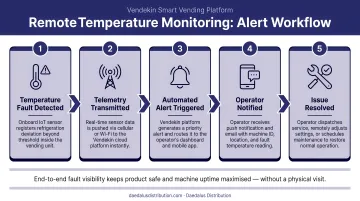
Remote management systems monitor machine health continuously, detecting power outages, temperature deviations, payment system errors, coin mechanism faults, and door/sensor anomalies. Operators receive immediate alerts via SMS or email the moment a fault occurs.
How this changes the maintenance model:
Instead of discovering a broken machine during a scheduled visit or when a customer complaint surfaces, operators are notified immediately. A technician can be dispatched with the right parts, or in some cases the issue can be resolved remotely. SECO, a telemetry hardware provider, notes that without telemetry, problems like unnoticed failures or technical malfunctions "can quickly cost sales, especially if they are discovered late", with faults going undetected for hours or even days.
Revenue impact:
Every hour a vending machine is out of service is direct lost revenue. The NAMA Census reports average annual vending revenue of $6,284 per machine (approximately $17.22 per day). A machine offline for even a single peak-hour day loses a disproportionate share of that revenue.
For operators of digital vending machines such as those from Vendekin (available through Daedalus Distribution), built-in connectivity means machine health data is accessible from day one without retrofitting older equipment.
Temperature compliance is regulatory, not optional:
For machines dispensing perishable items, temperature monitoring isn't just about revenue. It's also a matter of food safety and regulatory compliance. FDA Food Code 4-204.111 mandates that refrigerated vending machines automatically shut off and stop vending if internal temperature exceeds 41°F. The USDA confirms bacteria double every 20 minutes in the 40-140°F danger zone.
An unmonitored refrigerated machine that experiences a compressor failure may continue to vend unsafe food until the automatic shutoff triggers or the next scheduled service visit. Remote temperature monitoring eliminates this detection gap by alerting operators immediately when temperatures deviate from safe ranges.
KPIs impacted:
- Machine uptime percentage
- Mean time to repair (MTTR)
- Technician dispatch efficiency
- Customer complaint rate
Where downtime risk is highest:
Machines dispensing perishable items (beverages, frozen goods, dairy) face both revenue loss and food safety exposure when temperature faults go undetected. High-volume locations carry an additional risk: extended downtime directly threatens location host satisfaction and contract retention.
What Happens When Remote Management Is Missing or Ignored
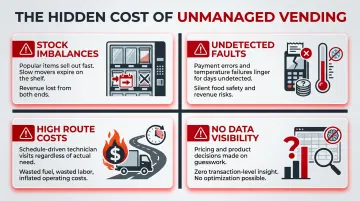
Without remote management, operators default to running fixed routes on a calendar schedule, discovering stockouts and machine faults only when physically present—meaning problems often go unaddressed for days.
The compounding consequences:
- Stock imbalances cut revenue from both ends — popular items sell out between visits while slow movers expire before they sell.
- Payment and temperature faults can linger for days — an error that occurs the day after a service visit may cost dozens of transactions before anyone notices. Refrigeration deviations add food safety risk on top of revenue loss.
- Route costs stay high because trips are schedule-driven, not demand-driven — operators visit every machine whether it needs attention or not, burning fuel and labor unnecessarily.
- Product and pricing decisions run on guesswork — without transaction-level data, there's no way to know which items are selling, which locations have distinct preferences, or what price points actually move the needle.
These problems also scale directly with fleet size. Industry veteran Orrin Huebner identifies the 50-100 machine range as the critical "breaking point" where owner-operators must move from manual management to systems-based operations. Below 10 machines, "yellow pads and muscle memory" can get you through. Beyond 50-100, cognitive overload sets in and operators start dropping the ball across the board.
Without a vending management system in place, roughly 30% of operational knowledge gets forgotten or omitted during employee training. That gap compounds with every new hire, creating inconsistency that quietly drags down efficiency across the entire operation.
Despite these documented consequences, the 2025 State of the Industry report found that 27% of operators still rely on paper-and-pencil data collection, suggesting a substantial portion of the industry continues to accept these inefficiencies.
How to Get the Most Value from Remote Vending Management
Remote management delivers the most ROI when applied consistently across your entire fleet—not just newer or higher-volume machines. Partial adoption creates blind spots that undermine the benefits of data-driven operations.
Establish a data review routine:
The data remote management generates is only valuable if you review it regularly and act on it. Set a weekly or bi-weekly routine for reviewing:
- Sales reports to identify product performance trends
- Restocking efficiency metrics to optimize route planning
- Machine health logs to identify patterns and adjust preventive maintenance
Build remote capability into your operation from the start:
Starting with connected equipment is far simpler than retrofitting older machines later. Daedalus Distribution's Vendekin machines come ready for remote management out of the box, which keeps setup straightforward and ensures consistent data quality across your fleet from day one.
Every Vendekin unit includes:
- Built-in connectivity
- Cashless payment systems
- The Vendekin cloud-based management platform (no separate software license fees)
Use insights to drive continuous improvement:
Review transaction data to refine product mix at each location. Track which machines consistently underperform and investigate location-specific issues. Monitor restocking intervals to identify machines that need service more or less frequently than your standard schedule. Use temperature logs to verify compliance and catch equipment degradation before it causes failures.
Operators who review their data regularly and act on it tend to run tighter routes, reduce waste, and grow revenue faster than those who treat the dashboard as an afterthought.
Conclusion
Remote management comes down to one practical shift: running your vending operation on real data instead of assumptions. You know what's selling, which machines need attention, and where your next restock trip actually needs to go — before problems show up in lost revenue.
The advantages compound over time. Operators who use sales data to refine product mix, reduce wasted trips, and catch faults early pull ahead of competitors still running fixed inspection schedules. Berg Insight reports the global connected vending installed base reached 8.1 million units in 2025, growing at a 7.6% CAGR toward 11.7 million by 2030—making non-connected operations increasingly uncompetitive.
Remote management isn't a one-time technology purchase. It's an ongoing operational practice. The operators who integrate it into their daily workflows—reviewing data weekly, acting on insights, and optimizing continuously—are the ones who grow from a handful of machines to a profitable multi-location operation without adding proportional overhead. If you're evaluating connected machines to make that shift, Daedalus Distribution carries the Vendekin lineup built specifically for that kind of scalable, data-driven management.
Frequently Asked Questions
How does remote monitoring work?
A telemetry device installed on the vending machine collects real-time data on sales, stock levels, and machine status, then transmits it via cellular or Wi-Fi to a cloud dashboard. Operators access this information from any device with internet connectivity.
Is owning a vending machine good passive income?
Vending machines can generate passive income, especially when remote monitoring reduces the need for constant on-site visits. Success depends on location quality, product selection, and how consistently operators use data to optimize performance.
What data can I access through remote vending management?
Most platforms give you access to real-time inventory levels, transaction history, machine health status (power, temperature, error codes), and route efficiency metrics. That data helps fine-tune restocking schedules and product selection.
Can remote management handle multiple vending machines at once?
Yes. Remote management platforms are specifically designed for multi-machine fleets, providing a single dashboard view of all machines regardless of how many you run or where they're located.
Do I need technical expertise to use vending management software?
No. Vending management platforms are built for everyday operators. Most use simple dashboards, mobile apps, and automated alerts that require no technical background.
What is the difference between a smart vending machine and a traditional one?
Traditional vending machines require manual inspection for inventory and fault detection. Smart vending machines use internet connectivity and onboard sensors to transmit operational data in real time, enabling remote management, cashless payments, and data-driven optimization.