Key Takeaways
- Hospitals, factories, offices, schools, and apartment complexes consistently outperform other locations due to captive audiences and steady foot traffic
- The best spots combine high daily traffic with limited nearby food options, driving consistent, need-based sales
- Pairing the right machine type and product mix to your audience can double per-location revenue
- Securing top spots requires professional outreach, agreed commission terms, and a written contract
- Cashless payment and remote inventory tracking cut service trips and keep sales running smoothly
What Makes a Vending Machine Location Profitable?
Two core factors drive vending machine profitability: foot traffic volume (the number of people passing the machine daily) and purchase necessity (how much those people need a quick food or drink option with no better alternative nearby). According to industry analysis, high foot traffic alone doesn't guarantee sales — a busy transit hub with thousands of daily commuters can generate barely enough revenue to cover electricity costs because commuters have only 8 seconds of mental availability versus the 10-20 minutes someone in a break room or waiting area has to consider a purchase.
The impulse versus habitual buying dynamic shapes long-term revenue. Lobbies and waiting areas drive impulse purchases from people who happen to be present. Break rooms and dorm hallways, however, create habitual daily buyers who incorporate the vending machine into their routine — generating predictable, recurring sales rather than one-time transactions.
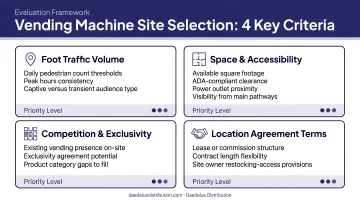
Both dynamics factor into site selection. Before committing to any location, assess:
- Average daily foot traffic during operating hours
- Hours of operation — 24/7 locations vastly outperform business-hours-only sites
- Proximity to competing food/drink options — even 50 meters from a convenience store can cause underperformance
- Dwell time — how long people linger and whether they're in a mindset to make a purchase
The Best Locations for Profitable Vending Machines
These locations consistently deliver high performance across three criteria: sustained foot traffic, captive audiences with limited alternatives, and repeat purchase behavior.
Hospitals and Healthcare Facilities
Hospitals rank among the top-performing vending locations because they operate 24/7/365, serve three distinct buyer groups (patients, staff, and visitors), and have cafeterias that close overnight — leaving vending as the only food and drink option during nights, weekends, and holidays.
What sets hospitals apart is the combination of long average dwell times for visitors, multiple high-traffic zones (waiting rooms, nursing floors, lobbies), and consistent demand regardless of season. Healthy snacks, hot beverages, and bottled water perform especially well in these environments, with 65% of operators reporting client requests for healthier product mixes.
| Factor | Details |
|---|---|
| Best Machine Type | Combo snack-and-beverage or healthy food-focused machines; hot drink machines for nursing staff |
| Earning Potential | $250-$600 per month in profit, with high-traffic waiting rooms reaching $800-$1,200 monthly gross revenue |
| Key Advantage | 24/7 operation across multiple buyer demographics with no off-peak hours |
Manufacturing and Industrial Facilities
Manufacturing plants and distribution centers employ large workforces across multiple shifts, often round-the-clock. Workers have short, scheduled breaks and cannot leave the premises, making break room vending machines the default food and drink stop. This creates predictable, recurring purchase behavior tied to shift schedules.
Manufacturing locations held the highest revenue share at 35.83% in 2024, and 30.2% of all U.S. vending machines are located at manufacturing sites — the single largest location category. What makes this especially attractive is the potential for multiple machines per site and the opportunity to negotiate a single contract covering an entire facility, often with minimal or no commission required.
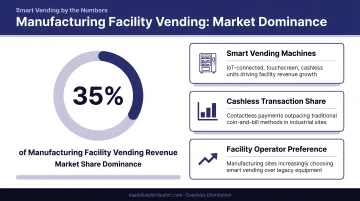
Digital machines with remote inventory tracking give operators a significant edge here — stock levels and restocking schedules can be managed across shifts without requiring daily on-site visits.
| Factor | Details |
|---|---|
| Best Machine Type | Snack, beverage, and combo machines; fresh food or frozen machines for facilities with longer shifts |
| Earning Potential | $500-$1,200 per month in profit — the highest among all location types |
| Key Advantage | Captive audience on scheduled breaks with no off-site food access |
Office Buildings and Coworking Spaces
Offices with 100+ employees are reliable vending locations because employees need snacks and drinks throughout the workday, most don't have time to leave the building for every craving, and the machine effectively becomes the on-site convenience store. Office vending is the fastest-growing location segment at a projected 3.5% annual growth rate.
Coworking spaces represent an emerging high-value target. They attract young, tech-savvy users comfortable with cashless payments, operate beyond standard business hours, and often lack any food service on-site. Customers spend 37% more per transaction when paying digitally ($2.24 versus $1.78 cash average), making digital payment-enabled machines significantly more profitable in these environments.
| Factor | Details |
|---|---|
| Best Machine Type | Coffee and hot beverage machines; snack and combo machines; healthy options for wellness-conscious workplaces |
| Earning Potential | $200-$500 per month in profit for typical office break rooms |
| Key Advantage | Daily repeat buyers with habitual purchasing patterns tied to the workday routine |
Schools, Colleges, and Universities
K-12 schools offer a large captive audience with regular daily traffic, while colleges and universities add dorm placements for late-night demand — one of the highest-frequency purchase scenarios in vending. One compliance note: USDA Smart Snacks standards apply to K-12 vending during school hours, restricting calories, sodium, sugar, and fat content in any products sold.
Universities specifically are high-earning locations because students stay on campus for extended hours, are comfortable with cashless payments, have limited late-night dining options, and become habitual buyers once they discover a convenient machine. 76% of university students surveyed experienced situations where they needed supplies late at night when on-campus resources were closed.
| Factor | Details |
|---|---|
| Best Machine Type | Snack and beverage combos for general campus areas; healthy vending for K-12; snack/convenience machines for dorms |
| Earning Potential | $300-$800 per month in profit, with seasonal variation |
| Key Advantage | High daily foot traffic combined with late-night demand from residential students |
Apartment Complexes and Residential Communities
Large apartment complexes with common areas (lobbies, laundry rooms, gyms, courtyards) provide 24/7 access to residents who want a quick snack or drink without leaving the building — particularly late at night or on weekends when nearby stores may be closed. Vending machines in residential buildings peak between 5 PM and 8 PM as people head home, hit the gym, or settle in for the night.
The key to success is placement within high-use communal spaces rather than quiet corridors. Machines accepting cards or mobile payments dramatically increase sales in residential settings where few people carry cash. Properties with smart vending report 20% increase in resident satisfaction and 30% higher lease renewal rates.
| Factor | Details |
|---|---|
| Best Machine Type | Snack and beverage machines; combo machines to cover both needs in a single unit |
| Earning Potential | Varies by building size; performance depends on resident demographics and placement visibility |
| Key Advantage | Round-the-clock access for residents with demand peaking during off-retail hours |
Hotels, Car Dealerships, and Waiting-Area Venues
These locations share a common trait: a captive audience with significant dwell time. Hotel guests stuck on their floor late at night, car dealership customers waiting 1-3 hours for service appointments, and people at car washes or DMV offices all have time and limited options — creating high purchase rates.
Of these, car dealerships are most often overlooked — yet they attract consistent foot traffic and some of the longest customer wait times of any retail environment. 53% of customers are willing to wait on-site for same-day service, and about 50% want complimentary drinks and snacks during their visit. Additionally, dealerships often belong to larger ownership groups, creating expansion opportunities from a single placement.
| Factor | Details |
|---|---|
| Best Machine Type | Snack and beverage machines for hotel floors and lobbies; combo machines for dealership waiting areas |
| Earning Potential | $150-$400 per month in profit for hotels, dependent on occupancy |
| Key Advantage | High dwell time creates reliable impulse purchase behavior across a captive audience |
How to Find and Secure a Vending Machine Location
Start by identifying business categories with large, regular foot traffic and limited on-site food access in your area. Use Google Maps, business directories, and in-person observation to assess traffic volume and current vending coverage. Look for facilities with 100+ employees or residents, extended operating hours, and minimal nearby food alternatives.
Approaching Property Owners
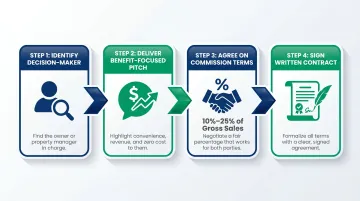
Contact the decision-maker — property manager, facilities director, or business owner — and keep your pitch short and benefit-focused. Your pitch should cover:
- Convenience: employees or tenants get on-site access to food and drinks
- No cost: installation, restocking, and maintenance are handled by you
- Optional revenue share: commissions give them passive income with zero effort
- Low commitment: offer a 3–6 month trial to reduce their perceived risk
Location commissions typically range from 10% to 25% of gross sales, though some industrial facilities charge no commission. A written contract covering placement terms, restocking schedule, commission structure (if any), and exit clauses is essential before installation.
Legal Requirements
Before placing machines, you'll need:
- Valid business license
- Seller's permit for sales tax collection
- City or county-level vending permits (varies by location)
- Liability insurance (often required by property owners)
Requirements vary significantly by state and municipality. For example, New York requires a $200 biennial operator license and health permits for temperature-controlled food machines, while Texas requires coin-operated machine registration with the Comptroller. Verify local requirements with your city and state authorities before launching operations.
Conclusion
The most profitable vending machine locations share three traits: consistent foot traffic, a captive audience with limited nearby alternatives, and buyers with habitual or need-driven purchase behavior. That combination is what separates a machine that breaks even from one that generates real passive income.
Evaluate each potential site individually using the criteria covered in this guide rather than relying on location type alone. Machine selection, product mix, and payment technology all act as multipliers on location performance. For instance, adding cashless payment can increase revenue by 35% across machine populations — and up to 110% on low-performing units.
If you're ready to put the right equipment in the right locations, Daedalus Distribution can help. As the authorized U.S. distributor for Vendekin Technologies, they supply all-digital vending machines with remote inventory tracking built in — purpose-built for operators who want to run profitable, low-maintenance routes. Reach out at contact@daedalusdistribution.com or call +1 843-490-2804.
Frequently Asked Questions
Where do vending machines make the most money?
Hospitals, manufacturing facilities, large office buildings, and universities rank among the highest-earning locations. These sites combine captive audiences, high foot traffic, and limited food alternatives — driving habitual purchases and need-driven sales around the clock.
What are the best locations to put a vending machine?
The best spots share three traits: high daily foot traffic, few nearby food alternatives, and extended operating hours. Hospitals, large offices, factories, universities, apartment complexes, and hotels all check these boxes — as do any locations where people have limited options and regular reason to buy.
How do you find good locations for vending machines?
Use Google Maps and business directories to identify high-traffic locations with limited on-site food service, then visit in person to observe foot traffic during peak and off-peak hours. Approach the property manager or facilities director with a pitch focused on the benefit to their tenants or employees, and get the placement terms in writing.
Where can I legally place my vending machine?
Machines can be placed on private property with the owner's written permission. Operators typically need a business license, seller's permit for sales tax collection, and in some cities a vending-specific permit. Requirements vary by state and municipality — check with your local authorities before installation.
How many vending machines do you need to make $100,000?
It depends on location quality and machine type. At $800–$1,500 monthly gross revenue per machine in moderate-traffic locations, you'd need roughly 6–11 well-placed machines to hit $100,000 in annual gross revenue.
What kind of vending machines make the most money?
Combo snack-and-beverage machines offer broad appeal and lower overhead by serving multiple needs in one unit. Machines with cashless payment options — credit cards, debit cards, and mobile pay — consistently outperform cash-only models across all location types, generating 37% higher average transaction values and enabling higher overall sales volume.