According to the National Automatic Merchandising Association (NAMA), the U.S. convenience services industry generated $31.1 billion in revenue in 2025, with vending machines representing the largest business line by both revenue and number of businesses. With an estimated under 3 million vending machines operating nationwide, these machines serve over 40 million consumers daily.
Most operators focus on placement strategy and product mix, but the machines that run 24/7 with minimal service calls share one thing in common: operators who understand how components work, how they interact, and which failures cascade into bigger problems. This guide breaks down every major vending machine component, explains what it does in practice, and shows how they all work together during a single transaction.
Key Takeaways
- Vending machines are built from six functional layers: payment input, storage, dispensing, control logic, sensors, and connectivity
- Payment systems (bill validators, coin mechanisms, cashless readers) authenticate every transaction before any product moves
- The dispensing mechanism — spiral motor, elevator, or rotary tray — is the single component most responsible for jam rates
- A Vending Machine Controller (VMC) ties everything together: it coordinates inputs and outputs, tracks inventory, and logs errors
- Modern machines with touchscreens, remote telemetry, and cashless readers sell more and require fewer in-person service visits
What Is a Vending Machine?
A vending machine is an automated retail device that accepts payment, validates it, and dispenses a selected product without human assistance. This fully automated cycle depends on every internal component functioning in precise sequence—if any single part fails, the entire transaction stops.
A vending machine is not just a refrigerator with a coin slot. It's a coordinated electromechanical system where sensors, motors, payment peripherals, and control logic communicate continuously. Operational complexity varies widely between a basic snack machine and an all-digital unit with remote monitoring, but the fundamental component architecture remains consistent.
Machine categories vary by product type:
- Ambient snack/combo machines — shelf-stable items stored at room temperature with no refrigeration system required
- Refrigerated beverage and food machines — temperature-controlled units maintaining 35°F–41°F with active compressor systems
- Frozen product machines — ice cream and frozen meals stored below 0°F, demanding heavier insulation and more robust cooling
- Specialty machines — non-food items, electronics, or pharmaceuticals
Whatever the product type, the internal components that make dispensing possible are largely the same — and understanding them is the first step to maintaining or scaling a vending operation.
Inside a Vending Machine: The Core Components Explained
Payment and Input Components
Bill Validator
The bill validator uses optical and magnetic sensors to scan a note's size, ink composition, security thread, and paper conductivity against stored reference data. If the bill matches known denominations, it's accepted; if not, it's rejected and returned.
This is one of the most commonly serviced parts. Stuck notes and dust buildup on sensors cause the majority of cash acceptance failures. Validators typically recognize $1, $5, $10, and $20 bills. While most units are technically capable of accepting $2 bills, operators rarely enable this denomination in their programming.
Coin Mechanism
The coin mechanism uses electromagnetic sensors to measure diameter, thickness, edge ridges, and metal composition to identify denomination and reject slugs or foreign objects. It also manages change dispensing, so a malfunctioning coin mechanism can block entire transactions even when bill acceptance is working fine.
Cashless Payment Reader
Also called credit relays or MDB-compatible readers, cashless payment systems accept NFC-enabled cards, mobile wallets (Apple Pay, Google Pay), and QR codes. The machine must support MDB (Multi-Drop Bus) protocol—a six-pin connector standard maintained by NAMA and EVA—to communicate with third-party cashless systems.
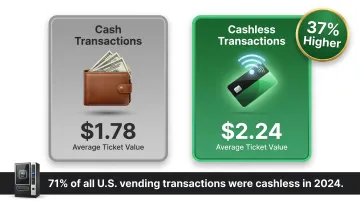
71% of all vending transactions were cashless in 2024, according to Cantaloupe's 2025 Micropayment Trends Report. Cashless transactions averaged $2.24 compared to $1.78 for cash—a 37% higher ticket. Operators who add cashless readers see measurable sales lift and eliminate cash-handling logistics.
Product Dispensing and Storage
Dispensing Mechanisms
Three primary systems handle product release:
- Spiral coil system — Most common for packaged snacks. A motor rotates a helix to push the product off the shelf. The coil's pitch and spacing determine which SKU shapes fit reliably.
- Elevator/lift system — Used for heavier or fragile items. A platform lowers the product gently to the collection bin, minimizing breakage.
- Rotary or drop tray system — Common for bottles or irregular shapes. Products sit in individual compartments that rotate and drop.
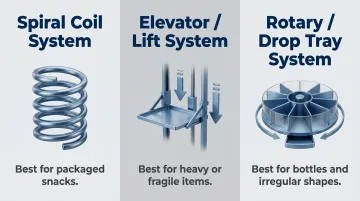
The dispensing motor type determines release precision and which products the machine can reliably vend without jamming.
Shelving and Storage
Internal product trays are called vend trays or planogram trays. Each spiral coil slot is a single column or lane. Column depth and spacing can be adjusted to accommodate different product sizes—this is why operators can customize a machine's layout.
The retrieval area at the bottom is the delivery bin or collection bin, typically protected by an anti-theft flap that prevents customers from reaching up into the dispensing area.
Refrigeration Units
Machines storing perishables use a compressor-condenser-evaporator refrigerant loop to maintain internal temperature. The thermostat controller keeps the cabinet within 35°F–41°F for chilled products, per FDA Food Code requirements for Time/Temperature Control for Safety foods.
Refrigeration draws more power than any other component. According to E Source Business Energy Advisor, refrigeration accounts for approximately 60% of a refrigerated vending machine's total energy consumption, with lighting representing 35% and electronics/motors the remaining 5%. This is why ENERGY STAR certification matters—certified machines use approximately 9% less energy and save around 1,000 kWh annually.
The Control Board and Sensors
VMC (Vending Machine Controller)
The control board is the brain of the machine. This central processor receives signals from all input components—payment systems, keypad, sensors—and sends commands to all output components, including dispensing motors, display, lighting, and cooling.
It stores product pricing, tracks inventory counts per column, logs transaction data, and flags errors. Every vend starts and ends with a command from the VMC.
Sensors
Multiple sensors coordinate to ensure successful vends:
- Infrared/optical drop sensors in the delivery bin confirm product delivery, triggering a "vend complete" signal and preventing the machine from crediting a second vend when nothing dropped
- Temperature sensors monitor refrigeration units to ensure cold-holding compliance
- Inventory/column sensors track whether a slot is empty, preventing the machine from accepting payment for out-of-stock products
- Proximity or motion sensors on modern machines activate the display when someone approaches
These sensors collectively prevent the most common customer complaint: paying for a product that never dispenses.
Structural and Security Components
The outer steel cabinet (typically 16–18 gauge steel) protects internal components from tampering and environmental exposure. The inner frame uses rails and brackets to hold trays in position.
The vending lock—keyed, combination, electronic, or biometric—restricts access to the cash box and product chamber. Lock quality is often underestimated, but a compromised lock means total exposure of inventory and cash.
How a Vending Machine Works: From Selection to Dispensing
The full transaction sequence:
- Customer selects a product via keypad or touchscreen
- VMC checks column inventory status — if empty, selection is blocked
- Payment is inserted — bill validator or coin mechanism authenticates it, or the cashless reader contacts the payment network
- Once payment clears, the VMC sends a command to the corresponding dispensing motor
- Motor activates, releases the product, and the drop sensor confirms delivery
- VMC updates inventory count, returns change if applicable, and logs the sale
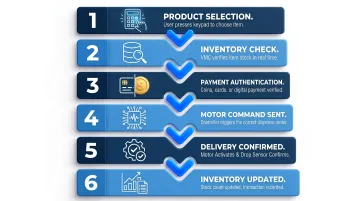
This entire cycle takes approximately 5–10 seconds and depends on every component executing without error.
Component failures break this chain in predictable ways. A malfunctioning drop sensor, for example, may fail to confirm the vend and hold payment in escrow — requiring operator intervention to resolve. Outdated VMC firmware can cause pricing or inventory data to desync. Knowing where each link can break helps operators diagnose issues faster and maintain the right components proactively.
Internal communication between the VMC and peripheral devices (coin mech, bill validator, cashless reader) follows the MDB/ICP standard, maintained by NAMA. Not all third-party payment peripherals are interchangeable — MDB version compatibility must be confirmed before mixing components. The current standard is MDB/ICP Version 4.2, which uses 9600 baud, 9-bit serial communication over a current loop bus.
What Modern Vending Machines Add to the Equation
Digital Interfaces Replace Analog
Modern machines replace physical keypads and LED price displays with large touchscreen panels that show product images, nutritional information, promotional content, and dynamic pricing. This directly affects customer engagement and average transaction value.
While vending-specific data is limited, a case study from Boostinc reported a 3,500% sales uplift within 90 days after replacing a traditional machine with a smart vending solution featuring a 24-inch digital touchscreen. That figure reflects a full hardware upgrade, not just a screen addition, but it underscores how digital interfaces drive purchasing behavior.
Telemetry and Remote Monitoring
A telemetry module (connected via Wi-Fi, 4G, or Ethernet) continuously transmits sales data, inventory levels, temperature readings, and error alerts to a cloud-based operator dashboard. This eliminates guesswork on restocking runs and enables predictive maintenance—operators can address issues before the machine goes out of service.
Daedalus Distribution's Vendekin machines include remote inventory tracking and sales data reporting as standard features—no additional software licensing fees required—making this level of visibility practical for operators at any scale.
Cashless-First Payment Architecture
Modern machines are increasingly designed around cashless payment as the primary input rather than an add-on. NFC, QR code, and mobile wallet acceptance expands the customer base to users who carry no cash.
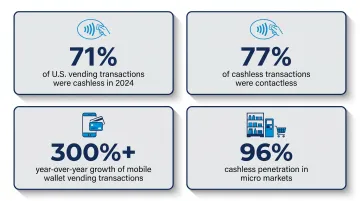
The numbers tell the story: 71% of all vending transactions in the U.S. were cashless in 2024, and 77% of those were contactless (tap-to-pay via phone, watch, or card). Mobile wallet transactions at vending machines grew by more than 300% year-over-year in 2024. In micro markets, cashless penetration reached 96%.
For context, a Visa Back to Business Study found that 41% of U.S. consumers have abandoned an in-person purchase because cashless payment options were unavailable. In a vending context, that's lost revenue every time someone walks away empty-handed. For vending operators, that means a machine without tap-to-pay isn't just inconvenient — it's actively costing sales.
Conclusion
A vending machine is only as reliable as its weakest component. Knowing what bill validators, dispensing motors, VMCs, and sensors each do—and how they interact—helps operators buy smarter, diagnose faster, and prioritize the right maintenance investments.
For operators ready to modernize, that knowledge makes the decision clearer. Daedalus Distribution's Vendekin machines are built around fully digital components from the ground up, which means fewer mechanical failure points, remote diagnostics, and real-time sales visibility baked in by default. If component reliability matters to your operation, that's where to start.
Frequently Asked Questions
What are the components of a vending machine?
A vending machine consists of six functional layers: payment input, product storage, dispensing mechanism, control board (VMC), sensors, and structural/security components. Payment input includes the bill validator, coin mechanism, and cashless reader; dispensing uses spiral motors, an elevator, or a rotary system; and the outer cabinet with lock system handles structural security.
Which sensor is used in a vending machine?
Vending machines rely on several sensors working together. Infrared drop sensors in the delivery bin confirm product delivery, temperature sensors keep refrigerated units within safe ranges, and inventory sensors track stock levels per column. Some modern machines also use proximity sensors to wake the display when a customer approaches.
What are the shelves in a vending machine called?
The product trays inside a vending machine are called vend trays or planogram trays. Each individual product slot is referred to as a column or lane, with each spiral coil occupying one column.
What routine maintenance is required on a vending machine?
Key maintenance tasks include cleaning and inspecting the bill validator (removing stuck notes, clearing dust from sensors), lubricating vending locks, checking spiral motors for wear, verifying drop sensor function, and wiping down the delivery bin and door seals to prevent contamination and keep the machine running reliably.
How often should a vending machine be serviced?
Most operators service machines during each restocking visit—typically every 1–2 weeks for high-traffic locations. A deeper mechanical inspection is recommended quarterly, with a full component audit performed annually or when error rates increase to catch issues before they cause downtime.
Can you put a $2 bill in a vending machine?
Most modern bill validators are programmed to recognize $1, $5, $10, and $20 denominations. While $2 bills are legal tender and many validators are technically capable of recognizing them, operators rarely enable this denomination. The bill may be rejected not because it's counterfeit but because it's outside the validator's programmed denomination set.