Introduction
In 1982, a group of computer science students at Carnegie Mellon University installed a custom sensing board on a Coca-Cola machine in Wean Hall. The board monitored indicator lights on six bottle columns, transmitted status updates over the campus network, and let anyone check inventory remotely using the Unix "finger" command. That makeshift system — tracking availability, quantity, and even whether bottles were "cold" or "warm" — became the first recognized Internet of Things device. Four decades later, that same core idea has evolved into a global industry of smart vending machines with embedded sensors, cloud dashboards, and AI-driven analytics.
Yet many vending operators still face the same frustrations their predecessors dealt with in the pre-IoT era: blind restocking trips that waste fuel and labor, machines failing silently with no warning, and zero visibility into what's actually selling. Traditional vending has run on fixed schedules and guesswork, treating each machine as an isolated black box.
IoT changes that entirely — turning a passive dispenser into an active business asset that reports its own status, surfaces real sales data, and flags problems before they cost you a service call.
The global intelligent vending machines market was valued at $20.5 billion in 2022 and is projected to reach $55.5 billion by 2030 at a 14.0% compound annual growth rate. This article breaks down what makes a vending machine "smart," the IoT features that matter most to operators, the measurable business benefits, and what to look for when choosing a modern machine.
TLDR
- Smart vending machines use embedded sensors, wireless connectivity, and cloud software to enable remote monitoring and data-driven decision-making
- Operators reduce wasted service trips by up to 45% and extend equipment lifespan through predictive diagnostics
- Cashless payments deliver 37% higher average transaction values ($2.24 vs. $1.78 cash)
- Cellular connectivity is preferred over Wi-Fi for commercial deployments due to independence from host-site infrastructure
- The right machine comes down to connectivity reliability, software depth, and U.S.-based support
What Makes a Vending Machine "Smart"?
A traditional vending machine is a mechanical dispenser with basic electrical controls. A smart vending machine adds four critical layers: embedded sensors, wireless connectivity (cellular or Wi-Fi), local processing capability, and cloud-connected software that allows the machine to send and receive data in real time without human intervention at the point of sale.
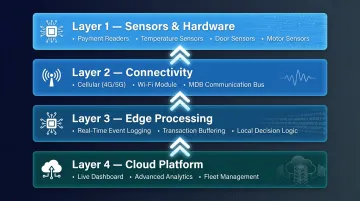
The Four-Layer IoT Architecture
Modern smart vending machines operate on a standardized IoT stack:
1. Sensors and Hardware Layer
- Cashless payment readers and NFC terminals
- Temperature sensors for refrigerated compartments
- Door and motor status sensors
- Inventory detection (optical, weight-based, or sales-counter logic)
- Bill validators and coin mechanisms
2. Connectivity Layer
- Cellular (4G/LTE/5G) or Wi-Fi telemetry
- MDB v4.3 internal communication bus between controller and peripherals
- Encrypted payment processing channels
3. Edge/Local Processing
- Event logging (power cycles, error states, door openings)
- Basic health alerts generated on-device
- Transaction buffering during connectivity interruptions
4. Cloud Platform
- Centralized reporting dashboard
- Demand forecasting and analytics
- Remote configuration and pricing updates
- Fleet management across multiple locations
Is a Vending Machine an IoT Device?
A traditional vending machine is not an IoT device — it operates in isolation, with no ability to communicate or share data. A smart vending machine is a fully capable IoT device. It collects environmental and transactional data, transmits that data over a network, and enables remote monitoring and control — no on-site intervention required.
Key IoT Features Powering the Smart Vending Revolution
Real-Time Inventory Monitoring
Embedded sensors continuously track product levels across each slot and push low-stock alerts to operators automatically. This eliminates the guesswork from restocking schedules, allowing operators to dispatch service only when data confirms a machine needs attention.
Real-time inventory data enables route optimization based on actual demand rather than fixed calendars. Operators can identify fast-moving and slow-moving SKUs by location, adjusting product selection per machine instead of running a one-size-fits-all inventory approach. Data-driven route optimization can improve operational efficiency by 30%, enabling one operator to handle 130% of machines with the same cost and time.
Leading operators using proactive IoT-based equipment management have reduced unnecessary service dispatches by 45% and extended equipment lifespan by an average of 2.3 years.
Remote Diagnostics and Predictive Maintenance
IoT-connected machines detect and report mechanical issues — coin jams, temperature deviations, power fluctuations, door faults — before they escalate into full machine failures. Technicians arrive with the right parts the first time, reducing both downtime and emergency repair costs.
For operators managing multi-machine fleets, this translates directly to the bottom line:
- Less downtime means uninterrupted revenue across every location
- Predictive alerts shift operators from reactive break-fix cycles to planned, efficient service
- Predictive maintenance reduces total maintenance expenditures by 18-25% compared to reactive approaches
Tracking Mean Time Between Failures (MTBF) remotely lets operators schedule replacements before failures happen — cutting emergency callouts and keeping machines earning, not sitting idle.
Sales Data and Analytics
Every transaction generates data: what was purchased, when, how the customer paid, and whether the transaction succeeded or failed. This data feeds into reporting dashboards that reveal purchasing patterns and help operators make smarter stocking and pricing decisions.
Analytics enable dynamic pricing adjustments and time-sensitive promotions directly on the machine's touchscreen — tactics borrowed from e-commerce that increase conversion rates. Connected vending technology providers like Cantaloupe and Nayax each support approximately 900,000 machines globally. These centralized platforms give operators sales tracking, demand forecasting, and performance analysis in one place.
Temperature and Compliance Monitoring
IoT sensors continuously monitor internal temperature for machines selling perishable goods — fresh food, dairy, frozen items — automatically alerting operators to unsafe conditions. Advanced systems can block the sale of expired products, ensuring food safety compliance and protecting brand reputation.
Advanced systems can block the sale of expired products, ensuring food safety compliance and protecting brand reputation. For operators running fresh food or dairy machines, this capability directly reduces liability exposure and spoilage losses.
Key compliance benefits include:
- Automatic temperature alerts before product safety thresholds are breached
- Sale-blocking for expired items without operator intervention
- Audit-ready logs for food safety inspections and regulatory reporting
How Smart Vending Machines Benefit Operators and Their Bottom Line
Reduced Operational Costs
Remote monitoring cuts unnecessary service visits. Operators dispatch only when data confirms a machine needs attention, reducing fuel, labor, and time costs across a fleet.
Cost impact: Strategic machine clustering enabled by data insights reduces operational costs by up to 40%. Most route optimization projects achieve payback within 6-12 months. For operators managing hundreds of machines, even a 5% bottom-line improvement represents meaningful dollar savings at scale.
Increased Revenue Opportunities
Three revenue drivers combine to lift per-machine performance:
- Uptime assurance: Diagnostic alerts catch silent downtime from jammed validators, motor errors, or payment failures before they cost you days of lost sales
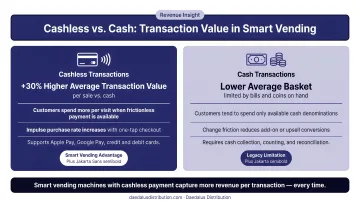
- Cashless payment acceptance: 71% of vending machine sales in 2024 were cashless, with the average cashless transaction ($2.24) generating 37% more than cash ($1.78)
- Smart restocking: Real-time inventory data prevents stockouts on high-demand items during peak hours
The NAMA Census reports that average sales per U.S. vending machine rose to $6,284 per year in 2023, up from $4,032 in 2020 — a climb driven largely by cashless adoption and price inflation.
Scalability Without Proportional Overhead
IoT-connected machines report their own status — inventory levels, error codes, sales data — so operators don't need to physically visit each location to know what's happening. One person can manage a large fleet across multiple locations without adding headcount to keep up.
Daedalus Distribution's Vendekin-powered machines ship with remote inventory tracking and sales reporting built in. Operators across the U.S. get that visibility from the start, backed by Daedalus's parts and service center in Summerville, South Carolina.
Better Business Decisions Through Data
Aggregate data from a smart machine fleet — what sells, where, when, and at what price — turns vending from a set-it-and-forget-it operation into a data-informed retail business that can respond to demand shifts quickly. In practice, that means operators can:
- Test new products in specific locations before committing to a full rollout
- Adjust pricing based on time of day or location demand
- Identify underperforming placements before renewing a contract
The Modern Consumer Experience: Touchscreens, Cashless Payments, and Personalization
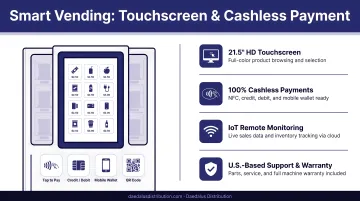
Interactive touchscreen interfaces replace traditional button arrays, giving customers a browsable shopping experience similar to using a tablet. Visual product presentation increases engagement time and drives impulse purchases through high-resolution images, nutritional information, and promotional messaging.
Cashless and contactless payment is now a baseline consumer expectation, not a premium feature. 77% of cashless vending transactions in 2024 were tap-to-pay (contactless card, phone, or watch), and mobile wallet transactions grew by more than 300% year-over-year. Customers who can't pay the way they want will simply walk away.
Beyond payment convenience, personalization is where smart vending machines start pulling real weight for operators. Machines can surface relevant products based on time of day (energy drinks in the morning, snacks in the afternoon), location context (protein bars at gyms, fresh salads in corporate offices), or loyalty program integration. Operators using these features consistently report stronger repeat purchase rates — the machine isn't just convenient, it's contextually useful.
What to Look for When Choosing a Smart Vending Machine
Connectivity Reliability
Wi-Fi vs. Cellular: Wi-Fi-dependent machines lose connectivity in basements, warehouses, or locations where operators don't control the network infrastructure. Cellular connectivity provides carrier-managed quality of service, hardware-level SIM authentication, PCI-compliant payment processing, and independence from host-site IT — making it the dominant choice for commercial vending deployments.
Every minute offline means payment processing failures, missing sales data, and inventory blind spots. Cellular removes that single point of failure entirely.
Software and Reporting Capability
Evaluate what the machine's companion platform actually shows you:
- Can you see real-time inventory levels per slot?
- Does the dashboard display sales trends, machine health, and per-location analytics?
- Is the software intuitive enough for a small operator to use without dedicated IT support?
- Are there ongoing SaaS or telemetry fees, or is the software included?
The best platforms make it easy to spot trends, catch problems early, and act on the data — without needing a dedicated analyst to interpret the reports.
Support and Service Infrastructure
A strong software platform means little without a vendor who can back it up when hardware fails. Before committing, ask about:
- Parts availability and inventory depth
- Response times for technical support
- Whether the provider has U.S.-based support and service
Daedalus Distribution runs a U.S.-based parts and service center in Summerville, South Carolina for Vendekin operators nationwide. Support is available Monday–Friday, 8 AM–5 PM EST for technical questions, replacement parts, and installation guidance.
Frequently Asked Questions
Is a vending machine an IoT device?
Traditional vending machines are not IoT devices. Modern smart vending machines are — they use embedded sensors, wireless connectivity, and cloud software to collect, transmit, and act on real-time data without requiring on-site human intervention.
How much does a smart market vending machine cost?
Smart vending machine pricing varies based on machine type, feature set, and brand. New IoT-enabled units generally range from $3,000 for basic snack machines to $9,000+ for advanced combo models. Budget an additional $19–$60+ per month for software and connectivity fees.
What connectivity options do smart vending machines use?
Smart vending machines use Wi-Fi or cellular connectivity. Cellular (4G/LTE/5G) is the preferred choice for commercial deployments — it delivers reliable uptime, carrier-managed service quality, and PCI-compliant payment security without relying on local IT infrastructure.
Can I manage multiple smart vending machines remotely?
Yes. Fleet management via a central cloud dashboard is a core benefit of IoT vending. Operators can monitor inventory levels, machine health, and sales data across all locations from a single interface without visiting each machine, so your operation can grow without adding proportional headcount.
What types of products can smart vending machines sell?
Modern smart vending machines handle snacks, beverages, fresh and refrigerated foods, frozen goods, and dairy. Premium models include dedicated refrigeration compartments to maintain proper temperatures for perishables.
How do IoT vending machines handle cashless payments?
Smart vending machines connect to payment processors in real time, accepting credit/debit cards, NFC tap-to-pay, and mobile wallets. Transaction data is transmitted instantly to the operator's reporting dashboard, providing real-time revenue visibility and eliminating manual cash reconciliation.