Introduction
Minnesota's vending market is built on concrete demand drivers. The state's 313,300 manufacturing employees work shift-based schedules that create consistent weekday sales, while the Twin Cities metro's 3.2 million residents support high-traffic locations year-round. Large university campuses like the University of Minnesota Twin Cities (52,017 students) and the Minnesota State system (270,000 students across 33 campuses) add predictable seasonal foot traffic. Cold winters push more people into malls, office buildings, and campus corridors — the exact environments where vending machines capture consistent, repeat sales.
The vending business model appeals to a wide range of operators — from side-hustlers and retirees to full-time entrepreneurs — because it requires no storefront, runs on low overhead, and scales gradually without forcing you to quit your current job. The U.S. vending industry generates $7.9 billion in annual revenue across 14,801 businesses. That scale matters: the market is large, but fragmented enough for independent operators to carve out a profitable foothold.
That opportunity is real in Minnesota specifically.
This guide covers the real steps, compliance requirements, costs, and considerations involved in starting a vending business in Minnesota, where state regulations are simpler than many other markets but local requirements vary significantly by city.
Key Takeaways
- Profit comes from the margin between wholesale cost and retail price—location and consistent restocking drive that margin
- Minnesota requires business registration, a sales tax permit, and a health permit for TCS food—no statewide vending license required
- Location quality drives success more than any other factor; secure a placement agreement before buying equipment
- Startup costs range from $2,000 to $15,000+ depending on machine type; stabilizing income typically takes 6–12+ months
- Expect hands-on work early on; passive-leaning income comes once routes and systems are running smoothly
What to Know Before Starting a Vending Machine Business in Minnesota
Vending is not passive income from day one. Early-stage operators handle location scouting, stocking runs, machine maintenance, and permit paperwork on their own — long before revenue justifies hiring help. Expect weekly machine visits for the first 90 days to monitor performance, adjust your product mix, and troubleshoot issues.
Revenue is highly location-dependent. The same machine in a busy urgent care lobby versus a quiet side hallway can produce wildly different results — often a 3–5x revenue gap. A single weak location doesn't mean the business model is broken; it means the placement needs to change. Successful operators relocate underperforming machines within 60–90 days rather than waiting for slow improvement.
Understanding those operational realities is half the battle. The other half is navigating Minnesota's regulations — friendly at the state level, but patchwork at the municipal level.
Minnesota-Specific Complexity
Here's what trips up new operators:
- Twin Cities metro overlapping requirements: Minneapolis requires a business license and vending machine license; St. Paul requires registration through Safety and Inspections; suburban cities may have their own rules
- Cold weather constraints: Outdoor placement is rarely viable; confirm indoor placement before purchasing winterized equipment
- Sales tax nuances: Most food is exempt, but candy, soft drinks, and prepared foods are taxable at 6.875% state + 1.25–3.0% local (combined rates in the metro range from 8.125% to 9.875%)
Miss any of these, and you're looking at fines, compliance gaps, or machines sitting idle while you sort out permits.
Realistic Income Timeline
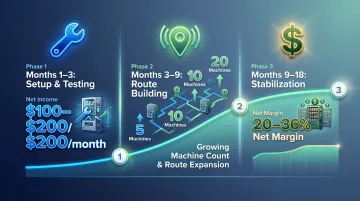
Most single-machine operators net $100–$200/month initially. Building meaningful income requires multiple well-performing locations and typically takes 6–18 months of consistent effort. According to industry benchmarks, net profit margins range from 20% to 36%. A machine grossing $1,000/month nets roughly $250–$360 after product costs, commissions, and fees.
How to Start a Vending Machine Business in Minnesota – Step by Step
The most common mistake new operators make is buying a machine before securing a location. Follow this execution sequence to avoid costly missteps. Minnesota simplifies early setup—no operator license, no machine registration required at the state level—but compliance still matters.
Step 1 – Research the Market and Identify Your Niche
Decide on a product category and match it to Minnesota locations with clear, unmet demand:
Product categories:
- Traditional snack/drink (chips, candy, soda, energy drinks)
- Healthy snacks (protein bars, nuts, sparkling water)
- Specialty items (personal care, electronics, PPE)
- Smart/micro market (fresh food, grab-and-go meals)
High-performing Minnesota location types:
- Warehouses and manufacturing facilities in the outer Twin Cities metro
- Medical waiting rooms and urgent care centers
- University campuses (U of M, Minnesota State campuses)
- Large apartment complexes (300+ units)
- Corporate office parks in Bloomington, Eden Prairie, and downtown Minneapolis/St. Paul
Visit shortlisted locations in person before committing. Observe foot traffic volume during peak hours (mid-morning, lunch, mid-afternoon). Check whether existing machines are present—poorly stocked or outdated machines signal a competitive opportunity. Assess whether nearby food alternatives (cafeterias, restaurants, convenience stores within a 3-minute walk) would compete directly with your machine.
Step 2 – Choose Your Machine Type
Compare your main options based on upfront cost, reliability, and revenue potential:
Used traditional machines ($1,000–$3,000):
- Higher breakdown risk
- Often lack cashless payment capability
- May require immediate repairs or part replacements
- Best for: Operators testing the market with minimal capital
New traditional machines ($3,000–$6,000):
- Manufacturer warranty included
- Basic cashless payment options available
- Proven reliability and lower maintenance costs
- Best for: Operators committing to 2–3 locations in year one
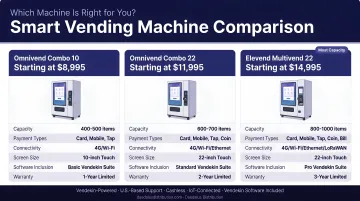
Smart digital machines ($6,000–$15,000+):
- Touchscreen interface with cashless payment (credit/debit, Apple Pay, Google Pay)
- Remote inventory monitoring and real-time sales data
- Reduces unnecessary service trips through automated alerts
- Higher revenue potential due to modern user experience
- Best for: Operators planning to scale to 5+ machines and optimize route efficiency
All-digital machines with remote tracking give operators real-time visibility into sales data—particularly useful when managing multiple locations spread across the Twin Cities metro. Daedalus Distribution's smart vending units include this remote monitoring capability, eliminating guesswork about when to restock and which products are moving.
One Minnesota-specific factor: avoid outdoor-rated equipment unless the property explicitly requires it. Indoor placement is strongly preferred — Minnesota winters demand winterized machines rated for extreme cold, which adds cost and complexity most operators don't need.
Step 3 – Register Your Business in Minnesota
Form an LLC through the Minnesota Secretary of State ($155 online, $135 by mail) or choose another entity type. LLCs separate personal liability from business operations and are required for most licensing and insurance steps. Both domestic LLCs and business corporations carry $0 annual renewal fees in Minnesota — no recurring state fees eating into early revenue.
Once your LLC is filed, complete these steps before operating:
- Get an EIN at irs.gov — free, and required for tax and banking purposes
- Open a business bank account — keeps personal and business finances separate from day one
- Confirm your registration is active — Minnesota doesn't require a statewide vending operator license or individual machine registration, but Secretary of State registration must be complete before you place your first machine
Step 4 – Obtain Required Permits and Tax Registration
Register for a Minnesota sales tax permit through the Department of Revenue using Form ABR. Under Minnesota Rule 8130.2500, one permit covers all vending machine locations statewide—you do not need a separate permit per machine location.
Sales tax rules:
- Exempt: Most food and food ingredients (bottled water, cookies, muffins, milk)
- Taxable: Candy, soft drinks (soda, sports drinks), dietary supplements, prepared foods
Taxable items are subject to 6.875% state sales tax plus local taxes ranging from approximately 1.25% to 3.0%, resulting in combined rates of 8.125% to 9.875% across the Twin Cities metro. Factor this into your pricing strategy, especially for candy and soft drinks.
If dispensing potentially hazardous (TCS) foods, fresh food, or operating a micro market, obtain a health permit from the local health department where each machine is placed. Annual inspections apply. Minnesota follows the 2017 FDA Food Code with state modifications; contact the Minnesota Department of Agriculture at MDA.FoodLicensingLiaison@state.mn.us for vending-specific food licensing.
Local permit requirements:
- Minneapolis: Business license and vending machine license required; contact Business Licenses & Consumer Services at 612-673-2080
- St. Paul: Registration through Department of Safety and Inspections required
- Other municipalities: Verify directly with city or county before placing machines; requirements and fees vary significantly
Step 5 – Secure Locations and Launch
Approach property managers in person with a short one-pager explaining your service: you handle installation, restocking, and all maintenance at no cost to them, with a small commission on gross sales (typically 5–15%). Get a signed placement agreement covering term length, commission rate, service responsibilities, and exclusivity before placing any machine.
Start with a limited, proven product selection rather than overstocking:
- Popular drinks (Coke, Pepsi, bottled water, energy drinks)
- High-margin snacks (chips, candy bars, protein bars)
- 1–2 specialty items based on location demographic
Track sell-through weekly in the first 30–60 days. Adjust product mix based on what actually moves at that specific location and demographic. Don't assume your personal preferences match customer demand—use sales data, not gut instinct.
Step 6 – Monitor Performance and Plan Your Next Move
Track key metrics from the first month:
- Gross sales per machine per week
- Gross margin after COGS (cost of goods sold)
- Commission as a percentage of gross
- Spoilage rate (expired or damaged products)
If a machine generates under $50/week after 60–90 days and product adjustments have been made, relocate it. Weak performance is almost always a location problem, not a product problem. Don't wait for marginal improvements—move the machine to a higher-traffic location.
Early data tells you which location types and product mixes work in your specific Minnesota market. Get those answers before adding machines — stable cash flow from two or three solid locations is a stronger foundation than five underperforming ones.
Minnesota Legal and Compliance Requirements
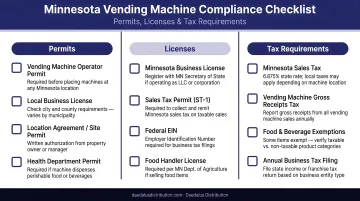
Minnesota doesn't require a statewide vending operator license or machine registration — but that doesn't mean you're off the hook for paperwork. You'll still need to handle business registration, sales tax permits, health permits for food machines, and local licensing that varies by city or county.
Before placing any machine, verify requirements directly with the relevant municipality.
Here's a breakdown of each compliance area to work through before you launch.
Compliance Checklist for Minnesota Vending Operators
Business registration:
- Register with the Minnesota Secretary of State
- LLC: $155 online / $135 by mail
- Business corporation: $155 online / $135 by mail
- Annual renewal fee: $0 for domestic entities
Sales tax permit:
- Register through Minnesota Department of Revenue (Form ABR)
- One permit covers all locations statewide
- Taxable categories: candy, soft drinks, dietary supplements, prepared foods at 6.875% state + 1.25–3.0% local
- Exempt categories: most food and food ingredients (bottled water, cookies, milk)
Health permit:
- Required for machines dispensing TCS (temperature-controlled or potentially hazardous) foods, fresh food, or micro market operations
- Minnesota follows 2017 FDA Food Code with state modifications
- Contact Minnesota Department of Agriculture for vending-specific licensing
- Certified Food Manager may be required for TCS food operations—verify with local health authority
ADA and Minnesota Accessibility Code:
- Vending machines must meet federal ADA standards for operable parts, reach ranges, and approach clearances
- Minnesota's accessibility code defers to federal ADA requirements for equipment design and functionality
- The state does not impose accessibility requirements exceeding federal minimums
Local permits:
- Minneapolis: Business license, vending machine license, health department permit
- St. Paul: Registration through Department of Safety and Inspections
- Always verify directly with city or county before placing machines; requirements and fees vary
How Much Does It Cost and What Can You Realistically Earn?
Startup Costs
| Cost Category | Estimated Range |
|---|---|
| New combo vending machine | $3,500–$8,200 |
| Smart/touchscreen machine | $6,000–$15,000+ |
| Initial inventory per machine | $200–$500 |
| Delivery/installation | $150–$500 |
| MN LLC formation (online) | $155 |
| General liability insurance | $300–$600/year |
| Contingency reserve | $500+ |
Total startup range: $2,000–$15,000+ depending on machine type and initial inventory.
Ongoing Monthly Costs
- Inventory restocking: Largest recurring expense (varies by sales volume)
- Location commissions: Typically 5–15% of gross sales, sometimes up to 25% for premium locations
- Card processing fees: Approximately 2.6% + $0.10 per transaction, which on the industry average transaction of $1.71 translates to over 8% of revenue per cashless sale
- Vehicle/fuel costs: Route travel expenses
- Maintenance reserve: $100–$300 per machine per year
Realistic Revenue Ranges
Industry benchmarks suggest net profit margins of 20–36% after COGS, commissions, and fees. A machine grossing $1,000/month may net $250–$360. High-traffic locations in Minnesota — urgent care lobbies, manufacturing break rooms, university buildings — can generate two to three times the gross sales of lower-traffic spots.
How $100k/year is achievable:
At the industry benchmark of roughly $362/month net profit per machine, you'd need about 23 machines to hit $100k annually. Scale that back to a conservative $200–$300/month net, and the target becomes 28–42 machines.
| Net Profit per Machine | Machines Needed for $100k/year |
|---|---|
| $362/month (benchmark) | ~23 machines |
| $300/month (moderate) | ~28 machines |
| $200/month (conservative) | ~42 machines |
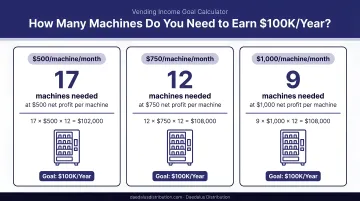
Reaching this level requires well-placed, high-performing machines and efficient route management. Operators typically need 12–24 months to build and stabilize a fleet of this size — making location strategy and capital reinvestment the two levers that matter most from day one.
Conclusion
Starting a vending machine business in Minnesota is realistic with modest capital. The state's regulatory environment is operator-friendly—no operator license, no machine registration, $0 annual renewal fees—and market conditions are strong. Success hinges on the basics: secure a strong location first, sort compliance before launch, and let real sales data drive every product and placement decision.
Sustained profitability is built through disciplined, ongoing operations:
- Relocate underperforming machines within 60–90 days rather than waiting them out
- Upgrade equipment as revenue grows to capture higher-margin product categories
- Build systems that reduce time-per-dollar-earned as your route expands
Minnesota's manufacturing workforce, university campuses, and Twin Cities metro density create consistent demand. Disciplined execution is what turns that demand into a scalable business.
Frequently Asked Questions
How many vending machines do you need to make $100k?
The number depends on average net profit per machine, which varies by location quality and product mix. Using industry benchmarks of $200–$360/month net profit per machine, operators typically need 23–42 well-performing machines to reach $100k annually.
Do I need an LLC to operate a vending machine business in Minnesota?
An LLC is not legally required, but it's the most common structure chosen because it separates personal liability from business operations. Regardless of entity type, business registration with the Minnesota Secretary of State is required — LLCs and corporations both cost $155 online, with no annual renewal fees.
Do you need a vending machine permit in Minnesota?
Minnesota does not require a statewide vending operator license or machine registration. However, you do need business registration, a sales tax permit, and a health permit if dispensing TCS or fresh foods. Local municipalities like Minneapolis and St. Paul impose additional licensing requirements.
What are Minnesota's sales tax rules for vending machine products?
Most food and food ingredients sold through vending machines are exempt from Minnesota's 6.875% state sales tax. Candy, soft drinks, dietary supplements, and prepared foods are taxable, with combined state and local rates ranging from 8.125% to 9.875% across the Twin Cities metro.
Do I need a separate health permit for each vending machine location in Minnesota?
For food vending machines dispensing TCS items, a permit is typically required from the local health department where each machine is located. However, one statewide sales tax permit covers all locations—no separate permit per location is needed for sales tax purposes.
What are the best locations for vending machines in Minnesota?
High-performing location types include manufacturing and warehouse facilities, medical waiting rooms, university campuses, large apartment complexes (300+ units), and corporate offices in the Twin Cities metro. Locations with captive audiences and no nearby food alternatives (within a 3-minute walk) generate the strongest sales volume.