Introduction
Many vending machine operators struggle with unexpected breakdowns, spoiled products, and payment system failures that erode customer trust faster than they generate revenue. Without regular maintenance, even a well-placed machine can cost more in repairs and lost sales than it earns.
Neglecting maintenance creates compounding problems fast:
- Equipment failures during peak hours when foot traffic is highest
- Liability exposure from spoiled perishable products
- Shortened machine lifespan from deferred mechanical wear
- Lost repeat customers who won't trust a machine that's failed them before
The financial case is just as stark. Preventive maintenance saves 12–18% compared to reactive repairs, per U.S. Department of Energy-cited benchmarks — and running equipment to failure can cost up to 10 times more than a regular maintenance program.
What follows covers the maintenance types every operator should know, early warning signs to watch for, proven practices to prevent breakdowns, and a scheduling framework built for profitable operation.
Key Takeaways
- Preventive maintenance costs far less than emergency repairs and avoids revenue-killing downtime
- Core tasks include cleaning, payment system checks, temperature monitoring, and dispensing mechanism inspections
- Payment rejections, unusual noises, and temperature swings are early warning signs — catch them before a full breakdown
- Service machines monthly at minimum, with quarterly deep inspections and annual professional servicing
- Remote monitoring on modern machines flags issues in real time, cutting response time before problems escalate
Why Vending Machine Maintenance Matters
Uptime Directly Determines ROI
Vending machines generate revenue only when they're running. A machine that goes down during peak hours doesn't just lose one sale—it breaks customer habit and erodes trust. Operators who rely on high-traffic locations know that visible neglect (dirty surfaces, broken payment readers, "out of order" signs) discourages repeat use, compounding revenue loss over time.
Maintenance Extends Machine Lifespan
Well-maintained vending machines can operate profitably for significantly longer than neglected units. While industry-wide lifespan benchmarks vary by usage and environment, manufacturer warranty terms offer insight: AMS provides three-year warranties on refrigeration units and control boards, with strict maintenance-compliance conditions for validity. Regular care protects these critical components and prevents premature replacement.
Food Safety and Hygiene Compliance
Machines dispensing perishables must maintain strict temperature control to prevent bacterial growth, mold, and product spoilage. The FDA Food Code requires cold time/temperature control for safety (TCS) foods to be held at 41°F or below, with ready-to-eat TCS foods requiring date marking when held longer than 24 hours. Failure to maintain proper refrigeration creates liability risks and potential health code violations.
Foods left in the temperature danger zone of 41°F to 135°F are most susceptible to pathogen growth. Modern refrigerated vending machines are designed to address this—alerting operators when temperatures stray outside safe limits so issues can be caught before products are compromised.
Preventive vs. Reactive Maintenance: The Cost Case
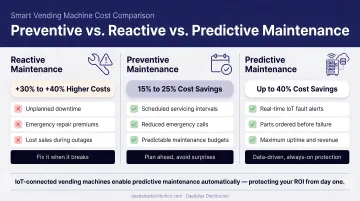
Small, scheduled tasks—cleaning, lubricating, inspecting parts—prevent large repair bills. Cross-industry facilities maintenance data shows that preventive maintenance saves 12% to 18% over reactive approaches, while predictive maintenance can save up to 40% compared to reactive repairs. The difference isn't just financial: preventive maintenance means fewer customer-facing failures and more consistent revenue.
Types of Vending Machine Maintenance
Vending machine maintenance isn't one-size-fits-all. Understanding each type helps operators plan time and budget more effectively.
Routine / Preventive Maintenance
Routine maintenance is scheduled, proactive care: wiping surfaces, cleaning interiors, checking product alignment, testing payment readers, and inspecting seals or filters. Done consistently, it prevents the dust buildup, debris accumulation, and mechanical wear responsible for most common failures.
When routine maintenance is sufficient:
- Newer machines in low-to-moderate traffic locations
- No recurring issues or error codes
- Machines already on a consistent service schedule
Corrective / Reactive Maintenance
Corrective maintenance is triggered by failure: jammed motors, rejected payments, broken dispensing coils, or cooling failures. This is the most expensive form of maintenance and the one that causes customer-facing downtime.
Why reactive maintenance is costly:
- Emergency service calls cost significantly more than scheduled visits
- Downtime during peak hours results in immediate lost revenue
- Cascading failures from one neglected component can damage related systems
- Voided warranties when maintenance obligations aren't met
Operators who only fix things when they break face higher cumulative costs than those who maintain proactively.
Predictive / Condition-Based Maintenance
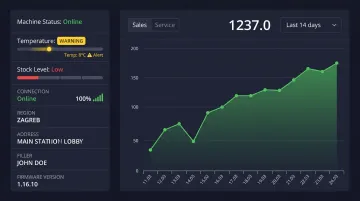
Predictive maintenance uses real-time data and performance trends to catch failures early — before a breakdown occurs. Key warning signals to track include:
- Sales velocity drops (suggesting a dispensing or product jam issue)
- Temperature fluctuations in refrigerated units
- Rising payment error frequency on card readers
Catching these patterns early allows targeted intervention instead of emergency repairs.
Modern digital vending machines make condition-based maintenance accessible. For example, machines equipped with remote monitoring—such as those offered through Daedalus Distribution's Vendekin lineup—include built-in inventory tracking and sales data reporting. 73% of operators now use telemetry or cashless devices for remote data collection, and 54% rate remote monitoring as a great ROI investment.
Major / Overhaul Maintenance
Overhaul maintenance is a comprehensive deep-service event: replacing worn mechanical parts, upgrading payment systems to current MDB standards, servicing compressors, and refurbishing internal components.
When an overhaul is warranted:
- After several years of heavy use
- Following a major component failure
- When multiple systems begin degrading simultaneously
- When incremental fixes are no longer cost-effective
A well-timed overhaul can extend a machine's profitable lifespan by several additional years.
Warning Signs Your Vending Machine Needs Maintenance
Most vending machine failures give advance warning. Operators who know what to look for can intervene before a minor issue becomes a costly breakdown.
Dispensing and Performance Issues
- Products frequently getting stuck
- Coils not rotating fully
- Items falling out of alignment
- Machine completing transaction but failing to deliver
These symptoms typically indicate worn dispensing motors, misaligned trays, or overloaded coils. During restocking visits, test each row, inspect coil spacing, and listen for irregular motor sounds.
Payment System Problems
Payment errors rank among the top customer complaints for vending operators. Common indicators include:
- Coin jams or rejections
- Bill acceptor failures
- Card reader errors
- Customers unable to complete transactions
Dust, debris buildup, and outdated firmware cause most payment system issues. Cleaning, recalibration, or a firmware update typically resolves these before any parts need replacing.
Temperature and Refrigeration Red Flags
- Drinks not reaching correct temperature
- Condensation buildup inside the cabinet
- Frost on non-freezer surfaces
- Compressor running continuously
Temperature failures carry food safety implications, not just product loss. Address these immediately by verifying thermostat settings and checking condenser coil cleanliness as first steps.
Unusual Noises, Error Codes, and Visible Wear
- Grinding or rattling sounds during dispensing
- Persistent error codes on the display
- Visible corrosion around door seals
- Dirty or cracked touchscreen surfaces
- Worn coin mechanisms
Keep a maintenance log to distinguish one-off occurrences from recurring patterns. Repeated minor errors on the same component reliably signal a part approaching failure.
Vending Machine Maintenance Schedule
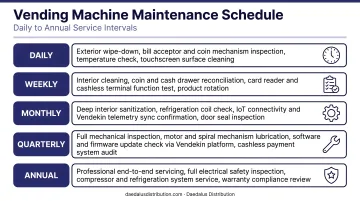
The right maintenance frequency depends on machine type, location traffic level, and whether the machine handles perishables. A high-traffic office machine needs more frequent attention than a low-volume standalone unit. Use the intervals below as a baseline, then adjust based on your specific setup.
Recommended Maintenance Intervals
Per-restocking checks (daily/weekly):
- Wipe exterior surfaces
- Check product alignment and spacing
- Verify temperature display readings
- Test payment system with sample transaction
- Inspect delivery chute for obstructions
Weekly tasks:
- Clean coin and bill acceptors
- Check for error codes or system alerts
- Verify all product rows are dispensing correctly
Monthly inspections:
- Deep clean interior cabinet
- Inspect door seals and gaskets
- Check and clean condenser coils (refrigerated units)
- Review sales data for anomalies or performance drops
- Test all payment methods thoroughly
Quarterly/annual servicing:
- Professional compressor and refrigeration inspection
- Full mechanical inspection of motors and dispensing mechanisms
- Part replacements as needed (belts, motors, filters)
- Software and firmware updates
- Calibration of payment systems
NAMA's reopening checklist emphasizes critical tasks including inspecting chilled units for appropriate temperatures, removing debris around condensers for proper airflow, and verifying product dates.
When to Escalate to a Qualified Technician
Always use a qualified technician for:
- Electrical component repairs
- Refrigerant system servicing (legally required to use certified recovery equipment)
- Control board issues
- MDB device connections (must be performed with power off to avoid damage)
Daedalus Distribution's U.S.-based parts and service center stocks replacement parts for fast turnaround. Reach the support team Monday–Friday, 9 AM–5 PM EST for maintenance assistance or parts inquiries.
Conclusion
Vending machine maintenance isn't optional overhead—it's the core operational practice that determines whether a machine generates consistent profit or unpredictable costs. Preventive maintenance saves 12% to 18% compared to reactive repairs, and proactively maintained machines last measurably longer than neglected ones.
Build a structured maintenance plan from day one. Combine routine preventive care, condition-based monitoring where available, and a clear escalation path for complex repairs. That structure is what separates operators who scale profitably from those constantly chasing repair costs.
Frequently Asked Questions
How much does it cost to service a vending machine?
Routine service visits typically cost less than corrective repairs. While specific pricing varies by region and provider, reactive maintenance can cost up to 10 times more than preventive programs, making scheduled upkeep the smarter financial choice.
What routine maintenance is required on a vending machine?
Core recurring tasks include exterior and interior cleaning, payment system checks and cleaning, product alignment verification, temperature monitoring for refrigerated units, and periodic filter or part inspections. Most operators perform basic checks with each restock visit and deeper inspections monthly.
How often should a vending machine be serviced?
Plan on a basic check with every restock, a deeper inspection monthly, and professional service once or twice a year. High-traffic locations and refrigerated units typically need more frequent attention.
What are the common vending machine problems?
The most frequently reported issues include product jams, bill and coin acceptor failures, card reader errors, temperature malfunctions in refrigerated units, and motor or coil wear from overloading. Many of these issues are preventable with regular cleaning and inspection.
Can I perform vending machine maintenance myself, or do I need a professional?
Most routine tasks—cleaning, restocking, basic inspections, and software resets—are owner-manageable. However, electrical repairs, refrigerant servicing, and control board issues should always be handled by a qualified technician to ensure safety and maintain warranty coverage.
How does neglecting maintenance affect vending machine revenue?
A machine in disrepair loses sales through downtime, payment failures, and product jams. Visible neglect—dirty surfaces, broken interfaces, persistent error messages—drives customers away and compounds revenue loss over time.