While vending machines are often dismissed as a simple convenience, their real value shows up in measurable outcomes: productivity gains, improved morale, employee retention, and reduced operational costs. According to the International Labour Organization, inadequate workplace nutrition causes up to 20% productivity loss — a staggering number that most businesses could easily address with on-site food access.
This article breaks down 9 specific, practical benefits that workplace vending machines deliver, grounded in how businesses actually operate day to day.
Key Takeaways
- Workplace vending machines provide 24/7 on-site access to food and beverages, cutting time lost to off-site trips
- They support employee productivity, morale, and well-being without the overhead of cafeteria staff
- Digital machines with touchscreen interfaces, cashless payments, and real-time inventory tracking reduce manual restocking effort and operational guesswork
- Customizable product selections serve diverse dietary needs and align with wellness initiatives
- Low overhead and no staffing costs make workplace vending one of the highest-ROI amenity investments available
What Are Workplace Vending Machines?
Workplace vending machines are self-service units stocked with snacks, beverages, and sometimes fresh food, placed within a work facility for employee and guest use — available without any staff involvement. They operate 24/7, require no human oversight during transactions, and provide immediate access to food and drinks whenever workers need them.
That 24/7 accessibility is only part of the story. Modern workplace vending has moved far beyond coin-operated candy dispensers — today's machines are purpose-built for how people actually pay and eat. Current units typically include:
- Touchscreen interfaces for intuitive product selection
- Cashless payment options (credit cards, Apple Pay, Google Pay, tap-to-pay)
- Remote inventory monitoring and sales reporting
- Support for fresh, frozen, and refrigerated goods
These capabilities turn a vending machine into a genuine food service channel — one that collects real operational data, reduces manual restocking guesswork, and runs without any on-site staff involvement.
9 Benefits of Vending Machines in the Workplace
The benefits below span employee experience, operational efficiency, and business outcomes — each tied to metrics that managers and business owners already track.
Benefit 1: Increases Employee Productivity
Hunger and low blood sugar directly impair focus, decision-making, and energy. Having food accessible on-site removes a major productivity drag without requiring employees to leave their workspace.
Why this matters: Research from Brigham Young University analyzing 19,803 employees across three large U.S. companies found that workers with unhealthy diets were 66% more likely to report productivity loss. Employees who rarely ate fruits, vegetables, and low-fat foods at work were 93% more likely to experience reduced output. Total health-related productivity loss accounted for 77% of all such loss and cost employers two to three times more than annual healthcare expenses.
When employees don't need to leave for food, they save significant time. Workers without on-site food access spend an estimated 30 to 60 minutes per day leaving the office to find lunch. Over a five-day work week, that's 2.5 to 5 hours of lost productive time per employee.
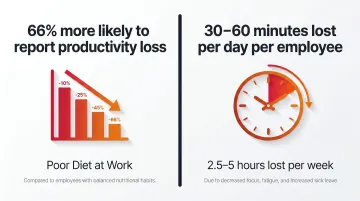
Workplace vending machines eliminate both problems: they provide immediate nutrition access to prevent cognitive decline and keep employees in the building during breaks.
Benefit 2: Keeps Employees On-Site During Breaks
On-site food access reduces the likelihood of employees driving off-site during lunch or breaks, which can extend a 30-minute break into an hour-long disruption — especially in locations without nearby food options.
According to ezCater's 2024 Food for Work Report, more than 40% of employees without employer-provided meals spend their breaks traveling to get food. This travel time eats into rest periods and creates coverage gaps.
When this matters most: Manufacturing facilities, warehouses, office parks, or any location not within walking distance of restaurants face the biggest impact. Without on-site options, employees either leave the premises for extended periods or skip meals entirely — both reduce effective working time or cognitive performance.
The average U.S. lunch break is 36 minutes, but off-site food trips routinely exceed 45-60 minutes when factoring in travel, wait times, and ordering. Vending machines eliminate that friction entirely.
Benefit 3: Boosts Employee Morale and Satisfaction
Providing on-site food access signals to employees that the company values their time and well-being — a small, visible gesture that contributes to a more positive work culture and higher job satisfaction scores.
ezCater's 2024 survey of 1,005 on-site employees found food access consistently outperforms other perks in employee perception:
- 52% identified free or subsidized food as the most appreciated work perk — ahead of flexible work (40%), education benefits (21%), and wellness benefits (20%)
- Nearly 90% said free food makes them feel more positively about their company
- 78% of workplace food orderers say food makes employees more likely to stay
The cost-benefit analysis is compelling. Replacing a managerial employee costs an estimated one to two times their annual salary, factoring in recruiting, onboarding, and lost productivity during the vacancy. Against that backdrop, even modest food access investments generate outsized goodwill and retention value.
Benefit 4: Provides 24/7 On-Demand Access
Unlike cafeterias or catering services with fixed hours, vending machines operate around the clock — making them particularly valuable for businesses running multiple shifts, overnight operations, or irregular schedules.
According to Bureau of Labor Statistics data from 2017-2018, 16% of all U.S. wage and salary workers worked non-daytime schedules — including 6% on evening shifts, 4% on night shifts, and 6% on rotating, split, or irregular shifts. In leisure and hospitality, 37% worked non-standard schedules; in transportation and utilities, 26%.
| Industry | % Non-Daytime Workers |
|---|---|
| Leisure and hospitality | 37% |
| Transportation and utilities | 26% |
| Wholesale and retail trade | 25% |
| All workers (average) | 16% |
For the millions of U.S. workers on non-standard shifts, cafeterias and off-site restaurants are typically closed. Vending provides the only practical 24/7 food-access solution.
KPIs impacted: This directly supports workforce coverage for shift workers, reduces complaints about limited food access during non-standard hours, and eliminates the need for managers to solve the "off-hours food" problem.
Benefit 5: Lower Overhead Than Traditional Food Service
Running a vending machine requires a fraction of the cost and operational complexity of a breakroom kitchen, cafeteria, or catering contract — no staff, no food prep, no cleaning crew, and minimal electricity consumption.
According to Fooda's 2026 industry data, workplace food service costs break down as follows:
| Food Service Format | Cost Per Person Per Use | Staffing Required |
|---|---|---|
| Pantry / Grab-and-go (vending) | $3 - $8 | None |
| Popup restaurant | $10 - $20 | Minimal |
| Managed cafeteria | $10 - $20 | Full dedicated staff |
| Catering (drop-off) | $15 - $30 | Minimal |
| Catering (full-service) | $30 - $50 | Full event staff |
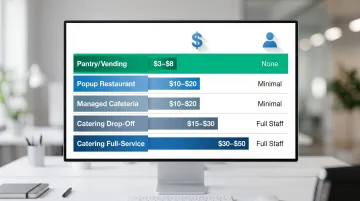
Traditional cafeterias require dedicated staff paid regardless of utilization and are prone to inventory waste. Vending machines and micro markets require no on-site staff and use digital inventory management to track demand and adjust product mix, controlling costs.
For small and mid-sized businesses who cannot justify cafeteria staffing, utilities, and food waste costs, vending delivers food access at a fraction of the per-person cost with zero staffing overhead.
Benefit 6: Easy Maintenance and Management
Modern vending machines require very little day-to-day involvement from the host business. Restocking, maintenance, and troubleshooting are typically handled by the vending operator — freeing up HR, office managers, or facilities teams from food service logistics entirely.
Cloud-based management platforms give operators remote visibility into their machines:
- Monitor stock levels and machine performance from anywhere
- Track inventory in real-time
- Receive automated alerts when stock falls below thresholds
For businesses partnering with distributors like Daedalus Distribution, this means access to U.S.-based parts and service support, fast response times during business hours, and machines equipped with IoT connectivity that flag maintenance needs before they become outages.
Benefit 7: Promotes Employee Health and Wellness
Today's vending machines can be stocked with nutritious options — protein bars, nuts, low-sugar beverages, fresh salads, and dietary-specific items — making them a practical tool for supporting corporate wellness goals.
According to the National Automatic Merchandising Association's (NAMA) 2022-2023 Industry Census, 53% of vending operators increased their "better for you" product offerings in 2023. Operators prioritize low/no sugar (78%), low-calorie (72%), low-fat (64%), fresh (56%), organic ingredients (50%), and gluten-free/allergen-free options (44%).
The business case extends beyond preference. A Harvard meta-analysis published in Health Affairs found that medical costs fall by approximately $3.27 for every dollar spent on wellness programs, and absenteeism costs fall by approximately $2.73 per dollar spent. While this covers comprehensive wellness programs, nutrition access is a recognized component.
The vending industry is actively shifting its product mix to deliver on these outcomes — including NAMA's Fit Pick program, which sets standardized nutrition criteria for vending products.
Benefit 8: Supports Team Culture and Social Interaction
Vending areas naturally become informal gathering spots — encouraging spontaneous conversations, cross-team connections, and the kind of low-pressure social interaction that strengthens workplace culture, especially in environments where employees otherwise work in isolation.
The cost of workplace loneliness is substantial. According to CDC/NIOSH estimates from 2019 data, employers faced an estimated $154 billion in lost productivity from loneliness, and lonely employees missed 5.7 additional work days per year. Approximately 50% of U.S. adults report experiencing loneliness.
Gallup's State of the Global Workplace: 2024 Report found that 20% of the world's employees experience loneliness, with 19% of U.S. employees reporting loneliness "a lot" the previous day. Fully remote employees report significantly higher loneliness (25%) than fully on-site employees (16%).
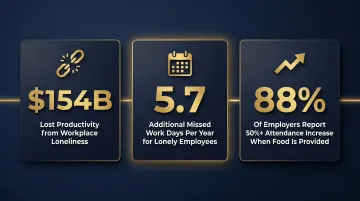
Vending areas function as low-pressure social spaces where brief, unstructured interactions strengthen team bonds. That value shows up in attendance data too: ezCater's 2024 research found that 88% of employers who invest in food for on-site collaboration report office attendance increases of at least 50% when food is provided.
Benefit 9: Smart Technology Delivers Operational Insights
Modern digital vending machines — including Vendekin Technologies units distributed by Daedalus Distribution — go beyond dispensing food. They collect real-time sales data, track inventory remotely, and flag maintenance needs before they become outages.
According to NAMA's 2022-2023 Industry Census, approximately 75% of the 2.89 million U.S. vending machines accept cashless payments, up from 69% in 2018. Among cashless-equipped machines, 94% accept debit/credit cards and 88% accept contactless payments (Apple Pay, Google Pay). Contactless payments grew from 19% to 22% of non-cash transactions between 2020 and 2023.
The connected vending machine market is experiencing rapid growth. Berg Insight estimates that 58.1% of the world's approximately 14 million vending machines are now connected. The global connected vending machine market is valued at approximately $4.1 billion (2024) and projected to reach $9.2 billion by 2030.
Operational outcomes smart vending delivers:
- Fewer stockouts through real-time inventory alerts
- Faster restocking decisions based on actual usage data
- Cashless payment convenience for employees
- Route optimization for operators
- Ability to adjust product selection based on data, not guesswork
Operators gain visibility that turns vending from a passive amenity into a managed, data-driven program — one that improves over time as usage patterns emerge.
What Happens Without a Workplace Vending Machine?
No on-site food access creates compounding problems: longer breaks, more off-site trips, and mid-afternoon energy crashes that drag down output. There's also the morale cost of a workplace that ignores a basic employee need.
Specific risks that scale with business size:
- In a 50-person office, even a few employees leaving for 45 minutes each day adds up to significant lost productive time weekly
- In a 24/7 facility, no food access during off-hours is a genuine workforce management problem
- Among workers without employer-provided meals, 65% eat snacks as meals, 48% skip meals entirely, and 18% rely on convenience stores
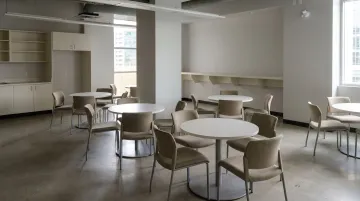
Businesses that rely solely on a cafeteria or catering model introduce cost, scheduling complexity, and coverage gaps a vending machine would eliminate. Managed cafeterias typically run 11 a.m. to 2 p.m. — leaving shift workers, early arrivals, and late-stayers with nothing.
How to Get the Most From Your Workplace Vending Machine
Vending machines deliver their full value when product selection is matched to the actual needs and preferences of the workforce. This means polling employees, tracking what sells, and adjusting the mix over time based on data rather than assumptions.
Placement matters. Machines positioned near break areas, common spaces, or high-traffic corridors get more use and serve their social and morale functions better than machines tucked in a corner.
Partner with the right vendor. The machine you choose shapes your entire program. Look for distributors who offer:
- Remote inventory tracking
- Fast restocking
- Responsive maintenance support
- U.S.-based parts availability
Daedalus Distribution, the authorized U.S. reseller for Vendekin Technologies, checks all of these boxes. Their machines come equipped with touchscreen interfaces, cashless payment systems, and cloud-based software that tracks sales data and inventory in real-time. U.S.-based parts and support back every unit, so you're covered if something goes wrong.
Conclusion
Workplace vending machines deliver more than convenience — they affect productivity, employee morale, and operational costs in ways that add up quickly. The impact grows when machine placement, product selection, and technology are dialed in for the specific workforce being served.
Treat the vending program as a managed asset, not a set-it-and-forget-it installation. Businesses that track usage, refresh inventory, and upgrade technology as needs evolve will see the greatest return from their investment.
Frequently Asked Questions
How do vending machines in offices work?
Office vending machines are self-service units connected to a power supply, stocked by a vendor or operator, and accessible to employees at any time. Modern machines accept cashless payments (credit cards, Apple Pay, Google Pay) and can be monitored remotely for inventory and maintenance.
What are the benefits of vending machines?
The core benefits are 24/7 food access, better employee productivity, and lower overhead than traditional food service. They also keep employees on-site, cutting time lost to off-site lunch runs.
Are digital vending machines worth it?
Digital vending machines provide clear upgrades over traditional models: touchscreen interfaces, cashless payment support, and real-time inventory tracking. These features make them more reliable and easier to manage than older mechanical units.
Where can I legally place my vending machine?
Vending machines can be placed in privately owned spaces (offices, warehouses, gyms, etc.) with the property owner's permission. Public or semi-public placements may require a local permit or vending license, which varies by city and state.
What is the useful life of a vending machine?
Most vending machines last 10–15 years with regular maintenance, and modern digital units with fewer mechanical parts tend to have lower failure rates. Partnering with a vendor that provides ongoing support and parts availability extends that lifespan considerably.