This guide is written for people who are serious about launching: the side-hustler wanting passive income, the entrepreneur building a route, and the employee eyeing an exit. It covers what Maryland specifically requires — including a licensing rule most national guides skip entirely — and what it actually takes to build a profitable route.
Key Takeaways
- Vending machines generate passive revenue through contracted locations, restocking, and collections — with low overhead and minimal staff
- Maryland charges $2.50 per machine for a vending license, filed with the Circuit Court Clerk in each operating county
- Expect to budget for machines, inventory, licenses, insurance, and location commissions before earning a dollar
- The most common early mistakes: skipping compliance steps, no written location contracts, choosing low-traffic sites
- Lock in licensing and location contracts before purchasing machines; buying first and sorting compliance later gets costly
What Is a Vending Machine Business and What to Know Before You Start
A vending machine business means purchasing automated machines, placing them in contracted locations, stocking them with products, and collecting revenue — all without full-time staff once the route is running.
Three Ways to Enter
| Entry Path | Speed to Revenue | Upfront Cost | Best For |
|---|---|---|---|
| Buy an existing route | Fast — locations already producing | Higher | Operators who want immediate cash flow |
| Buy a franchise | Moderate — system is set up for you | Moderate to high, plus ongoing fees | Those who prefer a proven framework with built-in guidance |
| Start from scratch | Slower — everything built from zero | Lower initial, more legwork | Operators who want full ownership of their margins and route decisions |
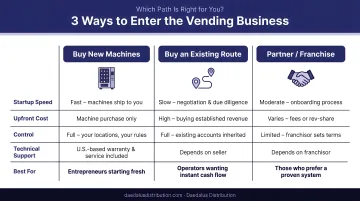
Of these three, most first-time operators in Maryland start from scratch. It takes more work upfront, but there are no franchise fees cutting into margins and no inherited problems from someone else's route.
Honest Expectations
The first few months are not passive. You'll be sourcing machines, prospecting locations, filing licenses, and troubleshooting. The passive-income phase comes after the route stabilizes — typically once you have several consistently profitable machines and a reliable restocking rhythm. Plan for 6–12 months of active management before the business runs more autonomously.
Why Start a Vending Machine Business in Maryland
Maryland isn't a guaranteed opportunity — but it's a genuinely good market for operators who execute well.
A Dense, Employed Customer Base
Maryland's civilian labor force exceeds 3.2 million, with the Baltimore metro alone accounting for over 1.4 million employed workers. Montgomery County adds another 570,000-person labor force, anchored by large federal employers like the NIH (17,535 employees) and FDA (8,500 employees). These aren't transient populations — they're workers in predictable locations, Monday through Friday.
University Demand Is Real and Verified
Fall 2024 enrollment figures from the Maryland Higher Education Commission tell the story clearly:
- University of Maryland, College Park: 41,725 students
- Johns Hopkins University: 30,215 students
- Towson University: 19,401 students
- Maryland community colleges: 107,669 students
Campus vending is competitive, but the volume is there. University facilities departments are also accustomed to vendor relationships and location contracts.
Core Business Advantages
That demand pairs well with a business model built for flexibility:
- No storefront required — machines go to the customers
- Flexible hours — you set the restocking schedule
- Scalable — start with one machine, reinvest profits into additional units
- Part-time compatible — many Maryland operators start while holding other income
- Industrial sites are high-value territory — manufacturing and factory locations account for 43% of vending revenue nationally (NAMA), and Maryland's 270+ warehousing establishments employ over 39,000 workers, most concentrated along the I-95 corridor
Maryland Licensing, Permits, and Compliance You Need to Know
Maryland has a licensing structure for vending machines that most national startup guides simply miss. Skipping any of these steps puts you in misdemeanor territory before your first sale.
Vending Machine License
Under Maryland Business Regulation Sections 17-1901 to 17-1906, every person selling goods through a vending machine in Maryland must obtain a vending machine license from the Clerk of the Circuit Court in the county where each machine is located.
Key details:
- Fee: $2.50 per machine
- License year: May 1 through April 30, annual renewal required
- Per-county requirement: Machines across multiple counties require separate licenses in each county
- Exempt products: Newspapers, magazines, postage stamps, bulk vending machines, tobacco, paper cups, soap, sanitary napkins, toilet seat covers, paper towels
- Sticker: The Comptroller prints stickers; the clerk distributes them and the sticker must be visibly displayed on the machine
- Penalty: Violation is a misdemeanor with a fine not exceeding $100 per machine
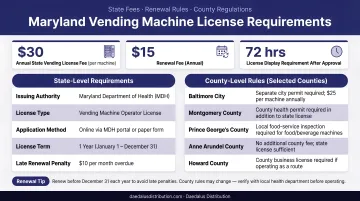
Use the Maryland Judiciary JPortal system to search licenses and contact your local Circuit Court Clerk's office to apply.
Business Registration and Tax Setup
Register your business through Maryland Business Express before placing a single machine. This covers:
- Entity registration with the Maryland Department of Assessments and Taxation
- Federal Tax ID (EIN) from the IRS
- Sales and use tax account with the Maryland Comptroller (state rate is 6%)
Important sales tax detail: Vending operators apply the 6% rate to 94.5% of gross receipts — not 100%. Certain products sold through vending machines are exempt from sales tax, including snack food, milk, fresh fruit, fresh vegetables, and yogurt. Sandwiches, ice cream, and other prepared foods are taxable. Verify product-specific exemptions directly with the Maryland Comptroller's office, since misclassifying a product can affect your margin calculations.
Health Permits and Micro Markets
Machines selling food or beverages that qualify as food service facilities require a health permit from the Maryland Department of Health, regulated under COMAR 10.15.03 and the 2017 FDA Food Code (Maryland modified).
Maryland specifically recognizes micro markets under Health-General Code Section 21-301, classifying them as food service facilities that require a separate permit. If you're considering an unmanned retail setup rather than traditional machines, that distinction matters legally.
One important exemption applies outside Baltimore City: locations used exclusively for prepackaged, commercially sealed, non-potentially hazardous foods (shelf-stable, packaged snacks and drinks) are exempt from the food establishment license requirement.
Local Permits and Baltimore City
Maryland operates under home rule — counties and municipalities can layer additional requirements on top of state mandates. Baltimore City operates as an independent jurisdiction and specifically allows a per-machine food license requirement, with a $10 vending machine fee listed in its food licensing portal.
Contact the licensing department in each county or city where you plan to operate before placing machines. Every jurisdiction you enter adds a potential compliance layer — state-level registration alone won't cover it.
Key steps before going live in any Maryland location:
- Confirm county-level vending license requirements with the local Circuit Court Clerk
- Check for municipal permits if operating in incorporated cities or towns
- Verify Baltimore City's food licensing portal if placing machines in the city
- Consult the local health department for any food service permit requirements specific to that jurisdiction
How to Start a Vending Machine Business in Maryland: Step by Step
The single most common early mistake is buying machines before securing locations or completing compliance. Don't do that.
Step 1 – Define Your Product Focus and Machine Type
Product choice drives everything downstream: machine type, cost, location requirements, and permit obligations.
Three main categories:
- Snacks and beverages — broadest appeal, most competitive
- Specialty products — protein bars, fresh food, personal care items, higher margins but harder to place
- Niche products tied to location — supplements at gyms, school supplies at universities, convenience items in apartment buildings
Machine types and cost ranges:
| Machine Type | Cost Range | Notes |
|---|---|---|
| Bulk vending (gumballs, capsules) | Under $500 | No electricity, exempt from vending license |
| Refurbished full-size machines | ~$1,295–$1,695 | Lower upfront, no warranty, older technology |
| New standard machines | ~$4,600–$7,500 | Warranty included, modern features |
| Higher-end combo machines | ~$8,500+ | Broader product range, highest capacity |
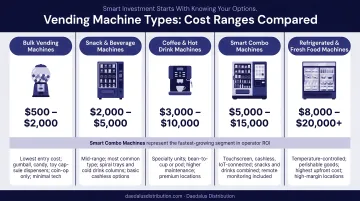
For operators managing multiple Maryland locations, machines with remote monitoring are noticeably more efficient for route management. Daedalus Distribution's Vendekin lineup — the Omnivend Combo 22, Omnivend Combo 10, and Elevend Multivend 22 — are fully cashless, touchscreen machines with cloud-based inventory tracking and sales reporting included at no separate software fee. The Elevend Multivend 22 adds an elevator dispensing system for dairy, fragile items, and fresh food, expanding placement options into locations standard machines can't handle.
Step 2 – Set Up Your Business Entity
An LLC is the most practical structure for vending operators. It separates personal assets from business liability and makes opening a business bank account simple. Sole proprietorships are easier to form but expose personal assets — once you own multiple machines, that risk isn't worth it.
Formation sequence:
- Register through Maryland Business Express
- Obtain an EIN from the IRS
- Open a dedicated business bank account
Keep business and personal finances completely separate. It protects your LLC status and makes tax filing far simpler. Consult an accountant or attorney before choosing your structure — it's worth the cost at the beginning.
Step 3 – Obtain All Required Maryland Licenses
Work through this in order before placing a single machine:
- Register the business entity via Maryland Business Express
- Register for a Maryland sales and use tax account with the Comptroller
- Apply for a vending machine license from the Circuit Court Clerk in each county where machines will be placed
- Obtain a health permit from the Maryland Department of Health if selling food or beverages
- Check with local county and city offices for any additional permits
Step 4 – Scout Locations and Negotiate Contracts
Strong Maryland location types:
- Office parks in the Baltimore–DC suburban corridor
- University campuses (UMD, Towson, Johns Hopkins, community colleges)
- Manufacturing and logistics facilities along the I-95 corridor
- Hospitals — Maryland has 43 acute care hospitals statewide
- Apartment complexes, gyms, laundromats
Never place a machine without a written contract. Key terms to include:
- Commission rate (typically 5–20% of gross sales; industrial sites often request nothing)
- Contract length and renewal terms
- Rights to add, remove, or swap machines
- Maintenance responsibilities
- Termination clause
Have an attorney review or draft your location contracts. Ambiguous termination clauses and missing commission definitions are the two provisions most likely to cause disputes — make sure both are explicit.
Step 5 – Source Machines, Stock Inventory, and Set Prices
Source machines from manufacturers, authorized distributors, or resellers. New machines come with warranties and current payment technology; refurbished units cut upfront costs but carry more operational risk.
Once you have machines confirmed, work through this pricing formula for every product before setting prices:
- Product cost + location commission + sales tax obligation + target margin = minimum sale price
- Research what nearby vending machines charge for the same items
- Adjust product mix based on actual sales data, not assumptions
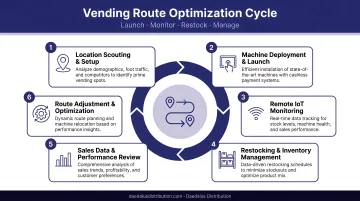
Step 6 – Launch, Monitor, and Optimize
Once machines are placed and stocked:
- Set a regular restocking and cash-collection schedule
- Cluster nearby locations to minimize drive time on restocking runs
- Track performance by machine and by location from week one
- Identify underperforming products and locations quickly — replace products before they expire, renegotiate or exit weak locations before losses compound
How to Grow and Stabilize Your Vending Route
Most operators who fail don't fail because they didn't work hard enough — they expanded too fast before their existing machines were consistently profitable.
The right sequence:
- Get your first one to three machines running profitably with stable locations
- Use that cash flow to fund the next machine — avoid financing machines against future revenue that hasn't materialized
- Build supplier relationships early to access bulk pricing as volume grows
- Identify your next best locations before the machines arrive, not after
Remote monitoring changes how route management works in practice. The Vendekin platform included with Daedalus Distribution machines lets operators restock based on actual consumption rather than fixed schedules. Key tools include:
- Real-time sales data across all machines
- Inventory alerts before stock runs out
- Route optimization to eliminate unnecessary trips
That directly cuts two costs that compound fast on a growing route: wasted trips and expired product.
Keeping that route running smoothly also depends on what happens when a machine needs attention. Daedalus ships nationwide from their warehouse in Summerville, South Carolina, with U.S.-based support and parts available immediately. For Maryland operators, that means machine issues don't require waiting on overseas logistics.
Conclusion
Starting a vending machine business in Maryland is a practical entry point for operators who want low overhead and a flexible schedule. Dense employment corridors, large university campuses, and a substantial manufacturing and logistics sector all support a scalable route from the start.
What separates operators who build stable businesses from those who stall out is how seriously they take the foundation: proper licensing through each county's Circuit Court Clerk, written location contracts before any machine gets placed, and product selection that matches the actual traffic at each site.
Maryland's licensing and permit requirements have real specificity by county, but none of it is complicated to execute. Operators who lock in compliance and location strategy early end up with routes that hold their value, attract better placement opportunities, and grow without constant firefighting.
Frequently Asked Questions
Do you need a license to have a vending machine in Maryland?
Yes. Maryland law requires a vending machine license from the Clerk of the Circuit Court in the county where each machine operates, at $2.50 per machine. The license year runs May 1 through April 30 with annual renewal. Certain items — newspapers, soap, postage stamps, and a few others — are exempt.
How much is a vendor's license in Maryland?
The $2.50 per-machine fee goes to the Circuit Court Clerk in each county where you operate. Note that this is separate from business registration fees, sales tax account setup, and any health permits your operation may require.
Do I need an LLC to start a vending machine business?
An LLC isn't legally required, but it's strongly recommended — it separates personal and business liability, simplifies banking, and is often required by lenders. A sole proprietorship is simpler to set up but leaves your personal assets at risk.
How much does it cost to start a vending machine business in Maryland?
Startup costs depend on the machines you choose. New full-size machines range from $4,600 to $8,500+. Factor in initial inventory, licensing fees, insurance, and any location commissions to get a realistic total before committing.
Do I need a health permit to operate a vending machine in Maryland?
Health permits are required for machines selling food or beverages that qualify as food service facilities, issued through the Maryland Department of Health. Micro markets are specifically regulated under Maryland law as food service facilities and require their own separate permit.
What are the best locations for vending machines in Maryland?
Locations with predictable, repeat foot traffic perform best. Strong options include office parks in the Baltimore–DC corridor, university campuses, hospitals, manufacturing and warehousing facilities along I-95, and apartment complexes. Industrial sites are strong performers — NAMA data shows manufacturing accounts for 43% of vending business nationally.