With that kind of competition, the difference between a machine that pays for itself in six months and one that collects dust comes down to one decision: where you put it.
New operators often focus on machine type, product selection, or pricing. Those matter. But location is the variable that makes or breaks profitability, and poor placement is the most common reason operators fail to break even. Get the location right first — everything else follows.
Key Takeaways
- Location is the single biggest driver of vending profitability — a great spot can earn multiples more than a poor one
- The most profitable spots share three traits: consistent foot traffic, a captive audience, and no strong nearby food alternative
- Top-performing location types include offices, hospitals, universities, manufacturing plants, gyms, hotels, and transit hubs
- Evaluate any location using four factors: count, captivity, competition, and compatibility
- Securing a location means finding the right decision-maker, presenting clear value, and locking in terms with a written agreement
What Makes a Vending Machine Location Profitable
Not all foot traffic is equal. A machine placed where thousands of people walk past daily can still underperform if nobody stops. Three factors have to align for a location to consistently generate sales.
The Three Core Pillars
1. Consistent foot traffic. The location needs a steady flow of potential customers — not just a Friday lunch rush or a single annual event, but regular daily traffic throughout the week.
2. A captive audience with meaningful dwell time. As Vending Times notes, foot traffic alone can be misleading. A commuter has seconds of mental availability; a person in a waiting room or break room has 10, 15, or 20 minutes. That dwell time is where purchasing decisions happen.
3. No strong competing food source nearby. A machine placed 30 feet from a staffed café is invisible. Remove the easy alternative, and the machine becomes the obvious choice.
All three need to be present. A captive audience with no traffic doesn't work. High traffic with easy food alternatives nearby doesn't work either.
High-Intent Zones vs. Passive Foot Traffic
The most profitable locations create what operators call "high-intent moments" — situations where a person realizes they need something and your machine is the immediate answer. A hospital waiting room at midnight or a hotel hallway at 11 PM when room service has stopped — those are moments of active demand, not passive browsing.
Contrast that with a busy sidewalk or a mall corridor. People are moving through, not stopping. The intent isn't there.
Additional Factors That Separate Good from Great
Beyond the three pillars, practical considerations affect long-term performance:
- Indoor placement protects against weather and vandalism, reduces maintenance costs, and improves visibility
- Confirmed power access before committing to a site — never assume an outlet is available
- Clear restocking access so a hand truck can move in and out without obstacles
- Well-lit, camera-covered areas to reduce shrinkage and machine damage
- 24/7 site access expands your revenue window beyond standard business hours
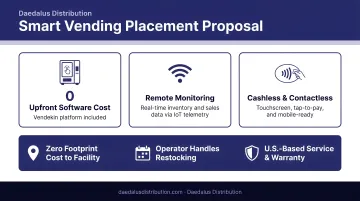
IoT-connected machines — like those Daedalus Distribution carries on the Vendekin platform — make it practical to manage multiple locations without constant site visits. Remote inventory tracking, real-time sales alerts, and machine-health monitoring give you a clear picture of every location from one dashboard.
Top Vending Machine Locations: Where Your Machine Will Earn the Most
These location types are recognized based on operator experience, captive audience quality, and industry data. Local conditions and product matching still matter — treat these as strong starting points, not guarantees.
Here's a quick reference across all seven location types before the detail:
| Location | Primary Audience | Standout Data Point |
|---|---|---|
| Offices & Corporate Centers | Employees, 9–5 captive | 20% of all U.S. vending locations (2023 NAMA) |
| Hospitals & Healthcare | Nurses, patients, families | 155.4M annual ER visits; 24/7 demand |
| Schools & Universities | Students, staff | Grew from 6.5% to 14% of locations (2019–2023) |
| Manufacturing & Industrial | Shift workers | 43% of all U.S. vending locations (2023 NAMA) |
| Gyms & Fitness Centers | Members mid-workout | 81 million U.S. fitness memberships (2025) |
| Hotels & Lodging | Guests, overnight travelers | 1.3 billion guest nights annually |
| Transit Hubs & Airports | Travelers in transit | $14.70 non-aeronautical revenue per enplanement |
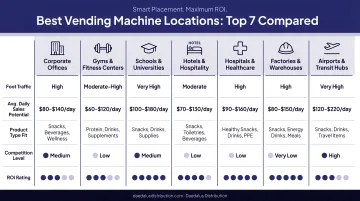
Offices and Corporate Centers
Office buildings accounted for roughly 20% of vending locations in the 2023 NAMA Census, making them one of the most common and consistently productive placement categories.
Employees are on-site for predictable hours, can't easily leave during the workday, and fall into habitual buying patterns around morning coffee, midday snacks, and afternoon energy boosts. The demand is repetitive and reliable.
Placement and product guidance:
- Target buildings with 50 or more employees — below that, machine revenue often doesn't justify the placement
- Position near break rooms, elevator banks, or main lobby corridors
- Stock coffee, beverages, quick lunch options, and premium healthy snacks
- Corporate audiences tolerate higher price points when convenience beats leaving the building
Hospitals and Healthcare Facilities
Hospitals represented 9% of vending locations in the 2023 NAMA Census, but their per-machine performance consistently punches above that share.
With 155.4 million emergency department visits recorded annually in the U.S. and nurses rotating through 24/7 shifts, hospitals deliver exactly what vending machines need: captive people, extended dwell times, and overnight hours when no cafeteria is open.
Placement and product guidance:
- Prioritize break rooms near nursing stations and public waiting areas
- Stock grab-and-go meals, healthy snacks, and beverages heavily
- Surgical waiting areas and ICU family lounges outperform quick in-and-out zones
- The Elevend Multivend 22, with its elevator dispensing system, handles fresh food and dairy items suited to healthcare environments
Schools and Universities
Colleges and universities jumped from 6.5% of vending locations in 2019 to 14% in 2023 — one of the sharpest growth trends in the NAMA data. Students are on campus all day, dining hours are limited, and late-night study sessions open revenue windows when no other food option is available.
Placement and product guidance:
- Prioritize dorms, libraries, and student union buildings
- Stock affordable snacks, energy drinks, and beverages — budget sensitivity is real
- K-12 schools are subject to USDA Smart Snacks standards governing what can be sold during school hours; universities operate under different rules
- Four-year universities outperform community colleges due to longer campus hours and residential populations
Manufacturing Plants and Industrial Facilities
Manufacturing is the single largest vending location category in the U.S., representing 43% of all vending locations in the 2023 NAMA Census.
Workers average over 41 hours per week under strict break schedules. During a 10–15 minute break, they cannot leave the facility — the machine is the only option. Multi-shift operations extend demand to near-24/7, increasing both restocking frequency and revenue potential.
Placement and product guidance:
- Position machines in break rooms or near shift change areas
- Stock calorie-dense snacks, hot beverages for early shifts, and energy drinks
- Two- and three-shift sites dramatically increase daily transaction volume
Gyms and Fitness Centers
The Health & Fitness Association's 2025 report counted roughly 81 million Americans holding fitness facility memberships. These members arrive with specific nutritional goals and a purchasing mindset, making them receptive to vending that matches their needs.
Placement and product guidance:
- Position machines near locker room exits or at the front desk area
- Stock protein bars, sports drinks, electrolyte beverages, and healthy snack options
- Upscale gyms support premium pricing; budget gyms require value-oriented selections
- The Omnivend Combo 22's large touchscreen format suits these environments well, where browsing and product discovery drive impulse purchases
Hotels and Lodging
The U.S. lodging industry includes over 64,000 properties and roughly 5.7 million guest rooms, with 1.3 billion guest nights annually. Hotel guests want convenience without effort: snacks at 11 PM, a bottle of water without calling the front desk, travel essentials when their bag is already upstairs.
Placement and product guidance:
- Place machines on guest floors near ice machines or elevators, not only in the lobby
- Stock snacks, bottled beverages, and basic travel essentials (pain relievers, phone chargers, hygiene items)
- Guest turnover means the audience constantly refreshes, with no repeat-customer drop-off
Transit Hubs and Airports
Airport concession data from the 2025 ACI-NA Concessions Benchmarking Survey reported $14.70 in non-aeronautical revenue per enplanement at surveyed airports, with food and beverage contributing the largest share. Travelers are time-pressured, captive between check-in and departure, and willing to pay for immediate access.
Placement and product guidance:
- Target areas with the highest dwell time: boarding gate areas, baggage claim, and ticketing concourses
- Stock packaged snacks, beverages, and travel essentials
- Airport placements require negotiating facility management agreements upfront — budget for revenue-sharing arrangements and longer lead times before a machine goes live
How to Evaluate a Location Before You Commit
Before signing any agreement, run every prospective location through four questions.
The 4-Factor Framework
| Factor | What to Assess |
|---|---|
| Count | Estimate daily foot traffic through direct observation — not assumptions |
| Captivity | Are people stuck on-site for an extended period, or just passing through? |
| Competition | What food options exist within a 3-minute walk? |
| Compatibility | Does your machine type and product mix actually match this audience? |
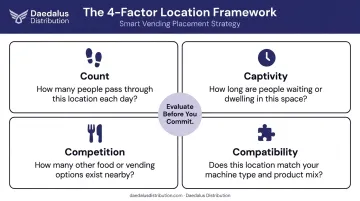
The Dwell Time Multiplier
A location with 200 people spending 45 minutes each is more valuable than one with 1,000 people rushing through in 60 seconds. The hospital waiting room versus the busy sidewalk illustrates this clearly — same city, same neighborhood even, but one creates purchasing conditions and the other doesn't.
Dwell time is what separates a busy location from a profitable one.
Visit Three Times Before Committing
Visit any prospective location at least three times across different days and time periods:
- Morning — how does traffic look at opening? Is this a slow start or immediately busy?
- Midday — peak hours reveal whether foot traffic is truly robust or just moderate
- Evening — does demand persist, or does this location go quiet after 5 PM?
Take notes on competing food options, power outlet access, delivery logistics, and security coverage. Once you have all three visits documented, score the location against your 4-factor framework before making any commitment.
How to Secure a Vending Machine Location
Finding the Right Decision-Maker
The person who can say yes varies by location type:
- Offices: Property manager or facilities director
- Hospitals/schools: Facilities or operations manager
- Manufacturing: Plant manager or HR director
- Hotels: General manager or F&B director
Approach with value first. Frame the machine as a free amenity that improves employee or tenant satisfaction — and one that can generate passive revenue for the host through a commission arrangement. That framing opens doors that a straightforward "can I place a machine here?" rarely does.
Key Contract Terms to Negotiate
Every placement should be covered by a signed written agreement. Key terms to address:
- Compensation structure: flat monthly fee versus a commission on gross sales (a public vending contract at Missouri State University, for example, used a 22% commission on gross sales as its basis)
- Contract duration: include a trial period option (3–6 months reduces the host's perceived risk considerably)
- Placement rights: specific location within the facility, not just "somewhere on the premises"
- Restocking access: confirmed times and entry procedures
- Maintenance responsibility: clearly defined before any dispute arises
Always formalize in writing. Verbal agreements don't hold up when disputes arise over commission payments or access rights.
Legal and Permitting Basics
Requirements vary by state and municipality, but expect to need:
- A business license in your operating jurisdiction
- A seller's permit for sales tax collection
- A vending machine permit in some cities and counties
- Health department compliance if selling perishable or refrigerated items — the FDA Food Code sets specific temperature standards, and some states (such as Florida) require pre-operation inspection and licensing for machines dispensing potentially hazardous food
Verify requirements with your local city or county clerk before installation. A quick call or website check before placement beats sorting out compliance violations after the fact.
Conclusion
Location strategy isn't a one-time decision. Strong operators review sales data regularly, rotate product selections based on what actually moves, and are willing to pull underperforming machines rather than accepting mediocre results indefinitely. The best locations compound over time as you learn what that audience wants.
Once you've identified the right locations, the machines you put in them determine how much of that opportunity you capture. Daedalus Distribution is the authorized U.S. reseller of Vendekin's all-digital touchscreen vending machines — the Omnivend Combo 10, Omnivend Combo 22, and Elevend Multivend 22 — built with remote inventory tracking, cashless payment, and the cloud-based Vendekin platform included at no separate license fee.
Whether you're placing your first machine in a corporate break room or scaling a multi-site route, reach out at contact@daedalusdistribution.com or call +1 843-490-2804.
Frequently Asked Questions
Where are vending machines most profitable?
The most profitable locations combine consistent foot traffic with a captive audience and limited nearby food alternatives. Offices, hospitals, manufacturing plants, and universities consistently top operator performance lists. Profitability also depends on machine type and whether the product selection matches what that specific audience wants.
Can you legally put a vending machine anywhere?
No. Placement always requires written permission from the property owner. Public property typically requires a municipal permit on top of that. If you're selling perishable food, health department requirements likely apply — and these vary widely by state and city.
How much does it cost to place a vending machine at a location?
Compensation structures vary: flat monthly rent, a percentage of gross sales, or a combination of both. Some locations — particularly offices offering employees a perk — accept free placement. Terms are negotiated individually and differ by location type; one documented university contract used 22% of gross sales, but operator leverage matters.
What products sell best in vending machines, and does it depend on location?
Product-location fit drives sales: protein bars and sports drinks move in gyms, grab-and-go meals and healthy snacks perform in hospitals, and affordable snacks with energy drinks lead in universities. Before stocking, ask the location host what their people want — they know their audience better than any general guide can.
How do I approach a business owner about placing a vending machine?
Lead with the benefit to them: a free employee amenity, improved tenant satisfaction, or a potential revenue share. Come prepared with a short proposal, offer a 90-day trial period to reduce hesitation, and show up looking like someone they'd want representing their space.
How do I know if a location is actually performing well after placement?
Review sales data after 30–60 days. Look at revenue per day, top-selling items, and slow-moving stock. Machines with remote monitoring — like those running the Vendekin platform — surface this data automatically through real-time inventory and sales reporting, so you're not guessing based on what's left in the machine when you show up.