Introduction
Picture this: someone walks past a vending machine, craving a snack after a long meeting. They tap their pockets — no cash, no coins. The machine is cash-only. They walk away.
That scenario plays out thousands of times daily across the U.S., and the operator never knows it happened. No error message, no record, no alert. Just a lost sale that compounds, invisibly, over weeks and months.
According to NAMA's 2022–2023 Industry Census, roughly 75% of vending machines accepted cashless payments in 2023 — which means a quarter of machines are still turning away a growing population of card-first consumers. Meanwhile, Pew Research found that 41% of Americans made no purchases with cash in a typical week in 2022, up from just 24% in 2015.
Cashless capability isn't a nice-to-have feature anymore. It's a direct revenue lever — one that affects how much customers spend, how often purchases actually complete, and how intelligently operators can run their machines.
Key Takeaways
- Cashless vending transactions average $2.24 vs. $1.78 for cash — a 37% higher ticket, per Cantaloupe's 2025 data
- 41% of U.S. consumers carry no cash on a typical week, meaning cash-only machines miss them entirely
- Upgrading to cashless also lifts cash sales: an MSU study found cash transactions rise 13% on machines after cashless is added
- Vendekin machines from Daedalus Distribution ship with cashless payments and sales reporting built in — no retrofitting or extra software fees required
What Are Cashless Payments for Vending Machines?
Cashless payments cover any transaction that doesn't require physical bills or coins. In a vending context, that means:
- Credit and debit cards — tap, swipe, or chip insert
- Mobile wallets — Apple Pay, Google Pay
- NFC contactless — any tap-enabled card or device
Adding cashless doesn't mean replacing your machine. Operators with older equipment typically retrofit a card reader. Newer machines have cashless hardware built in from the factory — nothing to add or configure later. Daedalus Distribution's Vendekin lineup is built this way from the start.
The Omnivend Combo 10, Omnivend Combo 22, and Elevend Multivend 22 all accept credit cards, debit cards, Apple Pay, Google Pay, and tap-to-pay as standard. That means no bill validators, no coin mechanisms, and no cash management overhead.
Key Advantages of Cashless Payments on Vending Machine Sales
The advantages below map to metrics operators actually track — average transaction value, purchase volume, stockout frequency. These aren't theoretical benefits.
Advantage 1: Customers Spend More Per Transaction
The "cashless effect" is well-documented: when payment doesn't require counting change or feeding dollar bills, the psychological friction of spending drops. Customers stop asking "do I have enough?" and start just buying.
At a vending machine, this plays out in a specific way. A customer using tap-to-pay doesn't hesitate before choosing a $3.50 energy drink over a $1.75 water. The higher-priced item doesn't feel more expensive — it just feels like a tap.
Cantaloupe's 2025 Micropayment Trends Report, drawn from over 625,000 active card readers, put real numbers on this:
| Payment Type | Average Transaction Value |
|---|---|
| Cashless | $2.24 |
| Cash | $1.78 |
| Combined average | $2.11 |
That $0.46 gap per transaction sounds modest. Run the math on a machine processing 20 transactions per day: that's roughly $3,358 in additional annual revenue per machine compared to cash-only. Across a five-machine operation, that's over $16,000 per year — purely from the payment method.
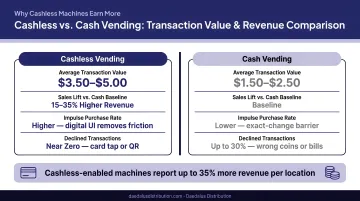
This gap is widest at locations stocking premium products — beverages above $3, specialty snacks, fresh food — and in demographics that default to card or mobile: offices, gyms, campuses, airports.
Advantage 2: More Purchases Actually Complete — Fewer Lost Customers
Cash-only machines don't just earn less per transaction. They miss transactions entirely.
When a customer has no cash — or no exact change — the sale disappears before it starts. The operator never knows it was lost. No data, no signal, no recovery. And because vending purchases are almost entirely impulse-driven, the longer that friction lasts, the faster the impulse fades.
A 2022 Visa Back to Business Global Study found 41% of consumers had abandoned a purchase at a physical location because digital payments weren't accepted. That's cross-category data, but the behavior is the same at vending machines.
The MSU/USA Technologies study adds a sharper vending-specific data point: after adding cashless capability, total transaction volume grew 26%. Here's what made that up:
- 74% increase in credit card transactions (new buyers who previously couldn't purchase)
- 13% increase in cash transactions (existing cash users buying more often)
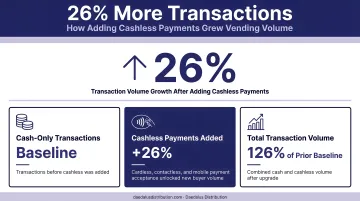
That second number is the part operators don't expect. Cashless capability doesn't just add a new payment lane — it appears to make the machine more visible and appealing overall, lifting cash sales alongside card sales.
High-foot-traffic locations serving consumers under 35 — transit hubs, universities, corporate campuses — see the strongest lift here, where card or mobile payment is simply assumed.
Advantage 3: Real-Time Sales Data Turns Guesswork Into Strategy
Cash transactions leave no trace. A cash-only machine is operationally blind between service visits — operators don't know what sold, when demand peaked, or whether a product sat untouched for three weeks.
Cashless transactions generate a data record for each sale: product, quantity, time of day. That data enables decisions that aren't possible without it.
What operators gain from cashless data:
- Which products are selling fastest — and which are dead weight
- When peak demand occurs by location and day of week
- Which machines are underperforming before a service trip confirms it
- When restocking is actually needed vs. when a trip is wasted
This connects to two concrete revenue levers: reducing stockouts of top sellers (which directly prevents lost sales) and replacing slow-moving products with proven performers. Both are impossible to execute accurately without transaction data.
Machines from Daedalus Distribution include the Vendekin platform — remote inventory tracking, real-time sales data, route optimization, and machine-health monitoring — built into every purchase. No separate software license, no third-party integration. Operators managing five machines across different locations get the same visibility as those managing one.
For multi-location operators and remote or unmanned sites, this is where margin is won or lost — a wasted service trip is a cost that data visibility eliminates.
What Happens When Vending Machines Skip Cashless
Skipping cashless doesn't mean staying neutral. It means absorbing a compounding cost.
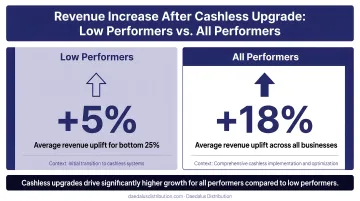
The MSU/USA Technologies study analyzed 250,000 machines, including 95,000 classified as low performers (under $2,000 in annual sales). After adding cashless capability, those low-performing machines increased top-line revenue by 110% over 18 months. Across the full machine population studied, sales increased 35%. These aren't projections — they're measured outcomes from machines that made the switch.
Many high-value placement opportunities now come with cashless as a baseline expectation. The University of Arkansas at Fort Smith's 2024 RFP explicitly required vending machines to simultaneously support coin mechanisms, bill validators, and credit/debit card readers. Cash-only machines don't qualify. That exclusion extends to universities, corporate campuses, hospitals, and fitness centers — the locations that consistently drive the strongest revenue per machine.
Without transaction data, restocking runs on fixed schedules rather than demand signals. That creates two problems that don't show up as line items but erode margins steadily:
- Unnecessary service trips to machines that don't need restocking
- Undetected stockouts on top sellers that go unnoticed between visits
How to Get the Most Value from Cashless Vending
Payment technology and placement strategy work together — one without the other limits what's possible.
A card reader on a machine in a low-traffic hallway won't move the needle much. The same machine in a corporate break room serving 200 employees, or a university gym, will. Location quality multiplies the value of cashless — so operators should evaluate both together before committing to a placement.
Behaviors that separate thriving operators from stagnant ones:
- Review transaction patterns regularly, not just when something seems wrong
- Adjust product mix based on actual sales data — not gut feel or supplier recommendations
- Identify underperforming machines early (the data will show it) and investigate placement or product issues before they compound
- Use route optimization features to schedule service trips based on demand, not calendar dates
Getting those fundamentals right from the start saves money and headaches later. For operators starting or scaling a vending business, buying machines with cashless capability built in eliminates retrofitting costs — payment processing, data reporting, and touchscreen functionality all work together out of the box. Daedalus Distribution's Vendekin machines are built this way: the Omnivend Combo 10, Omnivend Combo 22, and Elevend Multivend 22 are cashless-ready from day one, with the Vendekin management platform included at no separate license fee.
Conclusion
The revenue case for cashless vending is no longer speculative. Higher average transaction values, more completed purchases, and data-driven operations are documented outcomes — not theoretical benefits. They also compound: operators who use cashless transaction data to continuously refine product mix and placement strategy widen their advantage over time.
As cash use continues declining — the Federal Reserve's 2025 Diary of Consumer Payment Choice reports cash accounted for just 14% of consumer payments in 2024 — the performance gap between cashless and cash-only machines will only widen. Operators still running cash-only equipment aren't just leaving money on the table today — they're falling further behind with every year the trend continues. Adding cashless acceptance is the clearest near-term lever most vending operations have.
Frequently Asked Questions
How to increase vending machine sales?
The most reliable levers are adding cashless payment options, placing machines in high-traffic locations matched to the right product mix, and using sales data to swap out slow movers for proven performers. Each factor reinforces the others — cashless unlocks more buyers, better locations raise volume, and data keeps your product mix sharp.
Why are vending machines cashless?
Operators have adopted cashless because fewer consumers carry cash today, cashless transactions consistently produce higher average spend, and modern machines generate transaction data that helps operators stock smarter and serve more buyers per day.
How many vending machines to make $100k a year?
It depends on location quality and cashless capability. Most operators estimate $1,500–$2,500/month per well-placed cashless machine, putting $100k/year within reach for a focused route of 4–6 strong locations. A cash-only machine in a low-traffic spot can take two or three times as many units to match that output.
Do cashless vending machines actually make more money than cash-only ones?
Yes. Cantaloupe's 2025 data shows cashless transactions average $2.24 vs. $1.78 for cash, and the MSU/USA Technologies study found total transaction volume grew 26% after adding cashless — with both card and cash sales rising.
What types of cashless payments can vending machines accept?
Modern machines accept credit and debit cards (tap, chip, and swipe), mobile wallets like Apple Pay and Google Pay, and NFC contactless payments. Vendekin machines from Daedalus Distribution support all of these as standard, with no additional hardware required.
Is it worth the cost to upgrade a vending machine to accept cashless payments?
For most operators, yes. The MSU study found a 35% revenue increase across all machines studied, and 96% of operators surveyed by Automatic Merchandiser identified cashless as a high-ROI investment. Retrofit card readers run roughly $300–$400 per unit; machines with cashless built in skip that cost entirely.