The gap between those two outcomes is the story nobody tells in the highlight reel.
Vending machines are genuinely accessible. You don't need employees, a storefront, or a specialized background to start. But the dream of truly passive income requires building something first — routes, systems, and smart equipment that do the heavy lifting once you're no longer doing it yourself.
This article covers why vending has become a go-to passive income play, what "semi-passive" actually looks like in practice, and what separates operators who scale from those who stall at one machine.
Key Takeaways
- The U.S. vending industry operates roughly 3 million machines generating $18.2 billion in annual revenue, per NAMA — this is a proven market, not speculation
- Expect 5–15 hours/week managing a small 2–5 machine operation early on — vending income becomes more passive once routes and systems are in place
- Location quality is the single biggest profitability driver — the same machine can earn $50/week in a slow spot or $500+/week in a high-traffic captive environment
- Cashless payments and remote inventory tracking cut unnecessary site visits, making modern digital machines far easier to manage at scale
Why Americans Are Chasing Passive Income Through Vending Machines
The timing of vending's popularity isn't accidental. According to Bankrate's 2025 survey, 27% of U.S. adults currently have a side hustle, and the Federal Reserve found that 31% of gig workers would struggle to make ends meet without supplemental income. When people are actively looking for ways to earn outside their primary job, vending machines check a lot of boxes.
The Appeal Is Real
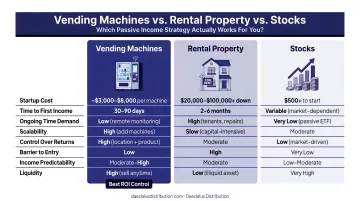
Compare vending to other passive income options and the entry math becomes clear:
- A rental property requires $20,000–$50,000+ in down payment, tenants, and ongoing management
- Stock dividends require substantial capital to generate meaningful monthly returns
- A single used vending machine can be placed and generating revenue for under $3,000 all-in
No employees. No storefront lease. No specialized background required. The machine operates 24/7 — earning while you're at your day job, asleep, or on vacation. Scaling means adding machines, not adding hours.
The Market Is Established
NAMA's 2023 census puts U.S. vending at 2.89 million machines generating $18.2 billion in annual revenue. That's not a trend-chasing investment — it's a mature, well-established industry that has operated steadily for decades.
Social media simply made the business model visible to a new generation of entrepreneurs. Operators like Jaime Ibanez — who built nearly half a million YouTube subscribers documenting his vending journey — showed that this wasn't reserved for large commercial operators. Anyone with one machine and a decent location could participate.
That said, vending took a serious hit in 2020, with trade reports showing sales fell roughly 45% as offices emptied during the pandemic. "Recession-proof" oversells it. Location-dependent is the more accurate framing — which leads directly to the most important variable in this business.
The Reality Check: How "Passive" Is a Vending Machine Business, Really?
The operators who build successful vending businesses tend to say the same thing: it's not passive until you make it passive. That process takes months, not weeks.
What You're Actually Doing Early On
A small 2–5 machine operation realistically requires 5–15 hours per week in the early stages. That time goes toward:
- Location acquisition — cold outreach, in-person pitches, follow-ups, and negotiations with property owners
- Restocking runs — driving to locations, refilling machines, collecting cash if applicable
- Routine maintenance — cleaning, troubleshooting jams, addressing customer complaints
- Sales tracking — reviewing what's selling, adjusting product mix, monitoring performance
Finding profitable locations is harder than operating machines once they're placed. Walking into businesses unannounced, following up multiple times, and absorbing rejection is the unglamorous core of building a vending route. Every experienced operator will tell you it takes many attempts before a quality location says yes.
How It Becomes Passive Over Time
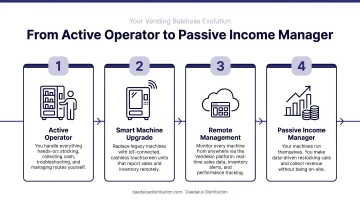
The shift happens gradually as you build infrastructure:
- Routes stabilize and restocking schedules become predictable
- Remote inventory tracking eliminates unnecessary site visits
- As volume grows, part-time stockers handle route runs
- You shift from operator to manager, reviewing data rather than driving to locations
Established operators interviewed in media profiles report 4–6 hours per week once their businesses are fully set up. That's the realistic ceiling of "passive" — reduced, predictable, and manageable alongside other work.
Setting Realistic Expectations
Early machines may net $100–$200/month after costs. One bad location can offset the profit from a good one. Most operators don't see meaningful returns until month three or four, once routes are stable and locations are proven. The business rewards patience and process, not speed.
What Actually Determines Vending Machine Profitability
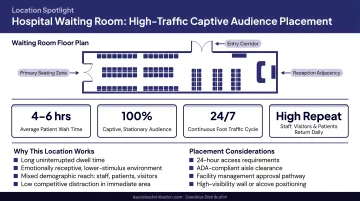
Location isn't just the most important factor — it dwarfs everything else. The same machine, stocked identically, can earn $50/week in a low-traffic office suite or $500+/week in a hospital waiting room. No product selection, pricing strategy, or machine brand closes that gap.
Revenue Ranges by Location Quality
According to 365 Retail Markets, a vendor resource guide:
| Location Type | Gross Weekly Revenue |
|---|---|
| Slow (low traffic, alternatives nearby) | ~$50/week |
| Decent (moderate traffic, some captivity) | $100–$300/week |
| Strong (high traffic, captive, 24/7 access) | $500+/week |
What Makes a Location "Strong"
The best vending locations share a few consistent traits:
- Consistent daily foot traffic with people on-site throughout the day
- Captive audience — limited or no nearby food alternatives
- Extended hours — shift workers, 24/7 facilities, or after-hours access
- Demographics that match the product — health-focused items in gyms and medical offices; hearty snacks in warehouses
Concrete examples of high-performing placements: hospital waiting areas, distribution warehouses with multiple shifts, large apartment complexes, military installations, and urgent care centers.
The Profit Formula
Using $1,000 gross monthly revenue as a baseline:
- Cost of goods: ~$500 (50% of revenue, per 365 Retail Markets industry benchmarks)
- Location commission: $50–$200 (5–20% of gross sales, per WSJ)
- Card processing fees: ~$30–$40 (roughly 3–4%)
- Fuel, supplies, incidentals: variable
What remains is your operating margin — and it varies widely based on location terms and machine efficiency. High-volume locations with favorable commission rates outperform lower-traffic spots even when gross revenue looks similar on paper.
Beyond location and cost structure, product mix shapes profitability in ways that don't show up until restock day. Matching inventory to the people actually using the machine — not personal preference — drives sell-through rates. Premium beverages and protein bars move in corporate offices; classic snacks outperform in blue-collar warehouses where the same selection would sit.
How Modern Vending Technology Reduces the Hands-On Burden
The biggest operational shift in vending over the last decade isn't the machines themselves — it's what happens between visits. Remote monitoring has changed the economics of running a route.
Cashless Payments Matter More Than You Think
Cantaloupe's 2023 Micropayment Trends Report found that the average cashless vending transaction was $2.11 vs. $1.36 for cash in 2022 — a meaningful difference per transaction across thousands of sales annually. By 2024, cashless accounted for 77% of vending transactions across Cantaloupe's network.
Accepting credit cards, debit cards, Apple Pay, Google Pay, and tap-to-pay isn't a premium feature anymore — it's a baseline expectation for any machine placed in a modern environment.
Remote Tracking Eliminates Guesswork
Traditional operators drove routes on a fixed schedule regardless of what machines actually needed. With telemetry and remote inventory monitoring, operators can see stock levels, sales by product, and machine health from any device — and only dispatch when restocking is genuinely needed. Cantaloupe has reported up to 40% route reduction in operator case studies using inventory monitoring and route optimization tools.
How Daedalus Distribution Fits In
This is the operational model that Daedalus Distribution — the authorized U.S. master reseller for Vendekin Technologies — builds its machines around. Every machine ships with the Vendekin platform included at no separate license fee, covering:
- Remote inventory tracking and real-time sales data
- Inventory alerts so you only restock when needed
- Machine health monitoring from any device
Their three current models each include cashless payment capability, IoT connectivity, and full platform integration out of the box:
- Omnivend Combo 10 — 10-inch touchscreen, compact footprint
- Omnivend Combo 22 — 22-inch touchscreen for higher-traffic locations
- Elevend Multivend 22 — 22-inch touchscreen with an elevator delivery system for fragile or breakable items
A U.S.-based parts and service center in Summerville, South Carolina backs every machine with warranty coverage and technical support Monday through Friday.
For operators building toward a lower-touch route, having monitoring and sales tools built in from day one means fewer wasted drives and faster decisions — without bolting on third-party software later.
How to Start a Vending Machine Business for Passive Income
The order of operations matters here. Most beginners get it backwards.
The Right Sequence
- Identify target locations first — research foot traffic opportunities in your area before spending a dollar on equipment. Talk to property managers, scout industrial parks, hospitals, and apartment complexes.
- Secure a signed placement agreement — get the location committed before ordering any machine. A handshake doesn't count.
- Choose the right machine — match the machine type to traffic volume, product category, and your budget. A new digital machine with remote monitoring makes sense for a high-traffic location; a smaller-format new machine can be a cost-effective way to test a lower-volume spot.
- Stock with proven bestsellers — use the first 30–60 days of sales data to adjust the product mix, not your intuition on day one.
Realistic Startup Costs
| Equipment Option | Estimated Cost |
|---|---|
| Entry-level new combo machine | $3,000–$6,000 |
| New digital/specialized machine | $10,000–$15,000+ |
| Initial inventory (per unit) | ~$200 |
| Tools and supplies | $300–$700 |
New digital machines carry higher upfront costs but come with warranties, cashless payment built in, and remote monitoring — all of which reduce operating costs and increase revenue potential. Daedalus Distribution carries new digital machines in this category; you can reach their team directly to discuss specs and pricing for your setup.
Common Beginner Mistakes to Avoid
- Buying before securing a location — the most expensive mistake new operators make
- Underestimating location acquisition time — expect weeks of outreach before landing a quality placement
- Stocking based on personal preference — demographic data beats personal taste every time
- Skipping equipment inspection — used machines without verified condition can generate repair costs that erase early profits immediately
Frequently Asked Questions
Are vending machines a good way to make passive income?
Vending machines can generate income with minimal daily involvement once systems are established, but they require active work upfront — particularly in securing locations and building a restocking routine. The "passive" component grows as routes stabilize and remote monitoring tools reduce the need for in-person visits.
How many vending machines do you need to make $1,000 a month?
It depends almost entirely on location quality. A single well-placed machine in a hospital or warehouse can generate $1,000/month in gross revenue. Poorly located machines may require three to five to reach that figure. Net profit after COGS, location commissions, and fees will be a fraction of gross revenue.
How much does it cost to start a vending machine business?
An entry-level new snack machine runs $3,000–$6,000. Digital machines with touchscreen, cashless payment, and remote monitoring typically run $10,000–$15,000+. Ongoing costs include inventory restocking, location commissions (5–20% of gross), and card processing fees.
What is the best location for a vending machine?
Captive-audience environments with consistent daily foot traffic and limited nearby food alternatives perform best. Hospitals, distribution warehouses with shift workers, large apartment complexes, military bases, and urgent care waiting areas consistently rank among the highest-performing placement types.
How much time does managing a vending machine business take per week?
A small 2–5 machine operation typically requires 5–15 hours per week for restocking, location visits, and administration in the early stages. That drops significantly once remote tracking tools are adopted and part-time help handles route visits. Experienced operators report as few as 4–6 hours per week at full scale.
Can you start a vending machine business with no experience?
No specialized background is required. Success depends on willingness to learn location acquisition, basic machine maintenance, and inventory management — all learnable skills. Starting with one machine in a confirmed location is the recommended approach for beginners before committing capital to additional units.