Here's the honest version: most passive income sources require real upfront effort, capital, or both. But once operational, the ongoing time commitment drops dramatically, making them genuinely worthwhile for business owners who want to diversify beyond their core revenue.
This article covers 16 specific passive income sources organized across four categories — physical assets, property and space rental, digital and content, and eCommerce — plus a practical framework for choosing where to start.
Key Takeaways
- Passive income requires upfront work, but rewards you with revenue that doesn't scale with your hours.
- Physical assets like vending machines and ATMs generate recurring, location-driven income with minimal staffing.
- Digital streams like affiliate marketing and online courses carry near-zero marginal cost once built.
- Real estate and space rentals (Airbnb, storage units) convert underused assets into steady monthly cash flow.
- Start with one stream, stabilize it, then reinvest profits into a second.
Physical and Location-Based Passive Income Streams
Vending Machines
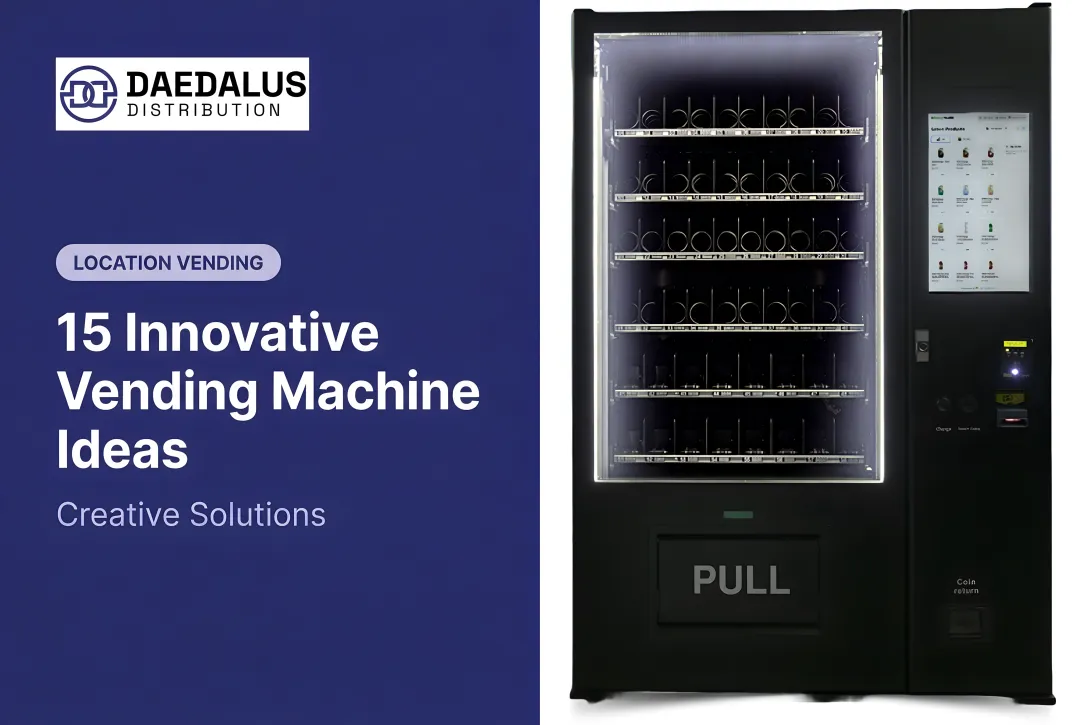
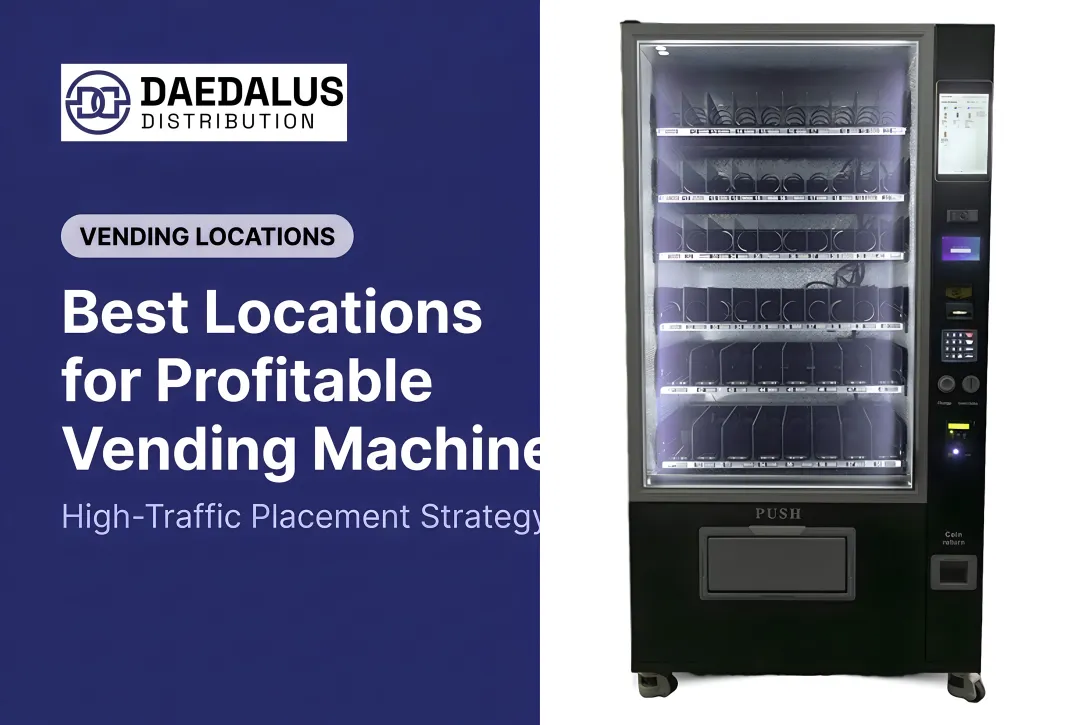
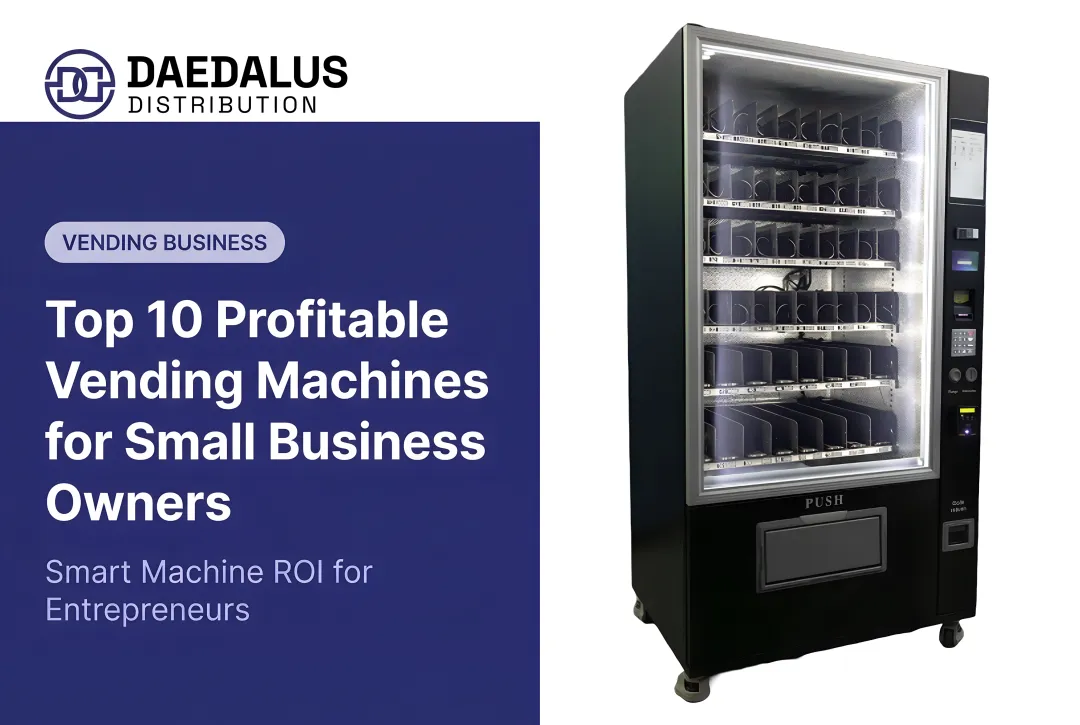
Vending machines are one of the most accessible physical passive income sources for small business owners. Low barrier to entry, no employees required at each location, 24/7 revenue, and a straightforward scale-by-machine growth path.
What drives profitability:
- Location quality — foot traffic, captive audience, and proximity to competing food options matter more than almost anything else
- Product mix — matching inventory to the audience (protein bars in gyms, beverages near transit) directly affects sales velocity
- Machine type (modern smart machines outperform older mechanical units by a wide margin)
According to NAMA's Convenience Services Census, the U.S. vending industry generated $18.2 billion in revenue in 2023 across nearly 2.9 million machines , with roughly 75% now accepting cashless payments.
On the cost side, used machines typically run $1,200–$3,000 and new machines $3,000–$10,000, per NerdWallet's vending business guide. That same source notes average gross revenue of around $300/month per machine ; location commissions (typically 5–25% of sales) and inventory costs come out of that figure.
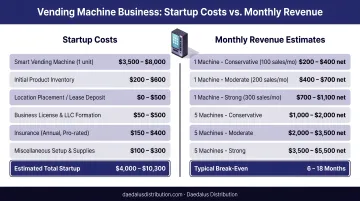
How passive the income actually feels depends heavily on your technology. All-digital smart machines, such as the Omnivend Combo 22 and Elevend Multivend 22 distributed through Daedalus Distribution, include touchscreen interfaces, cashless payment (credit, debit, Apple Pay, Google Pay, tap-to-pay), and the Vendekin cloud platform for remote inventory tracking and real-time sales reporting — no separate software license fee. That visibility reduces unnecessary site visits and improves restocking decisions.
Laundromats
People always need clean clothes — demand is consistent regardless of economic conditions. The U.S. coin laundry industry includes roughly 29,500 locations generating nearly $5 billion in annual gross revenue, with annual cash flow ranging from $15,000 to $300,000 depending on facility size.
The catch is capital. Startup costs range from $50,000 to over $3 million, with new construction starting around $250,000. Digital payment systems and remote monitoring software have made modern laundromats more hands-off than older setups, but this remains an operationally involved asset compared to a vending machine.
ATMs
ATMs run on a surcharge-per-transaction model : the national average surcharge hit $3.22 in 2025, per Bankrate's checking account survey. A well-placed independent ATM processes 150–300 transactions per month, generating estimated net profit of $250–$450/month, with high-traffic placements exceeding $800/month.
Placement in bars, hotels, or convenience stores drives volume. Maintenance is largely handled by providers, making ownership close to fully passive once the machine is placed. New ATMs cost $3,000–$7,000; refurbished units run $1,500–$3,500.
Car Washes and Parking Lots
Car washes require significant capital : in-bay automatic systems typically run $500,000–$1.2 million. Automated systems minimize labor needs, and profit margins range from 25–50% depending on format. Location near high-traffic corridors is non-negotiable.
Parking lots with automated pay kiosks eliminate attendant costs entirely. Proximity to urban centers or event venues drives occupancy. After setup, recurring costs are minimal , and net margins can reach 50–70% at well-utilized locations.
Property and Space Rental Income
Rental Properties
Long-term residential or commercial tenants create predictable monthly income. Hiring a property manager converts this from active income into something largely passive — at a cost of roughly 8–12% of monthly rent. The tradeoffs are real: upfront capital requirement, maintenance obligations, and market exposure. For business owners with capital to deploy, few income streams match rental properties for long-term consistency and asset appreciation.
Short-Term Rentals and Asset Rentals
Homeowners can monetize underused assets beyond just spare bedrooms:
- Short-term rentals (Airbnb, VRBO): Airbnb reported the typical U.S. host earned over $13,800 in 2021. Review-driven platforms handle most of the marketing, but short-term rentals require more active maintenance than long-term leases.
- Car sharing (Getaround): Platform states hosts can earn up to $1,000+/month
- Pool rental (Swimply): Most hosts reportedly earn around $1,000/month at $25–$100/hour
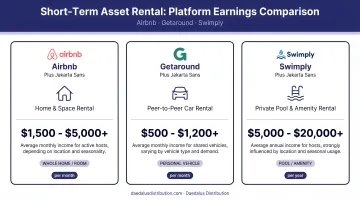
These platforms handle discovery, booking, and payments. Asset condition drives review scores — and review scores drive revenue.
Self-Storage and Billboard Advertising
Self-storage benefits from near-zero product liability and consistent demand. SSA's 2025 Demand Study reported 12.6% U.S. household penetration in 2024 — over 16.6 million renter households. With national average asking rates around $16.22 per square foot (Yardi Matrix, May 2026), facilities in high-density markets with limited nearby supply can achieve strong occupancy and stable per-unit revenue.
Billboard advertising generates passive income tied to location and advertiser demand. U.S. out-of-home advertising revenue surpassed $9.1 billion in 2024. Landowner lease income varies widely by market, but the model is low-maintenance once a lease is in place.
Digital and Content-Based Income Streams
Affiliate Marketing
The model: earn a commission every time someone purchases through your unique referral link. It requires an existing audience — a blog, email list, or social following — but the income compounds quietly as older content keeps pulling organic traffic without additional work.
Commission ranges vary significantly by category and program:
- Amazon Associates: 5% for categories like physical music and handmade goods
- SaaS programs like HubSpot: 30% monthly recurring commission for up to one year
The passive nature compounds over time. A well-ranked blog post from two years ago can still generate commissions today without any ongoing work.
eBooks, Digital Products, and Stock Content
Create once, earn repeatedly. Key platforms and rates:
- Amazon KDP: eBook royalties of 35% or 70% depending on pricing and distribution options
- Adobe Stock: 33% royalty on non-video assets, 35% on video
- Etsy, Gumroad: Strong discovery for digital downloads and templates
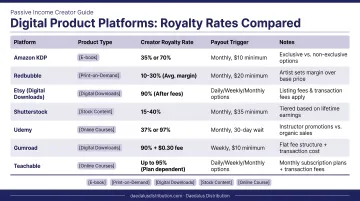
Evergreen products optimized for platform search generate ongoing income long after creation. The Authors Guild's 2023 survey found experienced self-published authors (active since 2018) reported $24,000 median annual book income — a realistic benchmark for prolific, consistent creators.
Online Courses and Membership Sites
Platforms like Teachable and Kajabi handle hosting, payments, and delivery, so no custom website is required. Subscription-based membership sites add predictable recurring revenue on top of one-time course sales.
Income potential varies widely — most creators earn modestly, while top performers pull far ahead. Kajabi's State of Creators '24 Report found 40% of top earners reached six figures in under two years, though platform-wide averages are much lower. Realistic ongoing maintenance includes periodic content updates to retain subscribers.
YouTube Channels and Stock Video
YouTube ad revenue builds gradually as evergreen videos keep attracting views long after upload. NerdWallet estimates conservative earnings at $1–$5 per 1,000 views, with finance, tech, and education niches commanding higher rates.
To access ad revenue, channels must meet the YouTube Partner Program threshold: 1,000 subscribers and either 4,000 valid public watch hours in 12 months or 10 million Shorts views in 90 days. The upfront investment is time and equipment rather than capital.
eCommerce and Business Model Income
Dropshipping and Amazon FBA
Both models reduce or eliminate inventory management:
- Dropshipping: You sell the product; the supplier ships directly to the customer. No warehouse, no upfront inventory. Grand View Research valued the global dropshipping market at $365.7 billion in 2024.
- Amazon FBA: Amazon stores, packs, and ships your products. You manage sourcing and marketing; Amazon handles logistics.
Both require ongoing product research and some marketing effort. Neither runs itself completely, but both can operate with minimal daily involvement once your product listings and supplier relationships are dialed in.
Print-on-Demand
Platforms like Printful and Printify let you sell custom-designed merchandise — shirts, mugs, posters — without touching production or fulfillment. Startup cost is essentially time and creative effort.
Printful cites a good print-on-demand profit margin at 20–40%. The market itself is growing fast: Grand View Research valued it at $10.78 billion in 2025 and projects $57.49 billion by 2033. For small business owners who already have a brand or creative assets, it's one of the more accessible income streams to launch.
App Development
Shifting from physical products to digital software, app development represents a different kind of upfront investment — but the revenue model is similarly passive once built. A well-designed app monetized through subscriptions, in-app purchases, or advertising can generate income with limited day-to-day involvement. Global in-app purchase revenue reached $150 billion in 2024.
The numbers are sobering, though: RevenueCat's 2024 data found only about 17% of subscription apps reach $1,000/month in revenue, with median monthly revenue just under $50 at one year post-launch. Development cost — whether your own time or a hired developer — is significant, and periodic updates are necessary to retain users.
How to Choose and Stack Passive Income Streams
Match the Stream to Your Current Resources
Evaluate each option against three criteria before committing:
| Resource You Have | Best-Fit Options |
|---|---|
| Available capital ($5,000–$50,000+) | Vending machines, ATMs, parking lots, rental property |
| Existing audience or platform | Affiliate marketing, courses, YouTube |
| Creative skills or content | eBooks, print-on-demand, stock photography |
| Physical space or property | Storage units, short-term rental, parking |
Physical income sources suit business owners with capital ready to deploy. Digital streams suit those who already have an audience or specialized knowledge.
Automate Early, Outsource Where Possible
The difference between "technically passive" and "genuinely passive" is systems. Each income type has a go-to automation layer:
- Vending machines: IoT-connected platforms like Vendekin handle inventory alerts, sales reporting, and machine health remotely — cutting down site visits significantly
- Rental income: A property manager absorbs tenant issues and maintenance calls
- Digital products: Email sequences handle the entire sales process once set up
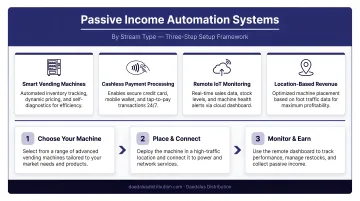
Set these systems up during launch, not after problems appear.
Reinvest and Diversify Once Stable
The "one stream first" principle: validate that a single source works for your specific situation before adding a second. Use profits from the first to fund the next. Diversification reduces income volatility, but spreading thin across five unproven streams is a recipe for all of them underperforming.
Frequently Asked Questions
What businesses are similar to vending machines?
Laundromats, ATMs, car washes, parking lots, and bulk gumball or candy machines all share the same core model — place an asset, collect recurring revenue — through high-traffic placement, low daily involvement, and consistent underlying demand.
How do I make $2,000 a month in passive income?
Reaching $2,000/month requires scaling one proven model or combining two streams. Four to six well-placed vending machines, a rental property, or digital products with steady organic traffic can all hit that target — timelines depend on your upfront investment and location or niche quality.
Are vending machines a good passive income source for small business owners?
Yes — they're among the most reliable physical options, with low staffing requirements, scalable investment, and 24/7 revenue generation. Modern smart machines with remote monitoring and cashless payment make the model genuinely more hands-off than older coin-operated equipment.
How much money do I need to start a passive income stream?
Entry costs vary widely: digital streams like affiliate marketing or print-on-demand can start under $100, vending machines run $3,000–$10,000 new, and real estate requires the most capital by far. The right starting point depends on what you currently have available, not what sounds most appealing.
What is the most truly hands-off passive income stream?
Digital products (eBooks, stock photography, courses) and vending machines or ATMs with remote monitoring come closest to truly hands-off once established. Every stream still requires active setup and periodic oversight — neglected income streams reliably shrink.
Do I need to report passive income on my taxes?
Yes — passive income is taxable. Rental income goes on Schedule E; sole-proprietor vending income goes on Schedule C. Vending machines may qualify for depreciation under IRS Publication 946. A tax professional can help you categorize income correctly and capture available deductions.