Introduction
Vending operators managing multiple machines across different locations face a constant operational challenge: without real-time visibility into inventory and machine status, they're forced to make costly decisions in the dark. Research shows that 62% of vending machines have at least one out-of-stock item, averaging 4.4 empty slots per machine. Each stockout represents lost revenue, while unnecessary service trips to machines that don't need restocking waste fuel, labor, and time.
A cloud-based Vending Management System (VMS) solves this by giving operators real-time data across every machine, from anywhere. This guide covers how VMS works, its key features and benefits, and what to look for when choosing one — whether you're running five machines or fifty.
TLDR:
- Cloud-based VMS delivers real-time visibility into inventory, sales, and machine health across your entire route from any device
- Operators reduce service visits by up to 30% and recover 7-10% of revenue lost to stockouts
- Telemetry hardware transmits live machine data to cloud dashboards for remote monitoring
- Route optimization and pre-kitting let drivers service 15-20% more machines per shift
- Daedalus Distribution's Vendekin-powered machines include built-in cloud connectivity and U.S.-based support
What Is a Cloud-Based Vending Management System?
A cloud-based Vending Management System (VMS) is a software platform that centralizes all vending operations—inventory tracking, sales reporting, machine diagnostics, and route planning—in a single dashboard accessible from any internet-connected device. Instead of relying on manual counts, physical visits, or locally installed software, operators manage their entire fleet remotely in real time.
The Two Core Components
Cloud-based systems combine two essential layers:
1. Cloud Software Platform Stores and processes data on remote servers operators access through a web browser or mobile app — live inventory levels, sales trends, and machine alerts, all without installing software on individual computers.
2. IoT Telemetry Hardware Each vending machine connects to a telemetry unit that captures transaction data, inventory changes, and machine diagnostics. These devices transmit via cellular (4G LTE) or Wi-Fi to the cloud platform, enabling continuous monitoring without manual intervention.
Cloud-Based vs. Traditional VMS
Cloud-based and legacy systems differ most on two fronts: accessibility and automation.
- Cloud-based systems update automatically, require no local installation, work on any device, and scale without infrastructure investment
- Traditional systems rely on physical machine visits for data collection, local server installations that require IT maintenance, and manual spreadsheet tracking that's prone to errors
Approximately 2.6 million connected vending machines now operate in North America — a number that reflects how thoroughly cloud-based management has replaced legacy approaches for operators who want real visibility into their business.
How a Cloud-Based Vending Management System Works
Here's how data moves from a vending machine to your dashboard in real time.
The Transaction Pipeline
- Customer makes a purchase → The machine's payment system processes the transaction (cash, card, or mobile payment)
- Telemetry unit records the event → The machine's controller logs the sale, updates inventory count for that product slot, and timestamps the transaction
- Data transmits to the cloud → The telemetry device sends this information via cellular or Wi-Fi connection to the cloud platform
- Operator views update instantly → The dashboard refreshes with current stock levels, sales totals, and machine status across all locations
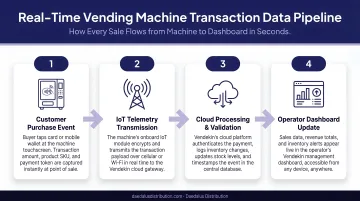
This entire sequence happens in near real-time. An operator managing 20 machines across different locations can log in from their phone and instantly know which machines need restocking, which have malfunctioning components, and which locations are underperforming — all without leaving their office.
That real-time flow is the standard — but cloud systems are also built to handle the exceptions.
Handling Connectivity Interruptions
Machines don't stop working during temporary internet outages.
Most cloud-based systems use offline buffering: transaction data stores locally on the machine when connectivity drops, then syncs automatically once the connection restores. Customers can still make purchases, but real-time reporting pauses until the machine reconnects.
Key Features of a Cloud-Based Vending Management System
Cloud-based vending management systems give operators the data and automation they need to stop guessing and start making decisions based on real numbers. Here's what the platform actually does.
Real-Time Inventory Monitoring
The system displays live stock levels for every product slot in every machine. Instead of estimating what each machine needs based on the last visit, operators see exact inventory counts remotely.
Key capabilities:
- Shows exactly how many units remain in each product slot across every machine
- Sends low-stock alerts before machines run empty, so operators can act before sales are lost
- Tracks historical consumption patterns to reveal how quickly specific products sell at each location
Operators implementing real-time inventory monitoring have reduced service visits by 30% while increasing average fills by 75%, eliminating the guesswork that leads to wasted trips.
Sales Reporting and Analytics
Every transaction feeds into comprehensive reports that reveal:
- Which products sell best at each specific machine and location
- Peak sales hours and days, so restocking happens at the right time
- Revenue trends week-over-week and month-over-month
- Location performance rankings that show which sites generate the most profit
Operators using VMS analytics to optimize product mix report gross sales increases of 12-15%, with some specific machines seeing nearly 40% revenue growth by stocking what actually sells rather than relying on assumptions.
Smart Pre-Kitting and Route Optimization
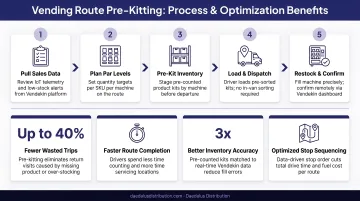
Cloud systems calculate exactly what each machine needs before the driver leaves the warehouse.
Pre-kitting process:
- Dashboard identifies machines below par levels
- System generates a picking list showing exact quantities needed per machine
- Warehouse staff pack totes with precise inventory before the route starts
- Drivers arrive at each stop with exactly what that machine needs—no more, no less
Route optimization benefits:
- Build demand-driven routes visiting only machines that need service
- Sequence stops efficiently to reduce drive time and fuel costs
- Service 15-20% more machines per route using existing staff
One operator improved route efficiency by over 140% overnight after implementing cloud-based pre-kitting, while another condensed eight routes down to six without reducing coverage.
Remote Machine Health Monitoring
The system tracks machine diagnostics in real time:
- Refrigeration temperature readings
- Payment terminal status and error codes
- Motor function and delivery mechanism performance
- Bill validator and coin mechanism jams
When a fault occurs, the operator receives an immediate alert specifying the problem. This enables dispatching the right technician with the right part before the issue compounds—instead of discovering a broken machine days later during a routine visit.
With average U.S. vending machine revenue at approximately $17.22 per day, each day of undetected downtime represents direct lost income that real-time alerts help prevent.
Cashless Payment Integration and Financial Reporting
Modern cloud platforms integrate with cashless payment readers to capture all transaction types:
- Credit and debit card payments
- Mobile payments (Apple Pay, Google Pay)
- NFC tap-to-pay transactions
- Traditional cash sales
All payment data flows into unified financial reports that automate:
- Daily and weekly revenue reconciliation
- Commission tracking for location contracts
- Profit and loss statements by machine or location
- Tax reporting preparation
Vendekin machines distributed through Daedalus Distribution include built-in cashless payment hardware and touchscreen interfaces that pipe transaction data directly into the cloud management platform. Operators get a complete financial picture without manually reconciling separate systems. U.S.-based technical support is available Monday through Friday, 9 AM–5 PM EST.
Benefits of Going Cloud-Based for Vending Operators
Cloud-based vending management delivers measurable gains across costs, efficiency, and competitive positioning — here's how each benefit plays out in practice.
Reduced Operational Costs
Eliminating unnecessary service trips cuts the three largest variable costs in vending operations:
- Fuel expenses from driving to machines that don't need service
- Labor costs from inefficient routing and redundant stops
- Vehicle maintenance from excessive mileage
Operators report up to 13% fewer machine visits per route after implementing cloud-based systems, with some achieving 30% reductions by switching to demand-driven routing.
Scalability Without Proportional Overhead
A cloud VMS manages five machines or 500 through the same dashboard. As operators add machines to their route, the system grows with them without requiring:
- Additional management staff to track inventory manually
- More office space for file storage and paperwork
- Proportional increases in administrative overhead
Existing drivers can absorb new locations because they're servicing each stop faster with pre-kitted inventory and optimized routes. This enables profitable growth without the traditional staffing constraints.
Faster Response to Problems
Cloud-based fault alerts shift maintenance from reactive to proactive:
- Traditional approach: Machine breaks on Monday, operator discovers problem during Thursday's scheduled visit, three days of revenue lost
- Cloud-based approach: Operator receives alert within minutes, dispatches technician same day, machine back in service by afternoon
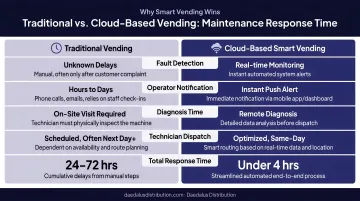
The difference between these scenarios represents real money. A machine generating the national average of $17.22 daily loses over $50 during a three-day undetected outage—losses that multiply quickly across a fleet of even five or ten machines.
Better Product Decisions and Reduced Waste
Sales analytics reveal what actually sells at each specific location, enabling operators to:
- Stock beverages in gyms and break rooms where hydration demand is high
- Place snacks and convenience items in offices and waiting areas
- Match product mix to demographic patterns and consumption preferences
- Reduce overstocking of slow-moving items that tie up capital
- Minimize spoilage of perishable goods through faster turnover
This location-specific optimization prevents the common mistake of using a one-size-fits-all product assortment that underperforms everywhere.
Competitive Advantage for Smaller Operators
Cloud-based systems give independent operators and small fleet owners the same data-driven capabilities as large regional operators — without the overhead those operators carry. That's a real edge when competing for location contracts.
When bidding for location contracts, smaller operators can demonstrate:
- Professional remote monitoring and rapid response times
- Data-backed inventory optimization and minimal stockouts
- Reliable service schedules based on actual demand rather than guesswork
Location managers notice the difference between operators who guess and operators who show up with data — and they sign contracts accordingly.
Cloud-Based vs. Traditional Vending Management: Key Differences
| Operational Aspect | Traditional Management | Cloud-Based VMS |
|---|---|---|
| Inventory Tracking | Visual estimation on-site; 62% of machines have stockouts | Real-time slot-level data; alerts prevent stockouts |
| Maintenance Detection | Discovered during next scheduled visit; days of downtime | Instant fault alerts; same-day response possible |
| Restocking Method | Estimated loads; high product waste and bring-backs | Data-driven pre-kitting; exact quantities per machine |
| Route Planning | Fixed schedules; frequent unnecessary visits | Demand-driven; 13-30% fewer trips |
| Sales Reporting | Manual spreadsheets or paper logs | Automated dashboards with trend analysis |
| Revenue Impact | Baseline performance with hidden losses | 7-10% revenue recovery from eliminated stockouts |
Without real-time data, operators over-service some machines while under-serving others—wasting labor on unnecessary trips while losing sales from empty machines elsewhere. Those two problems feed each other, and the revenue damage adds up fast.
Operators lose 7-10% of potential revenue specifically to stockouts—a direct hit that cloud-based inventory monitoring eliminates by keeping slot-level data current around the clock.
Cloud systems do require upfront investment in software subscriptions and compatible hardware. That cost recovers quickly: operators have reported 97% increases in average collections within just six weeks of switching, driven largely by route efficiency gains alone.
How to Choose the Right Cloud-Based Vending Management System
Not all platforms offer the same capabilities or value proposition. Smart selection starts with understanding your specific needs.
Match Features to Your Pain Points
Before evaluating vendors, identify your most pressing operational challenges:
- Inventory visibility issues? Prioritize platforms with robust real-time monitoring and customizable low-stock alerts
- Route inefficiency? Look for strong pre-kitting and route optimization tools
- Financial reporting complexity? Ensure the system provides automated P&L reports and commission tracking
- Maintenance response delays? Verify comprehensive machine health monitoring with immediate fault alerts
Not every platform excels in every area. Map your priority needs to vendor strengths rather than assuming all systems are equivalent.
Hardware Compatibility and Integration
The VMS must work with the telemetry hardware in or attachable to your machines. Key considerations:
Retrofit scenarios:
- Verify the system supports telemetry adapters compatible with your existing machine controllers
- Confirm connectivity options (cellular vs. Wi-Fi) match your machine locations
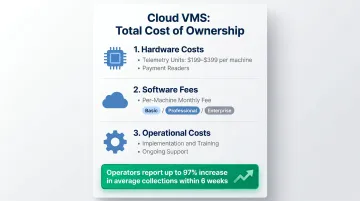
- Budget for hardware costs, typically $199-$399 per telemetry unit
Integrated solutions: Integration is simplest when machines and software are purpose-built to work together. Vendekin-powered machines distributed by Daedalus Distribution arrive with built-in cloud connectivity, touchscreen interfaces, and integrated telemetry that feeds directly into the Vendekin management platform.
Software is included at no separate license fee, and U.S.-based support covers everything from installation through ongoing maintenance — so operators sidestep the compatibility headaches common with retrofitted setups.
Pricing Model and Total Cost of Ownership
Cloud VMS pricing typically follows these structures:
- Per-machine monthly fee (most common)
- Flat subscription (less common, may have machine limits)
- Tiered plans based on feature access (basic, professional, enterprise)
Calculate total cost at your current fleet size and at 2x–3x growth to avoid being locked into a system that becomes prohibitively expensive as you scale. Factor in:
- Monthly or annual software fees
- Hardware costs (telemetry units, payment readers)
- Implementation and training expenses
- Ongoing support costs
While major vendors like Cantaloupe, Parlevel, and VendSys require custom quotes, some providers like Gimme Vending publish transparent pricing, simplifying comparison.
Support, Training, and Onboarding
Pricing matters, but support quality determines whether your team actually gets value from the platform. Look for vendors offering:
Comprehensive onboarding:
- Hands-on installation support for first machines
- Detailed training for office staff on dashboard features
- Driver training on mobile picking apps and field procedures
Responsive ongoing support:
- U.S.-based technical support during business hours
- Quick response times for troubleshooting
- Regular software updates and feature enhancements
User-friendly interfaces:
- Intuitive dashboards that don't require extensive training
- Mobile apps simple enough for field staff to adopt without friction
- Clear reporting that delivers insights without complexity
Daedalus Distribution provides U.S.-based support from Summerville, South Carolina, covering everything from first installation through ongoing maintenance, with technical assistance available Monday–Friday, 9 AM–5 PM EST.
Frequently Asked Questions
What is the best vending software?
There's no single "best" platform—the right VMS depends on your scale, machine types, and operational priorities. Major platforms include Cantaloupe Seed, Parlevel Systems, VendSys, and Gimme Vending, each with different strengths. Prioritize ease of use, hardware compatibility, responsive support, and transparent pricing when evaluating options.
What is the difference between a VMS and a cloud-based VMS?
All modern VMS platforms are cloud-based, but some older legacy systems rely on local software installations that require on-site servers. A cloud-based VMS stores data remotely, updates automatically without manual installations, and provides access from any internet-connected device—eliminating the infrastructure requirements of traditional systems.
Can a small vending operation benefit from a cloud-based VMS?
Yes—even operators with a handful of machines benefit from eliminating manual tracking errors, gaining real-time visibility into inventory and sales, and establishing professional workflows. Cloud systems give small operators the same data-driven tools as large fleets, making it easier to scale profitably when growth opportunities arise.
How much does a vending management system cost?
Pricing varies widely by vendor and plan. Hardware telemetry units typically cost $199–$399 per machine, while software is usually structured as a per-machine monthly fee (exact amounts require vendor quotes). Reduced service trips, eliminated stockouts, and optimized routes typically deliver rapid ROI—some operators report significant improvements within six weeks.
Do cloud-based vending machines need constant internet access to work?
No. Machines continue to accept payments and dispense products during connectivity drops, and transaction data syncs to the cloud automatically once the connection restores. Customers aren't affected; real-time reporting pauses briefly, but most interruptions resolve quickly with no lasting impact.
How does a cloud-based VMS help with route planning?
The system uses live inventory data to identify which machines actually need service, allowing operators to build demand-driven routes instead of following fixed schedules. This reduces unnecessary trips, cuts fuel costs, and ensures drivers carry exactly what each machine needs. Operators report servicing 15-20% more machines per route after implementing cloud-based route optimization.
Ready to modernize your vending operations with cloud-based management? Daedalus Distribution offers Vendekin-powered smart vending machines with integrated cloud connectivity, touchscreen interfaces, and a U.S.-based parts and service center. Contact us at contact@daedalusdistribution.com or call +1 843-490-2804 to learn how cloud technology can eliminate stockouts, reduce service costs, and maximize your vending revenue.