Why AI Is Changing the Vending Industry
The global intelligent vending machine market reached $20.5 billion in 2022 and is projected to hit $55.5 billion by 2030—a 14% annual growth rate that far outpaces the broader vending sector. That kind of expansion signals a real shift in how vending operations work and generate profit.
Traditional vending machines operate on guesswork. Operators restock on fixed schedules without real inventory data, miss out on 71% of cashless transactions, and find out about equipment failures only after revenue is already lost.
Smart vending machines powered by AI change that. Connected sensors, machine learning algorithms, and cloud-based dashboards give operators real-time control—so they can optimize routes, prevent downtime before it happens, and treat each location as a profit center rather than a maintenance headache.
This article covers what separates a truly intelligent machine from a merely connected one, the AI capabilities that deliver measurable ROI, how these features translate into real profitability across different commercial environments, and what U.S. operators should prioritize when modernizing their fleets.
TLDR
- AI-powered machines automate inventory tracking, forecast demand, and cut operating costs by up to 40%
- Demand forecasting, predictive maintenance, and cashless payments reduce workload and protect revenue
- Documented deployments show up to 320% sales increases after smart technology adoption
- Prioritize touchscreen interfaces, built-in cashless terminals, remote dashboards, and U.S.-based support
What Makes a Vending Machine "Smart"?
A smart vending machine isn't just a traditional unit with a card reader bolted on. True intelligent vending infrastructure integrates hardware, connectivity, and software into a unified system that generates usable data with every transaction.
Hardware Foundation
Smart machines start with interactive touchscreen displays—typically 10 to 22 inches—that replace mechanical button panels. These interfaces enable dynamic product presentation, nutritional information display, and promotional messaging that static labels can't provide. Built-in NFC and mobile wallet payment terminals accept Apple Pay, Google Pay, and contactless cards, addressing the reality that 71% of vending transactions are now cashless, with 77% of those being contactless.
The intelligence layer comes from IoT sensors embedded throughout the machine: weight sensors track product movement in real-time, temperature monitors ensure refrigerated goods stay within safe ranges, and RFID readers provide SKU-level inventory accuracy. Traditional machines offer none of this—operators open the door, eyeball what's missing, and restock based on memory.
Connectivity Layer
Cellular or Wi-Fi connectivity links each machine to a cloud-based management platform. This transforms isolated steel boxes into network nodes that transmit sales data, inventory levels, temperature logs, and mechanical health signals continuously. Operators access this intelligence through web dashboards or mobile apps, gaining remote visibility that eliminates blind service trips.
Berg Insight reports that 8.1 million vending machines globally are now connected, projected to reach 11.7 million by 2030. The infrastructure to support smart vending at scale already exists—major telemetry providers like Cantaloupe and Nayax each manage approximately 900,000 connected units.
Software Management Platform
The cloud platform aggregates data from all connected machines into operator dashboards that generate low-stock alerts, sales reports by product and location, automated restocking schedules, and route optimization recommendations. Raw sensor data becomes operational insight operators can use the same day.
Traditional vs. Smart Vending Comparison
| Capability | Traditional Vending Machine | Smart Vending Machine |
|---|---|---|
| Payment Options | Cash and coins only | Cashless, NFC, Apple Pay, Google Pay, contactless cards |
| Inventory Tracking | Manual visual inspection | Real-time IoT sensors with remote monitoring |
| Maintenance Alerting | Reactive—fix after breakdown | Predictive—alert before failure occurs |
| Data Reporting | None—operators rely on memory | Automated sales reports by SKU, location, and time |
| Customer Personalization | Static product selection | Loyalty programs, purchase history, dynamic recommendations |
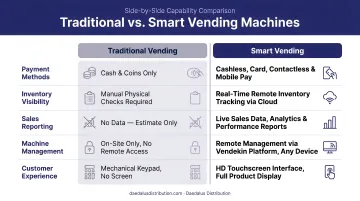
The Intelligence Distinction
A connected machine with a touchscreen and card reader is "smart." A truly AI-powered machine learns from data over time—adjusting product recommendations based on purchase patterns, flagging maintenance needs through anomaly detection in sensor data, and optimizing stocking decisions automatically using demand forecasting algorithms. Connectivity collects the data. Intelligence acts on it—without waiting for an operator to log in.
Key AI Capabilities Transforming Vending Operations
Demand Forecasting and Predictive Restocking
Machine learning models analyze historical sales data, seasonal patterns, time-of-day trends, and local foot traffic to predict which products will sell and when. Instead of restocking every machine on a fixed weekly schedule, operators receive alerts when specific SKUs will run out within the next 24-48 hours—before the stockout occurs, not after.
The revenue impact is significant. Research shows vending operators lose 7-10% of revenue specifically to stockouts, and the European Vending Association reports that 23% of all vending transactions fail due to out-of-stock items, payment issues, or jams. AI-driven inventory management directly addresses the single largest controllable revenue leak in the industry by ensuring top sellers remain available during peak demand windows.
Predictive stocking also cuts waste. Machines carrying perishable items—fresh sandwiches, salads, dairy—can adjust order quantities based on forecasted demand, reducing expired product disposal costs that erode margins.
Predictive Maintenance
Onboard sensors continuously monitor motor performance, compressor temperature, door seal integrity, and payment module status. When parameters drift from normal operating ranges—a refrigeration unit running 3°F warmer than baseline, a motor drawing 15% more current than typical—the system triggers alerts before catastrophic failure occurs.
The cost advantage is substantial: industry data shows preventive maintenance reduces repair costs by 60-75% compared to reactive approaches, and smart monitoring systems can predict 85% of common failures before they happen. Emergency service calls run $200-$500 per visit, while planned preventive interventions cost a fraction of that. Downtime costs $50-$150 per day in lost revenue for average locations, and over $200 daily in high-traffic environments.
Dynamic Pricing and Personalization
AI-driven dynamic pricing adjusts product prices based on demand levels, time of day, or approaching expiration dates. Common applications include:
- Morning peak pricing (e.g., cold brew at $3.50 during rush, $2.75 mid-afternoon)
- Automatic discounts on items approaching expiration to recover value instead of disposing them
- Demand-based adjustments tied to real-time foot traffic data
Personalization adds another revenue layer. Loyalty program integration lets machines recognize repeat customers via payment data or mobile apps, then surface their frequently purchased products or suggest complementary items based on purchase history—the same logic powering e-commerce recommendations, now running at a vending machine.
Route Optimization
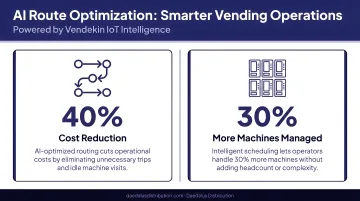
AI generates data-driven restocking schedules and route plans by analyzing real-time inventory levels, sales velocity, and machine locations. Operators visit only machines that actually need servicing, eliminating unnecessary trips to locations that are still 70% stocked.
Vendon's operator data shows telemetry-driven route planning saves up to 40% on routing costs and enables staff to manage 30% more machines with the same headcount. In an industry where labor and fuel represent the two largest operational expenses after cost of goods sold, this efficiency gain flows straight to the bottom line.
How AI Vending Machines Drive Real Profitability
The ROI case for AI-powered vending isn't theoretical. Operators who deploy smart vending technology see financial gains across four distinct areas — and the numbers are specific enough to model before you buy a single machine.
Revenue Protection Through Stockout Elimination
A machine that never runs out of its top sellers earns consistently. The average U.S. vending machine generates $300 to $1,500 in monthly revenue, with high-traffic locations reaching up to $17,000 monthly. Eliminating the 7-10% revenue loss from stockouts protects $21-$105 per machine monthly at average locations, or up to $1,190 monthly at premium sites.
Labor and Fuel Cost Reduction
Route optimization and predictive restocking reduce unnecessary service trips. Cantaloupe's documented case study with Accent Food Services showed a 40% route reduction after deploying smart vending technology, contributing to 3X overall business growth over four years. Academic research confirms these gains: route optimization delivers 15-20% savings in fuel and labor costs and improves technician utilization by approximately 22%.
Margin Improvement Through Product Mix Optimization
AI-recommended stocking aligned to location demographics—office workers vs. gym-goers vs. transit commuters—means less expired product, higher sell-through rates, and improved margins. Smart vending operations can achieve net profit margins of up to 50% compared to the traditional 20-25% margin, according to industry data.
Cashless Payment Revenue Lift
The most immediate impact comes from accepting cashless payments. Accent Food Services documented a 320% sales increase after installing cashless card readers—not from adding machines, but from capturing transactions that cash-only units exclude. With 75% of U.S. machines now cashless-capable and 71% of transactions already cashless, operators still running cash-only units are leaving measurable revenue on the table.
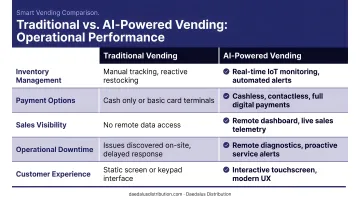
Traditional vs. AI-Powered Vending: Operational Comparison
| Metric | Traditional Vending | AI-Powered Vending | Impact |
|---|---|---|---|
| Stockout Frequency | 30-40% of machines run out of top sellers before restock | Near-zero with predictive alerts | 7-10% revenue recovery |
| Service Calls Per Year | 8-12 reactive calls | Significantly reduced via predictive maintenance | 60-75% repair cost reduction |
| Route Efficiency | Fixed schedules, all machines visited | Data-driven, visit only machines needing service | Up to 40% routing cost savings |
| Net Profit Margin | 20-25% | Up to 50% with optimized operations | 2X margin improvement |
| Cash Handling Cost | $50-$75 per machine monthly | Eliminated (cashless) | $600-$900 annual savings per machine |
Where Smart Vending Makes the Biggest Difference
High-Traffic Public Locations
Airports, transit hubs, hospitals, and universities represent ideal environments for AI vending deployment. The 24/7 unattended nature of these locations makes remote monitoring, automatic restocking alerts, and cashless payments especially valuable.
Consider a vending machine in a hospital emergency department waiting room: it might see 200+ transactions daily across three shifts. Predictive inventory management ensures it doesn't run empty during overnight hours when restocking staff aren't on-site.
Real-world adoption validates this: the 2026 NAMA event coverage noted that high-demand brands like Chick-fil-A are now accessible via automated vending in hospitals and transit hubs, maintaining strict temperature controls through smart refrigeration monitoring that traditional machines can't provide.
Corporate Offices and Workplaces
Consistent daily foot traffic from the same user base creates ideal conditions for AI personalization features. Loyalty programs, preferred product tracking, and recurring purchase pattern recognition work best when the same customers interact with machines repeatedly. An office break room vending machine can learn that certain employees buy sparkling water every afternoon at 2 PM and ensure those SKUs stay stocked during that window.
Expanding Product Categories Beyond Snacks
Connected hardware and software unlock higher-margin, non-traditional vending categories that traditional machines cannot support:
- Fresh food and refrigerated items: Temperature monitoring with compliance logging
- Pharmaceuticals and OTC medications: Age verification and controlled-access dispensing
- Beauty and personal care products: The U.S. market reached $91.6 million in 2023, growing at 10.5% annually
- PPE vending: Approximately 9% annual growth projected through 2030
- Medical vending: Global market projected to reach $2.7 billion by 2030
A pharmacy vending machine dispensing OTC medications in a hospital requires temperature compliance logging, SKU-level inventory accuracy, and real-time stock monitoring. These are capabilities only connected smart machines can deliver reliably at scale — and they open revenue streams that traditional snack-and-soda operators haven't touched.
How to Choose the Right AI-Ready Vending Machine
Core Features to Evaluate
Before purchasing, evaluate these essential capabilities:
- Remote monitoring dashboard: Web and mobile access to real-time machine status
- Inventory tracking accuracy: SKU-level visibility with automated low-stock alerts
- Payment system compatibility: NFC, Apple Pay, Google Pay, and contactless card support built-in
- Touchscreen interface quality: Responsive, intuitive display appropriate for your environment
- Data reporting depth: Sales by product, location, time of day, and customer segment
- Post-sale technical support: U.S.-based service availability, response times, and parts fulfillment
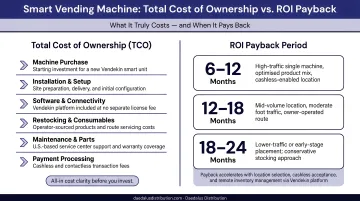
Total Cost of Ownership vs. Upfront Price
| Tier | Price Range | What You Get |
|---|---|---|
| Entry-level | $2,000–$6,000 | Basic cashless payments and remote monitoring |
| Mid-range | $8,000–$15,000 | Full telemetry, touchscreens, and advanced reporting |
| High-end AI | $15,000–$25,000+ | Computer vision, grab-and-go technology, predictive analytics |
Hardware cost is only part of the equation, though. Factor in:
- Monthly platform fees: Typically $25-$60 per machine for telemetry and management software
- Payment processing: Approximately 2.5% per transaction
- Connectivity costs: Cellular or Wi-Fi data plans if not included
- Electricity: $10-$50 monthly per machine, higher for refrigerated units
Balance these ongoing costs against the revenue gains from reduced stockouts (7-10% revenue recovery), lower maintenance expenses (60-75% cost reduction), and optimized routes (up to 40% savings). A $10,000 smart machine that generates $1,500 monthly revenue with 40% margins delivers $600 monthly profit—a 20-month payback period even before factoring in operational cost reductions.
Daedalus Distribution, the authorized U.S. master reseller for Vendekin Technologies, offers all-digital machines with built-in touchscreens and remote inventory tracking. Installation support and ongoing maintenance run through their Summerville, South Carolina service center.
Frequently Asked Questions
How much does a smart vending machine cost?
Pricing breaks down by capability tier:
- Entry-level (cashless payments, remote monitoring): $2,000–$6,000
- Mid-range (touchscreens, full telemetry): $8,000–$15,000
- High-end (computer vision, full AI): $15,000–$25,000+
Also budget for monthly platform fees ($25–$60), payment processing (~2.5%), and connectivity costs.
How much does an AI vending machine make?
Revenue varies widely by location, product mix, and foot traffic. The industry average is $300-$1,500 monthly ($3,600-$18,000 annually), with high-traffic locations like airports or large office buildings generating up to $17,000 monthly. AI optimization can increase sales volume by 20-50% through cashless payment acceptance and reduced stockouts.
How to use AI for vending machines?
AI runs through the machine's cloud-based software platform, which analyzes sales data for demand forecasting, monitors sensors for predictive maintenance alerts, and generates restocking recommendations. Most modern smart vending machines include these capabilities built-in or through a connected management platform.
What is the most profitable vending machine to own?
Profitability depends on location quality and product category, but machines stocking beverages, snacks, or fresh food in high-traffic environments typically generate the strongest returns. AI-powered machines amplify profitability regardless of category by reducing stockouts, minimizing waste, cutting maintenance costs, and reducing labor costs. Net margins often jump from 20–25% to 40–50%.
How many vending machines do you need to make $100k?
Using industry averages of $525 monthly revenue at 20–25% margins, you'd need roughly 71 traditional machines to net $100,000 annually. With AI-optimized machines generating $1,500 monthly at 40% margins, that number drops to approximately 15 machines.
Do I need an LLC for a vending machine business?
An LLC isn't legally required in most states to operate vending machines—you can operate as a sole proprietorship. However, the U.S. Small Business Administration recommends LLCs for businesses with significant personal assets to protect, as LLCs shield personal assets from business lawsuits or bankruptcy while offering tax flexibility. Consult a business attorney or accountant for guidance specific to your situation.