Introduction
When a vending machine jams, rejects payments, or stops cooling, most operators are left guessing. Without a clear picture of what's inside, diagnosing the fault — let alone sourcing the right part — becomes a time-consuming process that costs money.
The reality is that vending machines running 24/7 in offices, schools, hospitals, and transit hubs are more mechanically complex than they appear. Every dispensing cycle depends on a chain of components working in sequence.
This guide maps out that chain — the major systems inside a vending machine, what each part does, and how they work together to get a product from shelf to customer.
TL;DR
- A vending machine consists of five core component groups: cabinet structure, mechanical dispensing, electronic controls, payment processing, and user interface
- Each group performs a distinct function but integrates through a central control board that manages the entire vend cycle
- Digital machines add touchscreen interfaces and cloud-connected monitoring for remote inventory and sales tracking
- Reading the blueprint enables faster troubleshooting, better purchasing decisions, and smarter parts inventory planning
What Is a Vending Machine Blueprint?
A "vending machine blueprint" is a parts diagram or technical schematic that maps every internal component — structural, mechanical, electronic, and software — showing how each part connects within the machine's operational workflow. It's not simply a drawing of the cabinet exterior. The blueprint represents the functional architecture: how a payment signal triggers the control board, how that board activates a specific motor, and how a product travels from shelf to retrieval bin.
Operators benefit from understanding the blueprint even without technical training. It enables:
- Evaluate build quality, component brands, and serviceability before buying
- Narrow down whether an issue is payment-related, mechanical, or electrical
- Speak confidently with technicians and parts suppliers
- Stock the right replacement components based on actual machine architecture
Most modern blueprints cover three core views:
- Exploded mechanical diagrams — show assembly details and component relationships
- Electrical wiring schematics — map power and signal paths throughout the machine
- Controller pinout documentation — details communication ports including DEX (audit data) and MDB (peripheral connections)
The Vending Machine Parts Diagram: Key Components
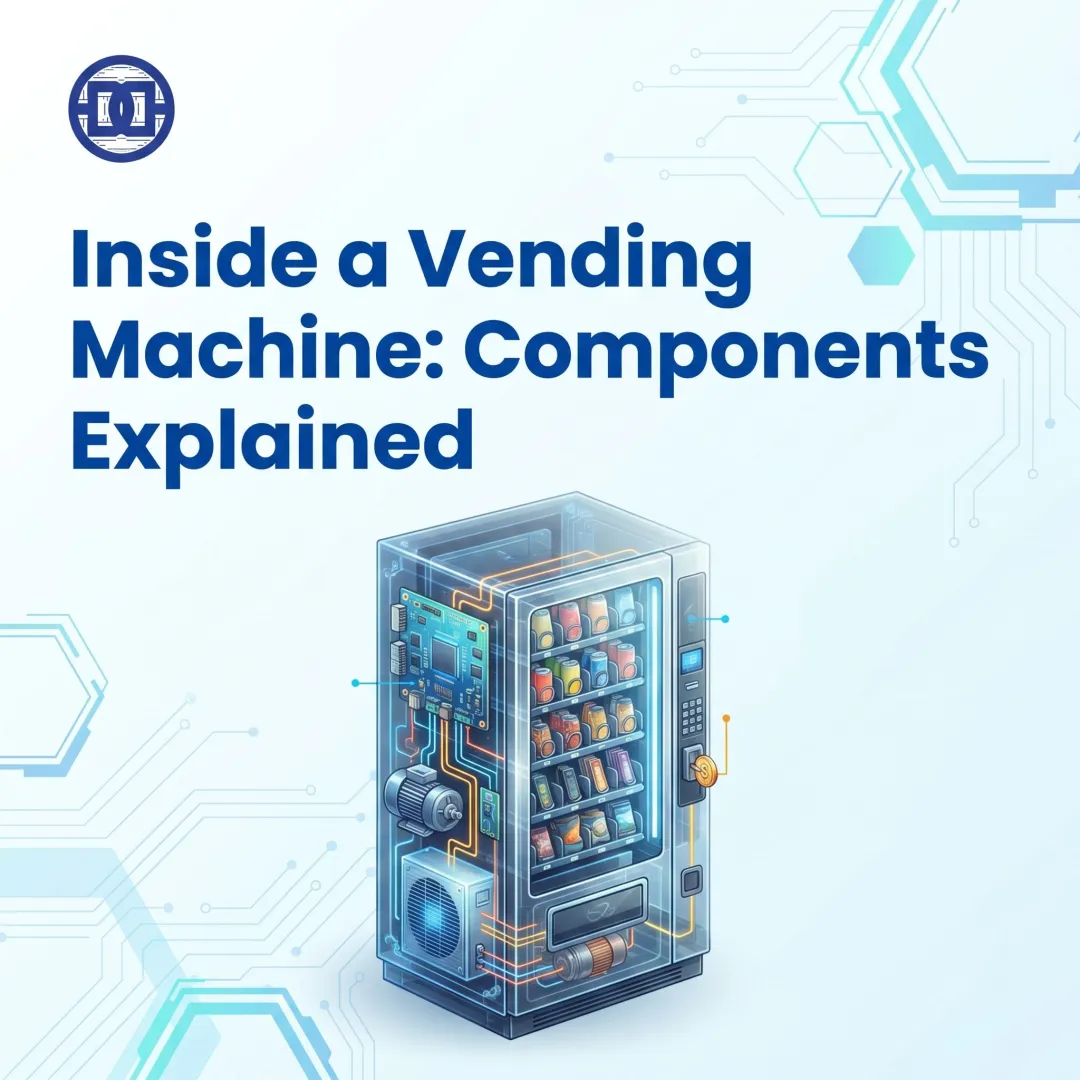
A standard commercial vending machine contains five major component groups. Each occupies a defined role in the machine's operation, and together they form an integrated system that processes payment, selects products, and completes transactions.
(A labeled diagram showing the internal layout of a vending machine — cabinet, dispensing mechanism, control board location, payment modules, and user interface — would be ideal here.)
Structural Cabinet & Frame
The outer cabinet and internal frame form the foundation of the machine:
- Steel housing — commercial machines meet UL 751 safety standards for electrical shock, fire, and casualty hazards
- Locking mechanisms — flush-mount T-handle locks with 1-point or high-security 2-point latching systems prevent unauthorized access
- Shelving or tray systems — hold product inventory in organized rows and columns
- Retrieval bin/chute — located at the base, where dispensed products land for customer pickup
- Door interlocks — detect when the main door is open, signaling the control board to enter service mode
Cabinet quality directly affects durability and theft resistance. When evaluating machines, pay close attention to steel gauge, hinge construction, and lock grade — these details separate machines built for years of commercial use from those that won't survive the first break-in attempt.
Mechanical Dispensing System
The dispensing mechanism is the physical system that holds and releases products. The design varies by product type:
| Mechanism | Primary Use | How It Works |
|---|---|---|
| Helical Coil | Snacks, chips, pastries | A 24 VDC motor rotates a spiral coil one full turn, pushing the product forward and off the shelf |
| Tray-and-Pusher | Cans, bottles, rigid packaging | Wide columns with adjustable cams dispense products sequentially in beverage machines |
| Elevator/Carrier | Fragile items, glass bottles | A motorized bucket travels to the selected shelf, catches the product, and gently lowers it to prevent breakage |
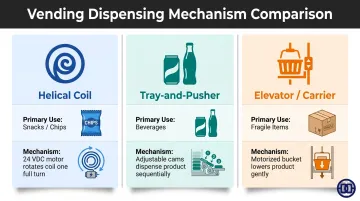
Each row or column has its own dedicated motor and dispensing unit. Operators snap product pushers onto coil ends to assist smooth product movement.
Electronic Control Board (PCB/Mainboard)
The control board is the brain of the machine. It receives input signals from the payment system and user interface, then processes selection logic, routes output commands to the correct motor, and manages fault detection.
Key functions:
- Processes credit confirmation from payment validators
- Cross-references product selection with inventory status
- Sends timed electrical pulses to motor drivers for precise coil rotation
- Monitors temperature sensors in refrigerated units
- Logs transactions and updates inventory counts
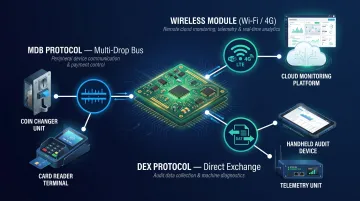
Modern control boards include:
- MDB (Multi-Drop Bus) — the industry-standard serial communication protocol (v4.3) that connects the control board to peripherals like coin changers and card readers
- DEX (Direct Exchange) — the NAMA-adopted standard for downloading audit data (sales, cash collected, door openings) to a handheld device or telemetry unit
- Wireless modules — 4G/Wi-Fi connectivity for cloud-based remote monitoring in digital machines
Payment Acceptance System
The payment module is a multi-channel unit that authenticates currency and signals credit approval to the control board:
Coin validators:
- Use physical dimensions, weight, and electromagnetic properties to authenticate coins
- Reject slugs and counterfeit currency
- Issue credit signals to the control board once validated
Bill acceptors:
- Employ optical sensors to scan denomination and security features as the transport motor pulls the bill through
- Include Level 3 anti-stringing mechanisms to block fishing attempts
- Stack validated bills and issue credit
Cashless/NFC readers:
- Support credit cards, debit cards, Apple Pay, Google Pay, and tap-to-pay
- Communicate via MDB protocol with the control board
- Enable higher transaction values — cashless users spend 37% more per transaction than cash users
As of 2024, 71% of all U.S. vending transactions were cashless, with contactless payments accounting for 77% of those transactions.
User Interface & Display
Those cashless payment trends put pressure on the UI to deliver. The user interface is where payment capability meets customer experience — and its design directly influences what customers buy:
Traditional machines:
- Button panels with alphanumeric selectors (e.g., "A3" or "B5")
- Simple LED displays showing credit amount and selection
Modern digital machines:
- Touchscreen displays (ranging from 10-inch to 49-inch screens)
- Show product images, pricing, nutritional information, and promotions
- Support multi-vend shopping carts and dynamic pricing
- Connected to the control board for real-time updates
For operators running digital machines, the touchscreen doubles as a revenue tool — real-time promotions and product imagery consistently increase average transaction size beyond what button-panel machines achieve.
How a Vending Machine Works: From Input to Output
Understanding the operational flow from customer input to product delivery helps operators quickly identify where failures occur. Each part in the blueprint plays a timed, sequential role.
Payment & Selection (Initiation)
The vend cycle begins when a customer inserts payment — coin, bill, or card. The validator authenticates the currency using sensors and physical checks, then sends a credit signal to the control board. Until sufficient credit is confirmed, the selection system remains locked.
Payment validation failure tops the list of customer complaints and service call triggers. Dirty sensors, worn coin mechanisms, or bill path obstructions account for most service calls.
Control Board Processing (Core Operation)
Once a valid selection is made, the control board:
- Cross-references the selected product slot (e.g., "B3")
- Confirms the item is in stock via sensor or inventory count
- Sends a timed electrical pulse to the motor driver for that specific row or column
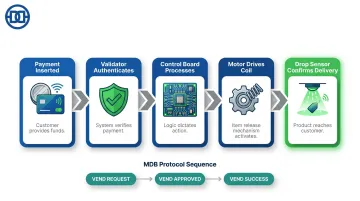
The precision of this pulse — its duration and current — determines whether the coil completes exactly one rotation or jams. The MDB protocol enforces a strict VEND REQUEST → VEND APPROVED → VEND SUCCESS sequence to govern this exchange.
Motor & Dispensing Execution
The motor (typically a small DC or stepper motor) rotates the helical coil one full turn, pushing the front product forward and off the shelf. A drop sensor or infrared proximity sensor at the delivery chute confirms the product has actually fallen.
If no confirmation signal is received within the timeout period (e.g., 12 seconds):
- The machine flags a vend failure error
- The control board may attempt a re-dispense (depending on programming)
- The cashless device refunds the customer or the machine escrows the cash
Regulation & Error Handling
The machine continuously monitors itself during operation:
- Temperature sensors regulate compressor cycling in refrigerated machines
- Door sensors detect if the cabinet is open, triggering service mode
- Inventory sensors track product levels per slot
- Drop sensors confirm successful vending
The control board uses all these inputs to flag faults, prevent vending without confirmed payment, or send remote alerts in connected machines. Operators running remote monitoring software receive real-time alerts for jams, low inventory, or temperature issues — catching problems before they cost a service visit.
Product Delivery (Output)
The product travels down the internal chute and lands in the retrieval bin, accessible through a hinged door at the base. Bin door design affects both ease of access and anti-theft performance:
- Gravity flap doors — simple, low-cost, but offer minimal security
- Mechanical gate doors — more secure, prevent fishing attempts
The control board logs the completed transaction, updates the inventory count, and resets for the next customer. Knowing where each step can break down is what turns a blueprint into a practical troubleshooting tool.
How Parts Differ Across Vending Machine Types
While the five core component groups remain consistent, the specific parts used vary significantly by machine type:
| Machine Type | Dispensing Hardware | Refrigeration Components | Control Logic Complexity |
|---|---|---|---|
| Ambient Snack | Helical coils, DC motors, drop sensors | None | Standard vend logic |
| Cold Beverage | Cams, rotors, wide columns | 1/3 HP compressor, condenser, evaporator fan | Space-to-sales programming* |
| Frozen/Food | Coils or pushers, heavy insulation | 1/2 HP compressor, defrost heaters | H&S lockout** |
| Combo | Mixed (coils for snacks, pushers for drinks) | Dual-zone or single-zone refrigeration | Complex VMC mapping for mixed vend logic |
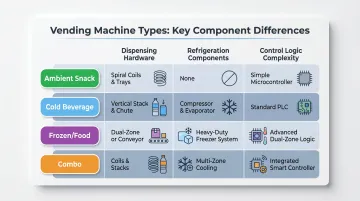
*Space-to-sales programming links multiple selection buttons to a single high-capacity column. **H&S (Health & Safety) lockout prevents sales automatically if internal temperature exceeds 41°F for 15 consecutive minutes.
Operators running mixed fleets need to know which parts cross over between machine types and which are model-specific — that distinction drives smarter replacement parts inventory decisions and fewer unexpected downtime costs.
Modern vs. Traditional: How Digital Machines Change the Blueprint
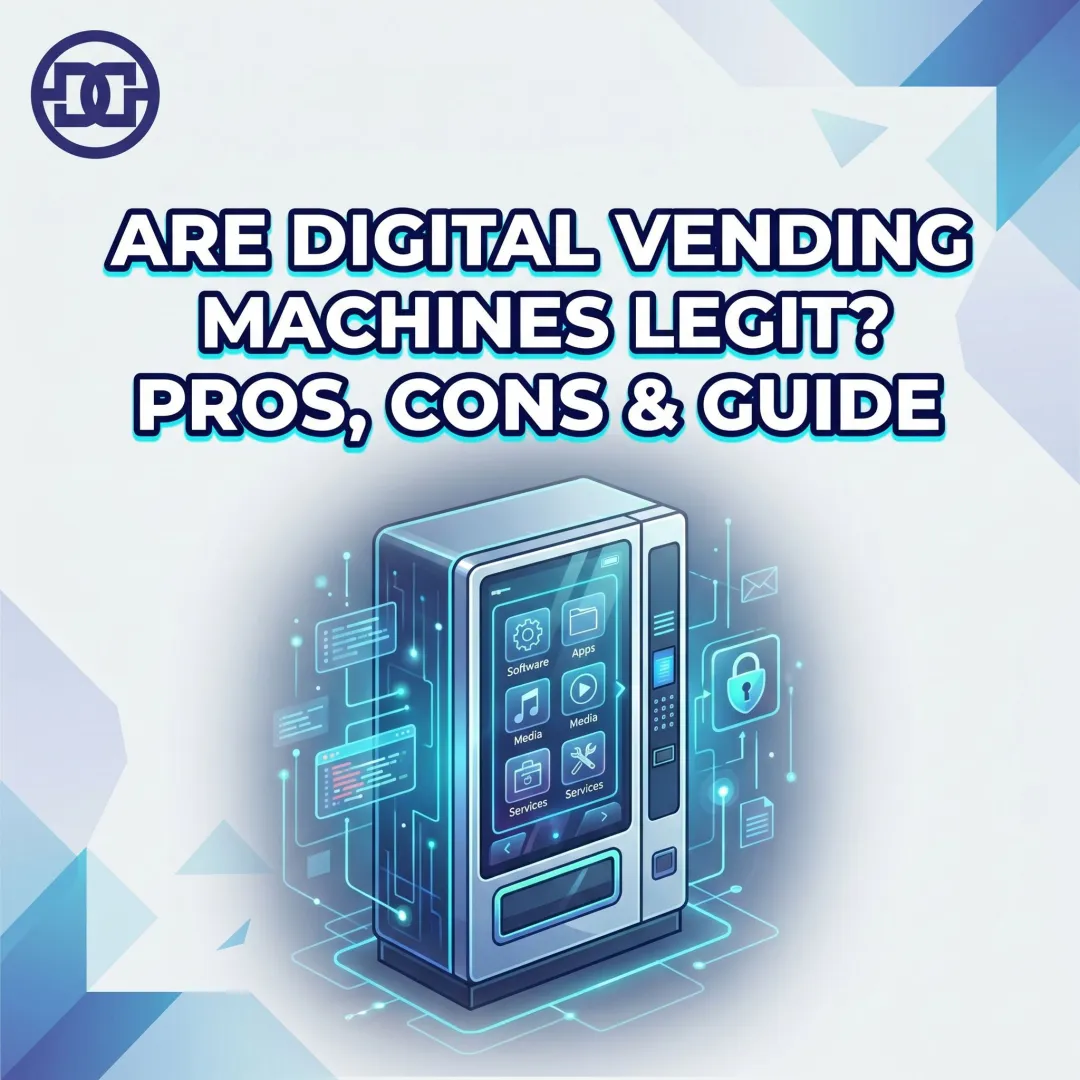
Traditional vending machines rely on a largely mechanical and analog blueprint. Physical button panels, coin-only validators, and no connectivity mean technicians must drive to each machine just to check inventory or diagnose a fault. All-digital machines eliminate that guesswork by restructuring the blueprint in three fundamental ways:
1. What the Customer Sees
- Touchscreen displays replace physical button panels
- Operators update pricing, product images, and promotions remotely through software
- Customers view nutritional info and build multi-item shopping carts before paying
2. How the Machine Communicates
- An onboard wireless module (4G/Wi-Fi) connects the control board to the cloud
- Real-time telemetry sends DEX audit data to your vending management system automatically
- Inventory levels, sales trends, and error alerts are visible remotely from any device
3. How Operations Change Day-to-Day
- Operators know exactly what each machine needs before leaving the warehouse — no wasted trips
- Route trucks can be loaded with precisely the right inventory for each stop
- Transaction-level reporting shows which products move, when, and at what margin
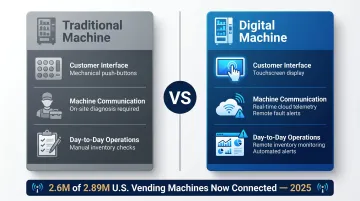
As of 2025, North America had approximately 2.6 million connected vending machines out of 2.89 million total units. For operators running 10, 50, or 500 machines, that connectivity translates directly into fewer wasted service runs, lower labor costs, and better restocking decisions — which is why the gap between connected and traditional deployments keeps widening.
Conclusion
A vending machine is not a single device but a system of interconnected components — cabinet, dispensing mechanism, control board, payment system, and user interface. Operators who understand the blueprint make better purchasing decisions, resolve issues faster, and run more profitable operations.
For operators ready to modernize their fleet, Daedalus Distribution offers Vendekin-powered machines with touchscreen interfaces, cloud-connected control boards, and a U.S.-based parts and support network — backed by fast delivery and ongoing maintenance support nationwide.
Reach out at +1 843-490-2804 or contact@daedalusdistribution.com to learn more.
Frequently Asked Questions
What are the main parts of a vending machine?
A commercial vending machine consists of five core component groups: the structural cabinet and frame, the mechanical dispensing system (coils, motors, pushers), the electronic control board (PCB/mainboard), the payment acceptance system (coin validators, bill acceptors, cashless readers), and the user interface or display.
How does a vending machine know which item to dispense?
The control board receives the selection signal from the user interface, identifies the corresponding motor slot (e.g., row B, column 3), and sends a timed electrical pulse to trigger that specific motor's coil rotation. The precision of the pulse determines whether the coil completes exactly one full turn.
What is the most commonly replaced part in a commercial vending machine?
Coin validators, bill acceptors, and dispensing motors are among the most frequently serviced components due to high-use wear, jamming, and exposure to dirt or vandalism. Refrigerated machines also require regular replacement of door gaskets, evaporator fans, and condenser coils.
How does the payment system in a vending machine authenticate currency?
Coin validators use physical dimensions, weight, and electromagnetic properties to verify authenticity. Bill acceptors scan denomination and security features using optical sensors. Cashless readers authenticate transactions via NFC chip or card magnetic stripes, using a standardized communication protocol to relay approval to the control board.
What is the difference between a traditional and a digital vending machine's internal layout?
Digital machines replace analog button panels with touchscreens and add a wireless communication module (4G/Wi-Fi) to the control board. This enables remote monitoring, cloud-based inventory tracking, and real-time sales reporting — none of which traditional machines support.
Can vending machine parts be sourced and serviced quickly in the U.S.?
Yes. The commercial vending market is highly standardized around major OEMs, though availability varies by brand and model. Suppliers with a domestic parts and service center — Daedalus Distribution operates one in Summerville, SC — shorten lead times and reduce machine downtime compared to sourcing internationally.