Introduction
Picture the old vending machine experience: you're standing in front of a unit with a coin jam, staring at an empty slot where your favorite snack used to be, and the machine has no way to tell anyone it's been sitting there broken for three days. Now contrast that with today's reality: machines that report sales in real time, alert operators before something breaks, and accept tap payments without missing a beat. If you're still running traditional machines, you're losing revenue every day to stockouts, undetected failures, and customers who walk away when they can't pay with a card.
This shift is happening because IoT connectivity has become affordable, reliable, and built directly into modern vending hardware. Operators of all sizes are running smart machines today. The numbers back it up: by the end of 2025, 58.1% of the world's 14 million vending machines were connected, with North America operating 2.6 million IoT-enabled units.
This post covers what IoT actually does inside a vending machine, the five key operational benefits that improve your bottom line, and what to look for when choosing an IoT-enabled machine.
Key Takeaways
- IoT turns vending machines into connected, self-reporting assets that eliminate guesswork for operators
- Key benefits: real-time inventory tracking, predictive maintenance alerts, cashless payment support, remote diagnostics, and actionable sales data
- IoT-enabled machines cut wasted service trips, reduce downtime, and increase per-machine profitability
- Smart vending is now the baseline expectation for modern locations and customers
What Makes a Vending Machine "Smart"?
In operator terms, IoT means your vending machine has a communication layer. It sends data about what's happening inside — sales, inventory levels, errors, temperatures — to a dashboard you can read from anywhere, without being physically present. That visibility directly changes how you run routes, catch problems early, and keep machines earning.
Core hardware components that enable this:
- Cellular connectivity — preferred over Wi-Fi for reliability in hospitals, gyms, government buildings, and other locations with restricted or unreliable network access
- Onboard sensors — track product levels, motor activity, temperature, and door events continuously
- Cashless payment readers — process credit cards, debit cards, mobile wallets, and tap-to-pay transactions securely
- Digital touchscreen interfaces — replace mechanical buttons with interactive displays that support product images, promotions, and real-time pricing
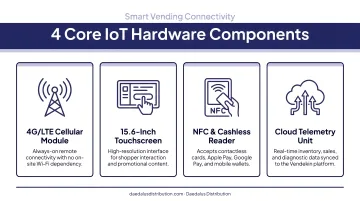
Traditional "dumb" machines require physical inspection for every check. Smart machines report their status automatically, turning invisible problems into visible alerts before they cost you money.
Together, these components raise a question operators frequently ask: how does IoT relate to AI?
IoT vs. AI in vending:
IoT is the foundation — it collects data and provides remote visibility. AI builds on top of IoT once enough data exists, using machine learning to forecast demand or optimize planograms. Most operators benefit significantly from IoT alone before needing AI-driven features. You don't need predictive algorithms if you can't even see what's selling right now.
The global installed base of connected vending machines reached 8.1 million units in 2025, growing at a 7.6% compound annual rate toward 11.7 million by 2030. For operators evaluating whether to upgrade, those numbers signal that the window for competitive advantage is now — not five years from now.
Real-Time Inventory Tracking and Remote Monitoring
IoT sensors track product levels in real time, slot by slot. You can see which products are running low, which are selling fastest, and which machines need restocking — all without making a physical visit. This changes service trips from "scheduled guessing" to "data-driven routing."
Remote monitoring dashboards give you:
- Online/offline status, sales totals, error alerts, and temperature readings for chilled units — all on one screen
- Full visibility across 50 machines at 20 locations, consolidated into a single dashboard
- Automatic restocking alerts when specific slots hit minimum thresholds, so you bring exactly what's needed
In 2025, North America operated 2.6 million connected vending machines out of 8.1 million globally. Connectivity penetration crossed the halfway mark worldwide, meaning more than half of all vending machines now report their status remotely.
The revenue impact of eliminating stockouts:
When a machine runs out of a top-selling product undetected, every hour it sits empty is lost revenue. Without IoT, you discover the stockout when a customer complains or when you physically check the machine days later. IoT turns stockout prevention from reactive to proactive — you get the alert when inventory hits 20% remaining, not when it hits zero.
A documented case study by Cantaloupe with Accent Food Services showed a 40% route reduction after deploying smart vending technology and telemetry-driven route planning. Fewer unnecessary trips, faster response to actual need, and higher revenue per visit.
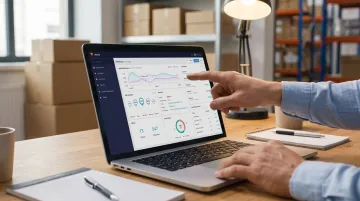
Remote monitoring also allows operators to manage planogram changes and pricing updates without a truck roll. The platform pushes adjustments digitally, saving time and fuel costs at scale. Vendekin machines from Daedalus Distribution include built-in remote inventory tracking and sales data reporting as standard — operators get this visibility from day one, with no need to retrofit older hardware with third-party sensors.
Predictive Maintenance and Reduced Downtime
Downtime is the single biggest revenue killer for vending operators. A machine that's offline, jammed, or malfunctioning bleeds revenue silently — sometimes for days before anyone notices. IoT changes this by making machines self-reporting.
IoT sensors monitor machine health continuously:
- Temperature fluctuations in refrigerated units
- Motor activity and mechanical wear patterns
- Payment reader errors and transaction failures
- Door-open/close events and unauthorized access
- Power cycles and electrical anomalies
These sensors flag anomalies before they become full failures. If a refrigeration unit starts drifting out of the safe temperature range, the system sends an alert. You schedule a targeted repair before the compressor fails completely and spoils an entire machine's inventory.
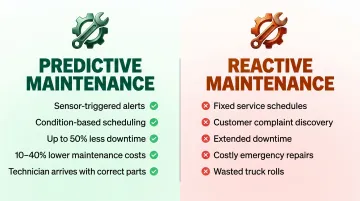
Predictive vs. Reactive Maintenance
Without IoT, operators run on fixed service schedules — every two weeks, regardless of need — or wait for customer complaints. With IoT, machines send alerts when specific thresholds are crossed. You schedule repairs based on actual condition, not guesswork.
According to a Körber Supply Chain analysis, predictive maintenance can reduce equipment downtime by up to 50% and lower maintenance costs by 10% to 40%. While this is a cross-industry benchmark, the principle applies directly to vending: catching failures early keeps machines running and earning.
Remote Diagnostics Cut Unnecessary Truck Rolls
Technicians can assess machine status before ever leaving the shop. They arrive with the right parts and resolve issues in a single visit — no wasted trips. According to a Nayax case study, one vending operator reduced service calls by 40% using real-time alerts and telemetry.
The Long-Term Payoff
Fewer breakdowns mean a longer machine lifespan, lower cumulative repair costs, and a stronger reputation with location partners who expect reliable service. A machine that stays operational consistently earns more — and costs far less to maintain — than one that fails without warning.
Cashless Payments and Enhanced Customer Experience
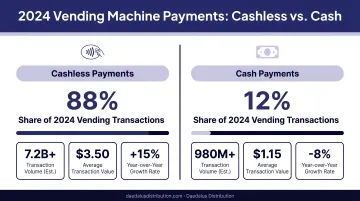
Cashless payment acceptance is now a baseline expectation, not a premium feature. Customers who don't have cash or coins will walk away from a machine that doesn't accept cards or mobile payments — no exceptions, no second chances.
According to the 2025 Diary of Consumer Payment Choice by the Federal Reserve, cash accounted for just 14% of all consumer payments in 2024, while credit and debit cards accounted for 35% and 30% respectively. Cashless payments made up 71% of all sales at vending machines in 2024, and the average cashless ticket was $2.24 — 37% higher than the $1.78 average for cash transactions.
IoT-Enabled Payment Options
- Tap-to-pay with credit and debit cards
- Mobile wallets (Apple Pay, Google Pay)
- Contactless transactions processed in under 2 seconds
- Secure payment processing through cellular-connected systems
Those cellular connections are what make reliable cashless payments possible anywhere. Cellular-connected machines work in hospitals, government buildings, gyms, and other locations with restricted or unreliable Wi-Fi. No password requests, no network configuration, no IT approval queue — the machine connects and stays connected on its own.
What Touchscreen Interfaces Add for Customers
- Personalized product suggestions based on purchase history
- Dynamic promotions and time-of-day product featuring
- Multimedia product displays with images and nutritional information
- Interactive browsing that increases average transaction value
Vendekin machines from Daedalus Distribution include built-in cashless payment systems supporting credit cards, debit cards, Apple Pay, Google Pay, and tap-to-pay options. These systems are pre-installed with digital touchscreen interfaces (10-inch or 22-inch depending on the model), giving operators a machine that handles payments, promotes products, and surfaces sales data — without any add-on hardware.
Data Analytics: Turning Vending Data Into Business Decisions
IoT vending machines generate data operators previously had no access to: sales by product, by time of day, by location, payment method breakdowns, traffic patterns, and which items get browsed but not purchased. Every transaction updates this data in real time.
Optimizing Your Product Mix
You identify which SKUs consistently underperform at a location and replace them with higher-velocity products. This reduces dead inventory and increases revenue per visit. A 2024 pilot by Selecta in Swiss offices used machine learning to rotate SKUs based on sales patterns, raising sales per machine by 19%.
Dynamic Pricing Capability
IoT-connected machines can apply time-based or demand-based pricing. For example:
- Discounting slow-moving items near expiry in a fresh food machine
- Pricing up premium items during peak hours
- Running promotions on underperforming SKUs to clear inventory
Roughly 8–10% of operators are experimenting with AI-driven dynamic pricing to adjust prices based on time of day or inventory expiration — an e-commerce tactic that's now viable in unattended retail.
Fleet-Level Decision Making
Aggregated data across a fleet helps operators make macro decisions:
- Identifying which locations are underperforming and why
- Determining which machine types suit which venue categories
- Deciding where to expand based on evidence, not gut feel
- Optimizing restocking routes based on real sales velocity
Cantaloupe's Seed Pick Easy platform allowed Maple City Dispensing to cut warehouse picking time in half, increase inventory accuracy, and reduce delivery routes. Fleet-level data transforms how you run the entire operation, not just individual machines.
That same principle applies to any modern IoT platform. Vendekin's management software, for instance, consolidates remote inventory tracking, real-time sales data, and automated reporting into a single dashboard — giving operators the visibility to act on fleet-wide patterns without being on-site.
What to Look for When Upgrading to an IoT Vending Machine
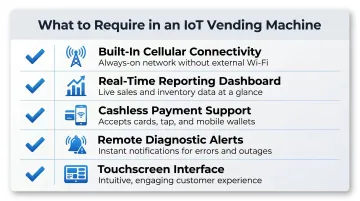
Key capabilities to require in a modern IoT vending machine:
- Built-in cellular connectivity — not Wi-Fi dependent, works reliably in any location
- Real-time reporting dashboard — view all machine statuses, sales, and alerts from one interface
- Cashless payment support — credit/debit cards, mobile wallets, tap-to-pay as standard
- Remote diagnostic alerts — temperature, motor activity, payment errors, and door events monitored continuously
- Touchscreen interface — digital displays that support promotions, product images, and dynamic pricing
Machines that require extensive third-party retrofitting add cost and complexity that cuts into your returns. Vendekin machines are designed as all-in-one IoT-enabled units from the ground up, so there are no third-party sensors or add-ons to source, install, or troubleshoot.
Check the supplier's support infrastructure, not just the hardware:
IoT vending machines are only as valuable as their uptime. Choose suppliers with a domestic support center, fast parts availability, and responsive service. A machine that's offline for a week waiting on overseas shipping means lost sales — and negates the efficiency gains you invested in.
Daedalus Distribution serves as the authorized U.S. reseller for Vendekin Technologies, with a parts and service center in Summerville, South Carolina. Operators get nationwide delivery and responsive technical support from day one, without depending on overseas suppliers or third-party service networks.
Match your upgrade approach to your current fleet:
- Starting fresh? Choose an all-digital machine with IoT built in from the ground up
- Upgrading an existing fleet? Prioritize cashless payments and telemetry connectivity first, then layer in advanced analytics once clean data starts flowing
Retrofitting a legacy machine with a cashless/telemetry reader typically costs around $399 for hardware plus $9.99/month for connectivity and management. Purchasing a new natively connected smart vending machine costs $2,500 to $10,000+ depending on type and features. Retrofitting extends the life of older equipment at lower upfront cost, but new machines deliver fully integrated systems with no compatibility trade-offs.
According to the NAMA 2024-2025 Industry Census, the typical operator maintains 277 machines and generates more than $6,000 in revenue per machine per year. Of machines that accept cashless transactions, 94% offer standard debit/credit and 88% offer contactless payments. Operators noted that the shift toward cashless has simplified their operations and led to higher transaction averages.
Frequently Asked Questions
What are the main advantages of IoT?
IoT gives operators real-time visibility into machine status and inventory, so you always know what's selling and what needs attention. It also enables predictive maintenance to prevent costly downtime, supports cashless payments, and generates sales data to guide smarter restocking and pricing decisions.
How does IoT reduce vending machine downtime?
IoT sensors continuously monitor machine health — temperature, motor function, payment errors — and send alerts when something is off. Operators can address issues before the machine fails rather than discovering the problem days later when sales have already been lost.
Can IoT vending machines accept cashless payments?
Yes. Modern IoT vending machines support card, contactless, and mobile wallet payments via secure cellular-connected payment systems. This makes them usable in locations with no or restricted Wi-Fi, including hospitals, government buildings, and gyms.
What is remote inventory monitoring in vending machines?
Remote inventory monitoring uses IoT sensors to track stock levels in each machine slot and report that data to a dashboard operators can view from anywhere. Restocking trips are driven by actual need rather than fixed schedules, reducing wasted visits and preventing stockouts.
How does IoT improve profitability for vending operators?
IoT increases profitability through fewer wasted service trips, faster response to downtime, elimination of stockouts on best-sellers, better product mix decisions based on real sales data, and dynamic pricing capabilities.
Do I need Wi-Fi to run an IoT-connected vending machine?
No. The best IoT vending machines rely on cellular connectivity rather than Wi-Fi, which means they work reliably in hospitals, office buildings, gyms, and any location regardless of available Wi-Fi. No passwords, network setup, or IT coordination required from the location host.