The consequences aren't theoretical. Administrative reviews regularly check whether schools are selling compliant foods, and violations can trigger corrective action or reimbursement risk. That makes understanding the rules not just useful — it's essential before you approach a single school.
This guide covers the federal law, state-level variations, what products are and aren't allowed, how to get placement approved, and what it costs to set up a school vending operation.
Key Takeaways
- School vending is legal, but products must meet USDA Smart Snacks standards during the school day
- Public schools in federal meal programs must comply; private schools depend on participation status and state law
- Product rules vary by grade level — elementary schools face the strictest beverage restrictions
- FDA calorie labeling applies to operators running 20 or more machines
- School placements typically use commission agreements at 15–20% of gross sales
Is It Legal to Put a Vending Machine in a School?
Yes — with conditions. Legality depends on whether the school participates in federal meal programs, what products you stock, when the machine operates, and what the district's Local Wellness Policy requires.
Public Schools vs. Private Schools
Public schools participating in the National School Lunch Program (NSLP) or School Breakfast Program (SBP) must comply with USDA Smart Snacks in School standards. These rules cover every food and beverage sold to students on campus during the school day — including vending machines. Non-compliance puts the school's federal reimbursements at risk, which gives administrators strong incentive to enforce the rules on any operator they allow on campus.
Private schools are a different story. Federally, the Smart Snacks rules are tied to NSLP/SBP participation, meaning a private school that doesn't participate isn't directly bound. California and Connecticut, for example, both tie private school obligations to program participation rather than school type.
Still, don't assume a private school is regulation-free. Many states extend nutrition requirements broadly, and private schools often adopt their own wellness policies.
Always confirm a school's federal meal program participation status before building your product plan.
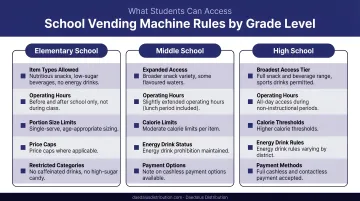
Age and Grade-Level Restrictions
Federal law draws a clear line between school levels:
- Elementary schools — water, low-fat/fat-free milk, and 100% juice only (8 oz max for milk and juice); all foods must be caffeine-free
- Middle schools — same beverage types as elementary, with juice and milk portions up to 12 oz
- High schools — gain access to calorie-free flavored water, diet sodas, and low-calorie beverages within specific calorie and size limits
Some states go further. Arkansas prohibits vending machines in elementary schools entirely during the school day. Operators serving multiple grade levels need a different product configuration for each school type — there's no one-size-fits-all product list.
The Federal Laws That Govern School Vending
Two separate federal frameworks apply to school vending operators. They're independent of each other, and both can apply simultaneously.
USDA Smart Snacks in School Standards
Smart Snacks covers all "competitive foods" — any food or beverage sold to students outside the federal reimbursable meal. Vending machines are included. The rules became mandatory in the 2014–2015 school year.
Core nutrient limits per item:
| Standard | Snacks | Entrées |
|---|---|---|
| Calories | 200 max | 350 max |
| Sodium | 200 mg max | 480 mg max |
| Total fat | 35% of calories max | 35% of calories max |
| Saturated fat | Under 10% of calories | Under 10% of calories |
| Sugar | 35% by weight max | 35% by weight max |
| Trans fat | 0 g | 0 g |
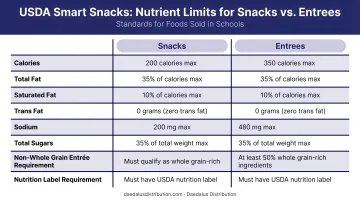
Items must also qualify as a grain product, fruit, vegetable, dairy, protein food, or a combination food containing at least ¼ cup of fruit or vegetable. Check individual products against the USDA Smart Snacks Product Calculator before stocking — brand-specific formulations change, and passing the calculator is your documentation.
The school day definition matters: Smart Snacks restrictions run from midnight before school until 30 minutes after the official school day ends. Machines operating during evening events or adult education programs may legally offer a broader product range outside those hours — which can affect revenue planning.
FDA Calorie Labeling Requirements
Under FDA rules (21 CFR 101.8), operators who own or operate 20 or more vending machines must post calorie information for each item, displayed clearly and visibly before purchase. Operators below that threshold aren't legally required to label unless they voluntarily opt in.
Note that this rule is entirely separate from Smart Snacks. An operator can be fully USDA-compliant but still carry FDA calorie labeling obligations based on total machine count across all locations — not just school placements.
Touchscreen machines with per-item display capability can simplify compliance — calorie counts can be shown on-screen before purchase, satisfying the visibility requirement without separate physical signage.
State and Local Regulations: What Varies by Location
Federal law establishes the baseline — but many states have added their own requirements on top of it. A few examples:
- Arkansas — No vending machines in elementary schools during the school day; additional limits on competitive food timing and frequency
- California — Public non-charter schools face state-specific competitive food requirements layered on top of federal Smart Snacks; whole grain and food-pairing rules differ
- Connecticut — State beverage law restricts milk sugar content and juice sweeteners; additional guidance limits candy, soft drinks, and caffeinated beverages around meal service
Beyond state rules, individual districts can pass Local Wellness Policies that are more restrictive than state law. A district might:
- Ban specific product categories outright
- Limit the number of machines per campus
- Require wellness committee approval before new machine placement
- Restrict operating hours beyond federal minimums
Before approaching any school, verify requirements at three levels:
- Federal — USDA Smart Snacks + FDA labeling threshold
- State — education department competitive food rules
- District — the specific Local Wellness Policy (publicly available)
Do that research before your first meeting. Walking in with answers — not questions — about compliance tells school administrators you're a credible partner, not a liability.
What Products Are (and Aren't) Allowed
Products That Typically Qualify
- Whole grain snacks: baked chips, popcorn, whole grain crackers, granola bars meeting fat/sodium/sugar caps
- Protein items: nuts, seeds, jerky (check sodium), cheese portions
- Dairy: low-fat or fat-free milk, low-fat yogurt within calorie limits
- Fruits and vegetables (fresh, dried, or packaged without added sugar/fat)
- Compliant beverages: plain water, 100% juice (in allowed portions), low-fat/fat-free milk
Verify individual products using the USDA Smart Snacks calculator. Formulations change, and the product label alone won't protect you — the calculator generates documentation you can reference during audits.
Products That Are Off-Limits During the School Day
- Regular potato chips, most cookies, pastries — fail fat, calorie, or sugar limits
- Candy bars and most candy — fail multiple nutrient standards
- Standard sodas and energy drinks — fail beverage type and calorie requirements for elementary and middle schools
- Full-calorie sports drinks — exceed calorie limits for most school levels
- Fruit drinks that aren't 100% juice — don't qualify as a compliant beverage
Stocking any of these during the school day at a participating school is a compliance violation. That means audit risk for the school's federal funding, not just a contract dispute between you and the administration.
How to Get a Vending Machine Placed in a School
Step 1 — Research Before Outreach
Confirm the school's NSLP/SBP participation status, download the district's Local Wellness Policy, and identify the correct decision-maker — this is often the food service director for larger districts, not just the principal.
Step 2 — Build a Compliant Product Plan
Prepare a written product list with full nutritional data for every item, verified against Smart Snacks standards. Schools won't approve proposals without this. Arriving without it signals that compliance isn't your priority.
Step 3 — Prepare a Formal Proposal
A strong proposal should include:
- Proposed machine locations and space requirements
- Complete product list with Smart Snacks compliance documentation
- Revenue-sharing or commission terms
- Restocking schedule and maintenance plan
- Equipment safety certifications
- Insurance and liability coverage information
Step 4 — Navigate the Approval Process
Approval typically involves the principal, the food service or wellness committee, and sometimes the full school board. Contracts often require annual renewal and include audit rights allowing the school to verify product compliance at any time. Ask explicitly about the decision-making chain and approval timeline before investing further time.
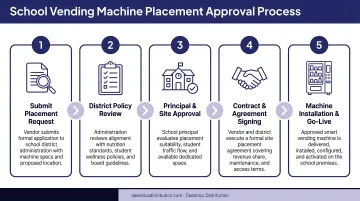
Step 5 — Execute the Contract and Stay Compliant
Compliance isn't a one-time task. Any product change — new items, seasonal swaps, restocks — requires re-verifying against Smart Snacks standards before the machine gets refilled.
The Vendekin platform included with Daedalus Distribution's machines makes this manageable. Remote inventory tracking, real-time sales data, and stock alerts let you monitor a compliant school account without a site visit every time something changes. Contact Daedalus at 843-490-2804 to request machine certification documentation for your proposal.
How Much Does It Cost to Put a Vending Machine in a School?
Machine Costs
Daedalus Distribution's Vendekin machines — the Omnivend Combo 22, Omnivend Combo 10, and Elevend Multivend 22 — are priced on request. For general market context, standard combo vending machines from other distributors typically list between $4,900 and $8,695, depending on features. For Vendekin pricing, contact Daedalus directly at contact@daedalusdistribution.com.
The Vendekin cloud management software is included at no separate license fee — no monthly subscription, no ongoing platform costs.
Commission Structures
Schools don't typically charge rent. Instead, they negotiate a percentage of gross sales:
- Greece Central School District (NY): 15% of gross sales revenue
- St. Johns County Schools (FL): 20% of gross sales minus sales tax
These documented examples aren't a universal rate, but they give you a realistic baseline. Final terms depend on the district's negotiating position and the volume you can demonstrate upfront.
Ongoing Operational Costs
Day-to-day operating costs:
- Product inventory and restocking labor
- Machine maintenance (warranty included with Vendekin machines from Daedalus)
Licensing and compliance costs:
- Business licenses and vending operator permits (required in most states — check with your state's department of agriculture or health)
- Any municipality-level permits required by local city or county ordinances
Frequently Asked Questions
How much does it cost to put a vending machine in a school?
Machine costs vary — standard combo machines run roughly $4,900 to $8,695 from distributors, with Vendekin machines priced on request from Daedalus Distribution. Schools typically receive 15–20% of gross sales rather than a flat placement fee, so your actual cost depends on the revenue-sharing terms you negotiate.
Is it illegal to sell snacks at schools?
Selling snacks isn't illegal, but selling non-compliant snacks during the school day at a school participating in federal meal programs violates USDA Smart Snacks standards. That violation creates audit risk for the school's federal funding and typically triggers immediate contract termination for the operator.
Do I need a license or permit to operate a vending machine in a school?
Most states require at minimum a general business license, and many require a specific vending operator permit or food handler registration. Michigan, Minnesota, and Connecticut all have documented licensing requirements for food vending operators. Check with your state's department of agriculture or health and your local city or county offices before operating.
Can elementary schools have vending machines?
Yes, but they face the strictest rules. Beverages are limited to water, low-fat milk, and 100% juice in small portions (8 oz max for milk and juice). Arkansas goes further and prohibits vending machines in elementary schools during the school day entirely. Check your state's rules before pursuing an elementary school placement.
What happens if a school vending machine is found to be out of compliance?
Consequences fall primarily on the school — violations identified in federal administrative reviews can trigger corrective action requirements or federal reimbursement risk. Operator contracts typically include a clause allowing the school to terminate immediately for compliance failures.
What's the difference between public and private school vending rules?
Public schools in federal meal programs must follow USDA Smart Snacks standards. Private schools outside NSLP or SBP aren't federally bound, but many states extend similar rules to them — and private schools often adopt comparable wellness policies on their own. Verify your state's requirements before assuming a private school placement is less regulated.