With 155.4 million U.S. emergency department visits annually (per CDC/NCHS data) and hospitals legally required to maintain 24-hour nursing operations, the captive audience inside any hospital campus is substantial and never stops. That's a sales environment most vending locations simply cannot replicate.
This guide covers everything operators need to know: licensing requirements, the approval process, equipment compliance, and where to place machines for maximum return.
Key Takeaways
- Yes — hospitals allow vending machines, but placement requires written approval from administration
- Expect to provide a business license, seller's permit, food permit, and liability insurance ($1–2M+ per occurrence)
- Hospital foot traffic is 24/7 and need-driven — one of the most stable vending revenue environments available
- Many hospitals mandate a minimum percentage of healthy products in every machine
- Approval takes weeks to months and involves formal proposals, contract negotiation, and ongoing compliance
Can You Place a Vending Machine in a Hospital?
Yes — vending machines operate in hospitals across the U.S. every day. But hospitals are privately controlled institutional environments, not open commercial spaces. You cannot walk in, find a corner, and plug in a machine. Access is governed by facility administration, and operators are treated as contracted service providers who must be vetted and formally approved before placement.
Who Controls the Approval
The approval authority depends on the hospital's size:
- Community hospitals — often a single Facilities Manager handles vendor approvals; faster process, more direct communication
- Large health systems and academic medical centers — vendor requests route through a Procurement or Contracts department; expect a structured RFP process and a longer timeline
- Multi-campus health systems — may issue system-wide RFPs covering multiple locations simultaneously, as Alameda Health System did when seeking operators for 48 machines across nine facilities
Contacting the wrong department wastes time and can damage your credibility before a proposal is even reviewed.
Minimum Documentation Required
Once you've identified the right contact, arrive prepared. Hospitals expect operators to have these in hand before any conversation moves forward:
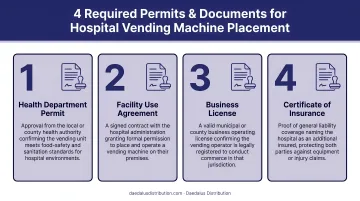
- Business license confirming your entity is in good standing with your state
- Seller's permit for sales tax collection (in California, one permit covers all machines under a single registration)
- Retail food handler's permit if dispensing food or beverages — issued locally in New York, while Florida requires a pre-operation inspection before approval
- Commercial general liability insurance with the hospital named as an additional insured — Kaiser Permanente sets minimums at $1M per occurrence/$2M aggregate; Alameda Health System's RFP required $1M/$3M aggregate
Own Your Machine vs. Joining a Managed Program
Some hospitals already have an exclusive vending contract with a single operator. Before pursuing a location, confirm whether an exclusivity clause is in place — it's a common arrangement that blocks outside operators entirely until renewal.
If exclusivity is locked in, you have two realistic paths:
- Wait for contract renewal — monitor the hospital's procurement portal or ask the Facilities Manager when the current contract expires; some health systems post upcoming RFPs publicly
- Partner with the existing operator — approach them about subcontracting a location or splitting coverage across the facility; this keeps you out of conflict with the exclusivity terms
- Pursue a different campus — multi-campus health systems don't always issue system-wide exclusivity; a contract at one facility may not extend to others in the same network
If no exclusivity agreement exists, you're free to submit a proposal directly to the appropriate department.
Why Hospitals Are One of the Most Profitable Vending Locations
Most vending locations operate on predictable schedules. Offices empty at 6 PM. Schools close on weekends. Retail traffic fluctuates seasonally. Hospitals don't work that way.
Under federal Conditions of Participation (42 CFR 482.23), hospitals must maintain 24-hour nursing services year-round. That operational requirement translates directly into a vending revenue opportunity that runs around the clock, every day of the year.
The Repeat Customer Advantage
Hospital staff work rotating shifts — often 8 to 12 hours — and return to the same floor, the same break room, and the same machine multiple times per week. That's not impulse buying. It's habitual, need-driven purchasing with low price sensitivity.
Consider the contrast:
- Retail vending — impulse-driven, price-sensitive, traffic varies by season and day
- Hospital vending — a nurse on a 12-hour night shift, a family in a surgical waiting room, or an ER visitor who hasn't eaten in four hours is buying because they genuinely need to
Need-driven buying means fewer slow days, fewer empty transactions, and more predictable weekly revenue than most other location categories.
Scale of the Opportunity
The data makes the opportunity concrete:
- The American Hospital Association reports 6,093 U.S. hospitals with over 35.6 million total admissions annually
- Healthcare facilities account for 9% of all vending locations nationally, per NAMA's 2022–2023 Industry Census
- The same census found that 42% of micro market operators reported actively exploring hospital and healthcare opportunities
- Overall vending and micro market industry revenue reached $33.85 billion in 2024, with medical and long-term care facilities cited as contributing notable gains
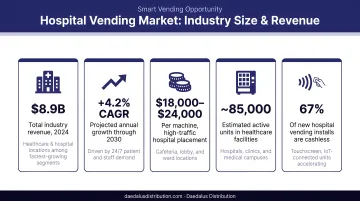
A single mid-size hospital campus can serve hundreds of staff per floor plus a constant rotation of outpatients and visitors. The scale of the captive audience is difficult to find in other location categories.
How to Get Approved to Place a Vending Machine in a Hospital
The approval process is not fast, particularly at large health systems. Plan for 4–12 weeks minimum, and treat every touchpoint as a formal business interaction.
Step 1 — Identify the Right Contact
Call the main hospital line and ask specifically who handles vendor or vending machine contracts. The answer will typically be one of three departments:
- Facilities / Plant Operations
- Food & Nutrition Services
- Procurement / Contracts Office
Going to the wrong department doesn't just delay things — it can signal that you're inexperienced with institutional procurement, which matters.
Step 2 — Prepare a Formal Written Proposal
Hospitals do not respond to informal pitches. Your proposal should include:
- Business credentials and license documentation
- Machine specifications (dimensions, power requirements, payment technology)
- Intended product categories and how they align with the hospital's wellness mission
- Contactless payment capability — this is increasingly expected in healthcare settings
- Any relevant experience serving institutional or healthcare locations
Machines with all-digital touchscreen interfaces and remote inventory monitoring are particularly well-suited to hospital proposals. Operators can verify stock levels and machine status without an on-site visit — a capability that directly supports the reporting obligations most contracts require. Daedalus Distribution carries the Vendekin line specifically for operators going after institutional placements like these.
Step 3 — Arrive With Your Documents Ready
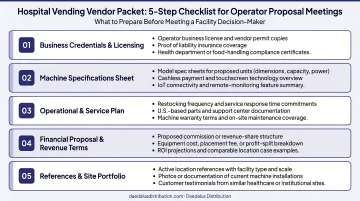
Walking into a proposal meeting without your permits and insurance certificate signals unpreparedness. Compile a vendor packet that includes:
- Business license
- Seller's permit
- Retail food handler's permit (state-specific)
- Certificate of insurance naming the hospital as additional insured
- Machine specification sheets
Step 4 — Negotiate Contract Terms Carefully
Hospital vending contracts typically cover:
- Commission rates: Paid as a percentage of gross sales — confirm exact terms per site, as these vary by facility and foot traffic
- Placement zones: Specific assigned locations on campus (not always your first choice)
- Restocking frequency: Service intervals are often contractually specified, not left to the operator
- Exclusivity clauses: Whether you're the sole operator or sharing the campus with competitors
- Reporting obligations: Many contracts require periodic sales reports submitted on a set schedule
For the reporting requirement specifically, cloud-based management platforms like Vendekin generate real-time sales data and automated reports — which makes contract compliance significantly easier to maintain.
Step 5 — Plan for Ongoing Compliance
Approval is not permanent. Hospitals periodically review contracts, and operators who maintain clean machines, meet product guidelines, and submit accurate sales reports on time are far more likely to see contracts renewed — and expanded to additional locations on the same campus.
Worth noting: Alameda Health System's RFP terms allowed immediate termination for repeated deficiencies not corrected within 30 days of written notice. That's standard language in healthcare contracts, not an outlier — so treat ongoing compliance as part of the job from day one.
Compliance, Equipment, and Product Requirements
Equipment Standards
Hospital-grade environments have specific expectations for vending equipment:
- NSF/ANSI 25 certification — establishes minimum food protection and sanitation requirements for vending machine materials, design, and construction
- ADA compliance — ADA compliance — ADA Standards Section 228.1 requires at least one machine of each type to meet accessibility requirements. Operable parts must be reachable between 15–48 inches, usable with one hand, and require no more than 5 lbs of force
- Temperature monitoring — for perishables, refrigeration units must maintain consistent temperatures; document inspections and any service events
- Quiet operation — machines placed near clinical or patient-care areas should not generate disruptive noise; confirm specifications with your equipment supplier
For ADA compliance details, exact certifications, and acoustic specifications for specific Vendekin models, contact Daedalus Distribution directly at contact@daedalusdistribution.com or +1 843-490-2804.
Hygiene and Sanitation
At every restocking visit, operators must:
- Clean all external touchpoints — payment panels, dispensing doors, screen surfaces
- Document the cleaning (hospitals may audit this)
- Inspect refrigeration units for moisture or bacterial growth risk
- Inspect refrigeration units for moisture or bacterial growth risk
- Note that digital touchscreen machines have fewer physical contact points than traditional keypads and coin mechanisms — a practical fit for hospital infection control standards
Product Requirements
Product Requirements
Equipment and hygiene compliance covers the machine itself — product compliance governs what goes inside it. FDA vending machine labeling rules require operators with 20 or more machines to disclose calorie information at the point of sale.
Beyond federal requirements:
- Roswell Park Cancer Institute required 25% of vending items to be healthy options, clearly identified
- Trinity Health (94 hospitals) gave sites the option of 50%, 70%, or 100% healthy vending, defining healthy snacks as ≤250 calories, ≤10g fat, ≤230mg sodium
- Many hospitals restrict or fully prohibit full-sugar sodas and high-calorie snack items
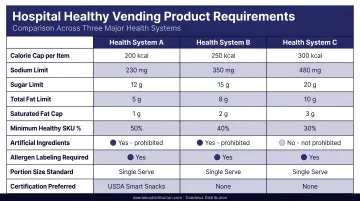
A 2018 study at Banner Health evaluated 23 locations and found that healthier product changes reduced vended calories, fat, and sodium — with no significant negative impact on total revenue or units sold. In practice, tightening your product mix to meet hospital standards doesn't mean sacrificing revenue.
Best Placement Spots and Operator Mistakes to Avoid
Highest-Value Placement Zones
Not all hospital real estate is equal. Prioritize these zones when negotiating placement in your contract:
- Emergency department waiting areas — 24/7 operation, high dwell time, stress-driven demand from families who may not leave for hours
- Nursing stations and staff break rooms — highest-frequency repeat users; staff on extended shifts rely on nearby machines consistently
- Main lobby and outpatient corridors — steady daytime visitor flow from appointments and check-ins
- Surgical waiting areas — families who will not leave the building for the duration of a procedure
Request foot traffic data per zone before finalizing placement terms. A high-traffic ER corridor can generate 3–5x the monthly revenue of a low-use administrative wing — zone selection matters as much as the contract terms.
Common Operator Mistakes
Knowing where to place a machine is only half the equation. These execution errors derail hospital vending placements before they ever get started:
- Approaching facility staff informally — without a written proposal, you won't be taken seriously
- Wrong product mix — bringing a machine stocked with items that violate the hospital's wellness policy is an immediate disqualifier
- Missing permits — arriving without a food handler's permit or insurance certificate ends conversations on the spot
- Neglecting the maintenance schedule — Alameda's contract required service calls within 2 business days and nonfunctional machine replacement within 2 weeks; missing these thresholds risks termination
- Underestimating approval timelines — large health systems routinely take 4–12 weeks through procurement; build that window into your planning before committing other resources
Frequently Asked Questions
Can I place a vending machine in a hospital?
Yes. Hospitals regularly host vending machines operated by external vendors. You must obtain written approval from the hospital's administration, facilities, or procurement department; secure all required business and food permits; and carry commercial liability insurance before any machine is installed.
How much do hospitals charge for vending machines?
Hospitals typically charge a commission on gross sales rather than flat rent. Rates vary by facility size, foot traffic, and contract terms — some locations use flat monthly fees instead. Clarify the structure early in your contract negotiations.
What kind of insurance do I need for a vending machine in a hospital?
Most hospitals require commercial general liability coverage with minimums of at least $1 million per occurrence and $2 million aggregate, with the hospital named as an additional insured. For example, Alameda Health System's vending RFP required $1M/$3M aggregate. Consult an insurance broker for current standards in your state.
What products are typically required or restricted in hospital vending machines?
Hospitals frequently mandate a minimum percentage of better-for-you options — water, low-sugar drinks, protein snacks, fresh food. Many restrict or ban full-sugar sodas and high-calorie items entirely. FDA calorie labeling applies if you operate 20 or more machines.
How do I approach a hospital about placing a vending machine?
Identify the right internal contact — Facilities, Food & Nutrition Services, or Procurement — then submit a formal vendor proposal covering machine specs, product mix, health alignment, permits, and insurance. Large health systems typically take several weeks to a few months to review.