This guide covers the legal rules you must follow before placing your first machine, the permits and licenses most states require, the types of locations that are off-limits or heavily restricted, and how to protect yourself with a proper placement agreement.
Key Takeaways
- Always get written permission from the property owner before placing a machine — no consent means trespassing charges, fines, or seizure.
- Most U.S. states require a business license, a seller's permit for sales tax, and a food handler's permit for machines dispensing food or drinks.
- Zoning laws often block commercial vending in residential zones — check your local zoning classification before committing to a location.
- Restricted products (tobacco, vape, alcohol) carry strict placement rules; federal law limits tobacco vending machines to adults-only establishments.
- Public property placements require government permits and competitive approval processes — private commercial space is generally easier to secure.
The Short Answer: No, You Cannot Install a Vending Machine Just Anywhere
Two foundational legal requirements apply to every vending machine placement:
- Written permission from the property owner or manager
- Compliance with local zoning and commercial activity laws
Without both, your installation is illegal—regardless of how low-traffic or "harmless" the spot appears. Ignoring either requirement can result in forced removal, fines, and in some cases seizure of your equipment.
Property Rights: Even Public-Looking Spaces Are Privately Owned
Even if a location appears publicly accessible—a parking lot, a building lobby, a transit station—it is almost always privately owned or controlled by a government authority. Placing a machine without explicit authorization constitutes trespassing.
Under Tucson, AZ municipal code (Article XIV, Sec. 7-301), operating an unregistered vending machine is unlawful and carries fines of $50 to $500 per offense. Each day of noncompliance is a separate violation, and the city may seize unregistered machines from public property at the owner's expense.
Treat every location as off-limits until you have written permission—and verify that it clears zoning requirements too.
Zoning Restrictions: Commercial Activity Is Prohibited in Many Zones
Municipalities classify land into zones—residential, commercial, industrial, and mixed-use. Vending is commercial activity, and residential zoning typically prohibits it outright.
Examples of zoning restrictions:
- Temple City, CA (Sec. 9-1T-15): "No reverse vending machine or collection facility may be allowed on a lot with a residential dwelling unit."
- Michigan statewide: Commercial or industrial zoning typically required for vending operations.
To check your location's zoning status, contact your local planning or zoning office. Most municipalities provide zoning maps online, but a quick call will confirm whether your target site is zoned for commercial activity.
Private, Public, and Semi-Public Property: Different Approval Processes
Property type matters legally:
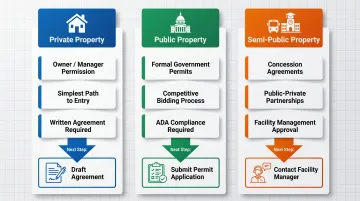
- Private property (offices, malls, apartment complexes): Requires owner or property manager permission; typically the simplest path.
- Public property (city sidewalks, parks, government buildings): Requires formal permits from the relevant government authority; often involves competitive bidding.
- Semi-public property (transit hubs, universities): May be governed by concession agreements or public-private partnerships; contact the facility management office.
Product-Specific Federal Restrictions
Some product categories carry federal or state placement restrictions on top of local rules. Under 21 CFR 1140.16(c), tobacco and vape vending machines are federally restricted to adults-only establishments—facilities where no person under 21 is present or permitted to enter at any time.
Four states—Idaho, South Carolina, Vermont, and Virginia—ban tobacco vending machines entirely.
Always verify product-specific rules with your state's regulatory authority before committing to a machine type.
What Permits and Licenses Do You Need Before Installing a Vending Machine?
The exact requirements vary by state and municipality, but most vending operators need to secure several core permits before placing a single machine:
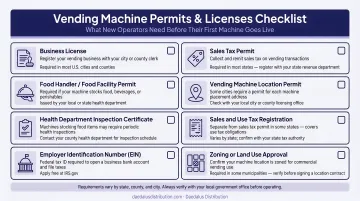
General Business License
Nearly every state and municipality requires vending route operators to hold a general business license issued by the city or county. Requirements and fees vary—contact your local city clerk or county office to confirm what's required in your jurisdiction.
Seller's Permit / Sales Tax Registration
If you sell taxable goods through a vending machine, you'll need to register with your state's revenue department to collect and remit sales tax. Some states have vending-specific rules that simplify compliance:
| State | Sales Tax Rule | Key Provision |
|---|---|---|
| California | Seller's permit required; one permit covers all machines | Cold food taxed on only 33% of gross receipts; items $0.15 or less exempt |
| Idaho | Seller's permit required; one for all machines | Items $0.11 or less exempt; items $0.12-$1.00 taxed on 117% of seller's cost |
| Tennessee | Standard state rate applies | Standardized 2.25% local rate for all vending, regardless of actual local rates |
Check your state's sales tax code to see if vending machine sales have specific exemptions or flat-rate options.
Health Department Permit / Food Handler's Certification
Any machine dispensing food, beverages, or perishable items is subject to health department oversight. You may need a food vending permit, and your machines may be subject to inspection.
- Massachusetts: Requires a license to operate a food or beverage vending machine at $10 per unit. Operators must display the license number on each machine and comply with sanitary standards under 105 CMR 590.000.
- Los Angeles County, CA: Machines dispensing potentially hazardous foods require a health permit; prepackaged non-potentially hazardous items (peanuts, gum, candy) are exempt.
Some states require the permit holder to complete a food safety course. Check with your local health department for specific requirements.
Vending-Specific License or Vendor Permit
Several states and municipalities issue a separate "vending machine license" distinct from a general business license.
- Tucson, AZ: Annual vending machine registration at $10 per machine, with decals issued for each unit. Registration runs July 1 through June 30.
- Texas: Tobacco vending machines require a specific retailer's permit from the Comptroller; merchandise vending machines (snacks, beverages) are exempt from the coin-operated machine occupation tax.
Verify whether your state or city requires this separate permit and understand the renewal cycle.
Business Entity and Tax ID
While not always legally required just to place a machine, forming an LLC and obtaining an EIN from the IRS is worth doing early. It:
- Separates personal liability from business operations
- Satisfies location owners who require proof of a legitimate business entity before signing agreements
- Properly manages tax obligations
The IRS EIN application is free and can be completed online in minutes. Once your permits and entity structure are in place, you're ready to move on to the placement agreements and location-specific rules that govern where machines can actually go.
Where You Can Legally Place a Vending Machine
With the right licenses and owner permission in hand, legal placement options are broad. The deciding factors come down to foot traffic and legal clearance — in that order.
Private Commercial Locations
Private commercial properties are the most legally straightforward placements. Common locations include:
- Office buildings and coworking spaces
- Manufacturing plants and warehouses
- Hospitals and medical centers
- Hotels and motels
- Gyms and fitness centers
- Shopping malls
- Apartment complexes and residential buildings
- Car dealerships and auto service centers
What makes these locations legally simpler:
- The property owner has clear authority to grant permission
- Existing commercial zoning already permits retail activity
- Operators need only standard business licenses plus a written placement agreement with the location owner
For example, operators running modern digital machines—such as Vendekin units distributed through Daedalus Distribution—can share real-time sales data reports with location owners through cloud-based management software. That kind of visibility tends to make placement agreement negotiations easier, especially in corporate or healthcare settings where accountability matters.
Public and Government-Owned Locations
Placing a machine on public property requires approval from the relevant government authority. This typically involves:
- A formal application process
- A public vendor permit or competitive bid process
- Additional rules around machine appearance, placement distance from curbs or entrances, and ADA compliance
Examples of public property placement processes:
- Chicago Transit Authority (CTA): Awards vending machine concession license agreements through formal ordinances, such as the 2024 agreement (Ordinance No. 024-69) with Romaine Empire, Inc. for vending operations across CTA facilities.
- Fresno Yosemite International Airport: Issues a Request for Proposals (RFP) for airport vending concession opportunities covering both Fresno Yosemite International and Fresno Chandler Executive airports.
- Bay Area Rapid Transit (BART): Manages station retail through formal RFP processes.
Public property placements are procurement-driven, not informal. Budget time for application cycles and compliance documentation.
ADA Compliance as a Legal Requirement
Any vending machine bolted to the floor or permanently installed in a public-facing location falls under the Americans with Disabilities Act (ADA). Operators must ensure:
- Controls and payment interfaces are between 15 and 48 inches from the ground (per ADA Standards Section 308)
- Machines are reachable from a wheelchair approach
- The path to the machine is unobstructed
Failure to comply can result in ADA complaints and fines. The ADA Title III Technical Assistance Manual provides a direct example: "Placing a vending machine on the accessible route to an accessible restroom in a bowling alley would be a violation if it obstructed the accessible route."
Review the ADA Standards for Accessible Design or consult an accessibility specialist when selecting machine placement.
Locations with Special Rules or Restrictions
Schools and Locations Serving Minors
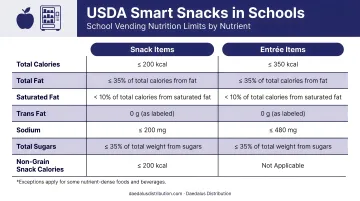
Schools and facilities primarily serving children have additional nutritional and product restrictions. USDA Smart Snacks in School regulations apply to schools participating in the National School Lunch Program (NSLP) or School Breakfast Program (SBP).
Key nutrient limits for snack items:
| Nutrient | Snack Limit |
|---|---|
| Calories | 200 maximum |
| Sodium | 200 mg maximum |
| Total fat | 35% of calories maximum |
| Saturated fat | Less than 10% of calories |
| Trans fat | 0 grams |
| Total sugars | 35% of weight maximum |
Some states impose stricter rules. Connecticut, for example, prohibits vending machines from ever selling soda, coffee, tea, sports drinks, hot chocolate, sweetened water, or juice drinks that are not 100% juice (C.G.S. Section 10-221q).
Check your state's school nutrition standards before approaching administrators — state rules can be significantly more restrictive than the federal baseline.
Restricted Product Machines
Tobacco, vape, and alcohol vending machines are subject to strict federal and state placement rules.
Federal tobacco vending rule (21 CFR 1140.16(c)): Cigarettes, smokeless tobacco, and e-cigarettes may only be sold via vending machine in facilities where the retailer ensures that no person younger than 21 years of age is present or permitted to enter at any time. This typically means bars, private clubs, and similar adults-only establishments.
State-level tobacco bans go further in some cases:
- Idaho, South Carolina, Vermont, and Virginia prohibit tobacco product vending machine sales entirely
- Several other states impose location or age-verification technology requirements beyond federal rules
Alcohol vending carries the same placement restrictions as tobacco, plus separate state liquor licensing requirements. Contact your state's alcohol control board to confirm what's permitted before purchasing equipment.
Residential Properties and HOA-Governed Communities
Placing a vending machine outside a private residence—even your own—requires:
- Checking local zoning for commercial activity in residential zones
- Potentially obtaining a home-based business license
- In HOA communities, getting explicit written approval from the homeowners association
Most HOA bylaws prohibit commercial equipment visible from the street. Temple City, CA (Sec. 9-1T-15) explicitly states: "No reverse vending machine or collection facility may be allowed on a lot with a residential dwelling unit."
Even in non-HOA residential areas, zoning laws typically restrict commercial activity. Verify both before committing to residential placement.
How to Secure a Location: Key Elements of a Placement Agreement
Why Every Placement Agreement Should Be in Writing
A written location agreement:
- Defines each party's rights and responsibilities
- Protects the operator if the location owner tries to terminate without notice
- Gives the location owner confidence that the operator is professional and accountable
Many location owners—especially businesses—will not allow a machine without a formal agreement.
Core Terms That Should Appear in Every Placement Agreement
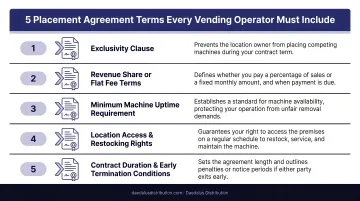
Every solid placement agreement should address these five areas:
- Duration and renewal: Specify the initial term (e.g., 12 months) and whether it auto-renews or requires renegotiation.
- Revenue sharing or flat rental fee: Commission rates range from roughly 5% to over 40% depending on traffic, product category, and competition. Common structures include split rates (e.g., 10% for snacks, 20% for beverages) or commissions based on gross revenue, gross revenue minus sales tax, or gross profit. Negotiate based on your specific location, not industry averages.
- Maintenance and restocking responsibilities: Spell out who handles cleaning, restocking, and repairs.
- Liability and insurance: Most location owners require proof of liability coverage before a machine goes on their premises.
- Early termination conditions: Define valid grounds for ending the agreement and the required notice period for both parties.
One factor that consistently smooths agreement negotiations: giving location owners visibility into sales data. Modern digital machines with cloud-based management software can generate real-time sales reports on demand — something location owners increasingly expect, and which removes a common source of friction during commission discussions.
How to Approach a Location Owner
Most rejections happen because operators approach without preparation. A professional pitch converts significantly better.
Prepare a short written proposal that outlines:
- The benefit to their customers or employees (convenience, 24/7 access, no staffing required)
- Your credentials (business license, insurance, professional references)
- The commission or rent structure you're offering
- How you'll maintain the machine and respond to service issues
Location owners field requests from many operators. A written proposal with clear terms — and proof you're insured and licensed — is what separates operators who get the spot from those who don't.
Frequently Asked Questions
Where can I legally place my vending machine?
You can legally place a vending machine on any private commercial property with the owner's written permission and appropriate business licenses. Public property requires government permits, often through competitive processes. Residential zones may prohibit commercial vending activity under local zoning laws.
Do I need an LLC to put a vending machine somewhere?
An LLC is not legally required in most states just to place a machine, but many location owners will require proof of a legitimate business entity before signing a placement agreement. Forming an LLC also protects personal assets from business liability.
Is owning a vending machine profitable?
Profitability depends heavily on location foot traffic, product selection, and commission costs. High-traffic locations with low overhead can generate meaningful passive income, but poor location choices are the most common reason vending businesses underperform.
Can I put a vending machine on public property?
Yes, but it requires a formal permit or application to the relevant government authority (city, county, transit agency). Public property placements often involve competitive processes and additional compliance requirements compared to private commercial locations.
What licenses do I need to operate a vending machine?
Most operators need a general business license, a seller's permit for sales tax, and a food handler's permit for food or beverage machines. Some states also require a separate vending machine license. Requirements vary by state and municipality—contact your local city clerk and state revenue department to confirm.