Introduction
University campuses concentrate thousands of students in a small area, with high foot traffic running around the clock and limited dining options after hours. Unlike office buildings or retail centers, campuses maintain residential populations that stay on-site evenings, weekends, and holidays, creating consistent demand that few commercial locations can match.
Yet many operators get stuck on the mechanics. How do you get permission to place machines on campus? Which buildings drive the most sales? What do college students actually want to buy? This guide covers all of it—practical steps for launching and growing a campus vending operation in 2025.
Key Takeaways
- Universities concentrate 15.4 million students with predictable schedules and 24/7 on-campus presence
- Formal university agreements are required—typically through facilities or food services—with commissions running 10–25% of gross sales
- Dormitory common areas, academic building lobbies, and libraries consistently outperform administrative or low-traffic locations
- Cashless payment is non-negotiable: 71% of vending sales are now cashless, and Gen Z rarely carries cash
Why University Buildings Are a High-Value Location for Snack Vending
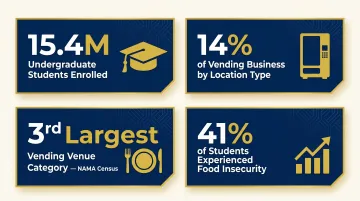
Universities concentrate purchasing power in a way few other locations can match. With 15.4 million undergraduate students enrolled at U.S. degree-granting institutions, campuses create dense, predictable customer bases with consistent daily schedules. Early morning classes, late-night study sessions during exam periods, and short breaks between lectures all drive snack purchase spikes throughout the day.
Food access gaps create structural demand for vending. 41% of college students experienced food insecurity during the 2023-2024 academic year, according to the Hope Center at Temple University. A separate Government Accountability Office analysis found that 23% of students (approximately 3.8 million) were food insecure in 2020.
Vending machines address this directly—providing affordable food access when dining halls are closed or students can't make it to one in time.
Most campus dining facilities operate on restricted hours that leave students without food access during critical periods:
- Evenings after 7-9 PM when dining halls close
- Weekends when facilities reduce hours or close entirely
- Holidays and academic breaks when most dining services shut down
- Late-night hours during exam periods when students study into the early morning
Vending machines become the only available food source during these windows. A University of Maryland student report noted that extending dining hours by just two hours (7-9 PM) attracted approximately 200 additional students per day—demonstrating the unmet demand when formal dining is unavailable.
Campus locations also outperform corporate offices on revenue consistency. While office buildings go quiet on weekends, residential students stay on campus around the clock—giving operators a more reliable income stream year-round. Colleges and universities represent 14% of vending business by location type, ranking as the third-largest vending venue category in the NAMA 2022-2023 Industry Census, tied with government buildings and ahead of healthcare facilities.
How to Get Permission to Place Vending Machines on a University Campus
Most universities require formal vending services agreements before allowing any machine placement. These contracts are typically managed through the facilities management department, food services office, or procurement/contracts office. Start by identifying the correct department at your target university—going through the right channel from the beginning matters. Contacting the wrong department or bypassing the formal process can result in rejected proposals, even if your machines and service quality are excellent.
Once you've identified the right contact, expect to negotiate a commission or revenue-sharing agreement. The institution takes a percentage of gross vending revenue in exchange for the location and utilities. Based on industry discussions and public RFP documents, commission rates typically range from 10–25% of gross sales.
That rate directly affects your margins. Higher commissions may require higher retail prices to stay profitable—or accepting thinner margins in exchange for a high-traffic location.
Larger universities often issue Requests for Proposals (RFPs) for vending services, while smaller campuses may be open to direct outreach. The competitive bid process requires formal proposals that detail:
- Commission percentage or flat monthly payment offered
- Machine specifications and technology capabilities
- Product mix including healthy or inclusive snack options
- Service commitments (restocking frequency, response time for repairs)
- References from other institutional clients
Publicly posted RFP examples include Ozarka College (Arkansas), Santa Fe College (Florida), and Southwestern Community College (North Carolina). These documents confirm that colleges use formal solicitation processes and expect multi-year contracts (typically 3 years).
What universities look for in a vending partner:
- Reliable machine uptime with minimal out-of-service periods
- Cashless payment capability (credit/debit cards and mobile wallets)
- Proven responsiveness to restocking complaints and repair requests
- A track record with other institutional or high-traffic accounts
- Compliance with campus nutritional standards where applicable
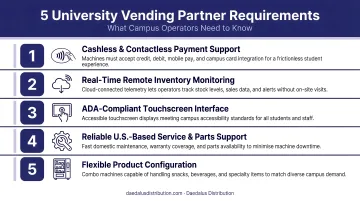
Tailor your proposal to address these priorities directly. Include data on your average machine uptime, examples of healthy product mixes you've implemented at other locations, and references from clients who can speak to your service responsiveness.
Some states and university systems have nutritional standards or "better-for-you" snack requirements for machines on public university grounds. The University of California system requires specific nutrition limits—snack items must not exceed 250 calories, 360 mg sodium, or 10% of calories from saturated fat.
Operators pursuing UC or similar system contracts must reformulate product mixes to comply. Check local policies before submitting proposals and be prepared to meet minimum healthy product quotas if required.
Finding the Best Locations Within University Buildings
Foot traffic volume combined with limited nearby food alternatives is the formula for high-performing vending locations. Scout buildings by observing traffic patterns at different times of day and week before committing to a spot. Stand in potential locations during peak periods (class changes, late evening study hours, weekends) and count people passing by. The best data comes from direct observation, not assumptions.
Here are the top-performing campus location types to prioritize:
Dormitory Common Areas and Lounges
Residential students are present at all hours and frequently buy snacks at hours when dining halls are closed. Dorm machines generate consistent daily demand—after dinner, during late-night study sessions, and on weekends when students don't want to cross campus. Few locations match this kind of round-the-clock, high-frequency traffic.
Academic Building Lobbies and Hallways
Students between classes have short windows for food—typically 10-15 minutes. Locations near lecture halls with large class sizes drive frequent impulse purchases. Place machines along main corridors where students naturally pass during class transitions, not tucked into dead-end hallways. Buildings with 200+ seat lecture halls generate particularly strong traffic.
Libraries and Study Areas
During midterms and finals, students routinely spend 6-10 hours in the library without leaving. That long-duration occupancy—paired with no desire to walk somewhere else—translates directly into consistent purchase frequency.
Campus Recreation Centers and Gyms
Post-workout demand for protein bars, trail mix, and energy snacks makes these strong complementary locations. Students finishing workouts seek convenient recovery nutrition without walking to dining facilities. Stock product mixes with a higher proportion of protein bars, nuts, and sports drinks than you'd carry in academic buildings.
What to avoid:
- Low-traffic administrative wings with primarily faculty/staff access
- Locations with nearby cafeteria or convenience store competition
- Buildings with limited student occupancy (faculty-only spaces, research facilities)
- Remote locations requiring students to walk out of their way
What Snacks Sell Best in University Vending Machines
Salty snacks consistently dominate vending sales across age groups. Circana's analysis of the broader $214 billion U.S. snack market identifies potato chips as the leading category at $8.6 billion in sales, with tortilla chips growing at 9.5%. Industry consensus from trade sources identifies chips/pretzels (Lay's, Doritos, Cheetos), candy/chocolate bars (Snickers, M&M's, Reese's), and cookies/pastries as the top three vending categories.
Core categories that perform well with college students:
- Salty snacks: chips, pretzels, popcorn, crackers
- Grab-and-go nutrition bars and protein snacks
- Chocolate and candy for stress/comfort eating
- Convenient single-serve items (trail mix, nuts, jerky)
Healthy snack demand is rising sharply among college students. 65% of operators report specific client requests for healthier product mixes, and 59% view better-for-you products as a primary growth opportunity, according to the NAMA 2024-25 Census. That said, going all-healthy is a mistake — a balanced product mix outperforms either extreme.
A Flinders University study published in Public Health Nutrition tracked what happened when healthy vending machines were placed alongside existing traditional machines on campus. The healthy machines generated 7,514 sales in year one and grew to 10,546 in year two. Traditional machine sales temporarily dipped from 10,125 to 8,671 — but recovered to 11,685 by year two.
The takeaway: adding healthy options expanded total market volume rather than cannibalizing existing sales.
Recommended product mix strategy:
- 40-50% traditional snacks (chips, candy, cookies)
- 30-40% better-for-you options (granola bars, nuts, dried fruit, baked chips)
- 10-20% premium/specialty items (protein bars, organic options)
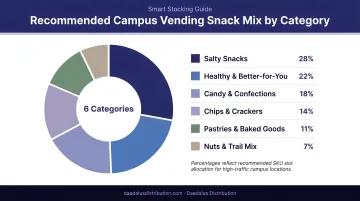
Rotate and test your product mix. Student preferences shift by semester, season (exam periods drive stress-eating, summer sees reduced traffic), and building type (gym locations favor protein snacks, dorm locations favor comfort foods). Use sales data to replace slow-moving SKUs every 4-6 weeks rather than leaving dead inventory in place.
What to Look for in a Campus Snack Vending Machine
Machine technology matters critically in university environments. Students are digitally native and expect cashless, frictionless transactions. Machines that only accept cash or have unreliable card readers generate complaints and lose sales. 71% of all vending sales are now cashless, according to 2024 Cantaloupe data, and the average cashless transaction is $2.24 vs. $1.78 for cash—a 25.8% higher spend.
Gen Z consumers are close to abandoning cash entirely. The Federal Reserve's 2024 Diary of Consumer Payment Choice found consumers under age 55 use cash for just 12% of payments. A Harris Poll found that more than half of Gen Z uses cash only as a "last resort". Campus machines without reliable cashless payment will lose the majority of potential transactions.
Key features to prioritize:
- Touchscreen interface for intuitive product browsing and selection
- Accepts credit/debit cards and mobile wallets (Apple Pay, Google Pay)
- Remote inventory and sales monitoring to cut unnecessary restocking trips
- Reliable dispensing mechanism with capacity sized for high-traffic periods
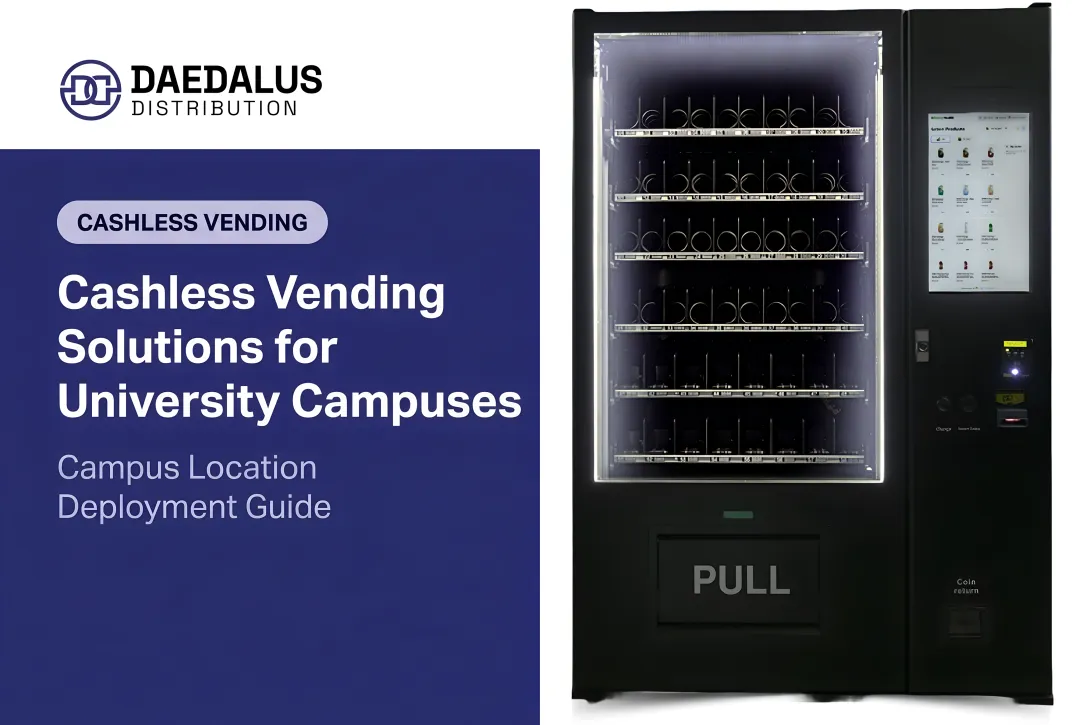
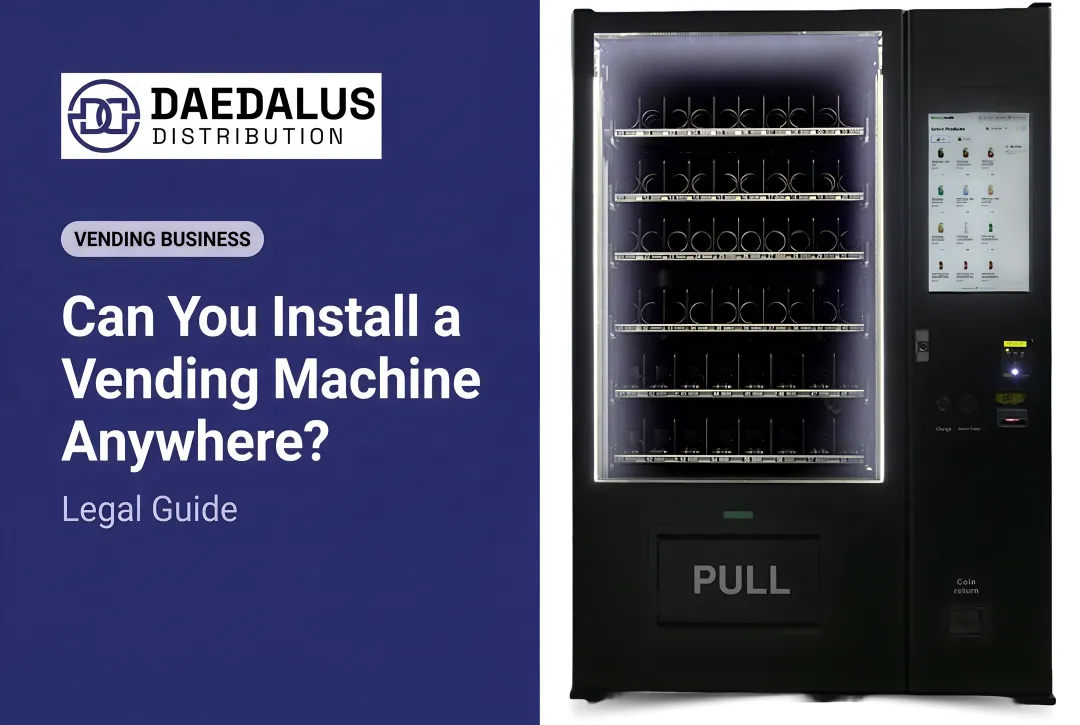
The Vendekin Omnivend Combo 22, distributed in the U.S. by Daedalus Distribution, checks all of these boxes. It features a 22-inch touchscreen with full cashless payment support and connects to cloud-based management software for remote inventory tracking.
That software layer matters as much as the hardware. Real-time sales data, low-stock alerts, and route optimization let operators manage multiple campus locations without daily on-site visits—reducing labor costs and guesswork for anyone running 5–10 machines across different buildings.
Managing and Growing Your Campus Vending Operation
Use sales data, not guesswork, to determine restocking frequency per location. High-traffic dormitory machines may need service two to three times per week during the academic year, while lower-traffic academic building machines may only need weekly visits.
Over-visiting wastes time and labor costs. Under-visiting costs sales when machines run out of popular items during peak demand periods.
Remote monitoring tools reduce operational overhead in meaningful ways. Machines equipped with real-time inventory tracking (such as those available through Daedalus Distribution's Vendekin platform) allow operators to see which products are running low without driving to each location. This enables route optimization—visit only the machines that actually need service on any given day, rather than running fixed routes regardless of actual inventory levels.
How to grow from one machine to a multi-machine campus operation:
- Track and document uptime, restocking responsiveness, and sales performance for 6–12 months with your initial machine
- Respond quickly to complaints and service requests — facilities contacts remember who shows up
- Approach the university about additional placements, using your documented track record as evidence
- Propose exclusive contracts for specific building clusters once you've demonstrated consistent service
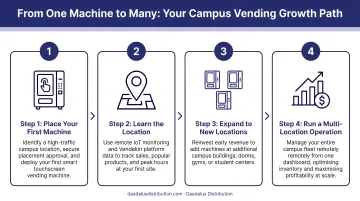
A strong track record of machine uptime, quick restocking, and low complaint rates is the most persuasive tool for expansion. Universities prioritize reliable service over minimal commission differences—if you've proven you won't let machines sit empty or broken for days, you'll have leverage to request additional locations or negotiate better commission rates.
Frequently Asked Questions
Can I put a snack vending machine on a university campus?
Yes, but it requires a formal agreement with the university's facilities or food services department. Contracts typically include a commission on sales (often 10–25% of gross revenue) and compliance with campus nutritional policies — institutional approval is mandatory before placement.
How do you find the best location for a snack vending machine on campus?
The best locations combine high foot traffic with limited nearby food alternatives. Dormitory common areas, academic building lobbies near large lecture halls, libraries, and campus gyms consistently outperform administrative wings or low-traffic areas. Scout buildings during peak periods before committing.
Do healthier snack vending machine products sell well on a university campus?
Yes, when paired alongside traditional snacks. A balanced product mix (roughly 40–50% traditional, 30–40% better-for-you) tends to outperform either extreme. Research shows that adding healthy options expands total sales volume rather than just replacing traditional snack purchases.
What payment methods should campus snack vending machines accept?
Modern campus machines must accept credit/debit cards and mobile wallets (Apple Pay, Google Pay) at minimum — 71% of vending sales are now cashless, and most college students don't carry cash. Machines with cash-only or unreliable card readers consistently underperform and generate complaints.
How often should you restock a snack vending machine at a university?
Restocking frequency depends on location and traffic volume. High-demand dormitory machines may need service two to three times per week, while lower-traffic locations may only need weekly visits. Remote monitoring tools show real-time inventory levels per machine, removing the guesswork from scheduling service runs.