Introduction
Rental competition has tightened sharply. According to CoStar's Q2 2025 multifamily report, national vacancy sits at 8.2% with asking rent growth barely above zero — meaning property managers can no longer rely on market conditions to fill units. Residents have options, and they know it.
Against that backdrop, vending machines tend to get dismissed as a minor convenience — and that's where properties leave real value on the table. Placed strategically and stocked correctly, they reduce daily friction for residents and generate passive income with no capital outlay from the property side. They also send a clear signal to prospective tenants during tours: management pays attention to the details.
This article covers the specific operational benefits of apartment complex vending machines — for property managers and vending operators alike — including how smart placement and modern machines turn an overlooked amenity into a measurable advantage.
Key Takeaways
- Apartment vending machines give residents 24/7 access to snacks, beverages, and essentials without leaving the building
- Property managers earn passive revenue through operator revenue-share agreements, with no upfront machine costs
- Well-placed machines improve resident satisfaction and boost lease renewal rates
- Cashless machines with remote monitoring cut operator workload by tracking inventory and sales data without on-site visits
- Revenue-share agreements require no machine investment from the property — operators cover equipment, stocking, and maintenance
What Are Apartment Complex Vending Machines?
Apartment complex vending machines are self-service units installed in residential building common areas, giving residents 24/7 access to products without leaving the property.
They're typically deployed in:
- Laundry rooms — high dwell time, natural demand for detergent and fabric softener
- Fitness centers and pool areas — post-workout hydration and snacks
- Main lobbies and mail rooms — daily foot traffic from nearly every resident
- Near elevators — passive visibility, impulse purchase opportunities
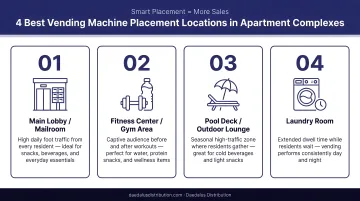
A well-placed machine does more than sell snacks. It improves resident experience, generates passive income for the property owner and operator, and gives the building a practical edge over comparable units nearby. Those three outcomes are exactly why apartment operators are adding vending to their amenity mix — and why the business case holds up across property types and sizes.
Key Advantages of Apartment Complex Vending Machines
The advantages below are grounded in operational and financial outcomes — not abstract quality-of-life claims.
Advantage 1: 24/7 On-Demand Convenience for Residents
Unlike office vending, which only matters during business hours, apartment vending serves residents at all hours. Late-night snack runs, early-morning grab-and-go, post-gym hydration — these needs don't follow a 9-to-5 schedule. The Bureau of Labor Statistics reports that 16% of U.S. wage and salary workers typically work non-daytime schedules. In a 200-unit building, that's potentially 30–40 households whose daily rhythm doesn't align with nearby store hours.
The convenience compounds when machines carry more than snacks. Laundry rooms stocked with detergent pods and fabric softener eliminate off-site trips for forgotten essentials — a small thing that removes one more source of daily friction.
Why this matters for retention:
Resident satisfaction is tied directly to how effortless daily life feels inside the property. Minor inconveniences accumulate over a lease term and consistently shape renewal decisions. When residents can self-serve basic needs on-site, complaint volume around minor inconveniences drops — and that reduction shows up in satisfaction scores.
KPIs impacted:
- Resident satisfaction scores
- Lease renewal rates
- Laundry facility utilization
- Foot traffic in common areas
When this advantage is strongest:
Large complexes (100+ units), urban properties without a 24/7 convenience store within walking distance, and any building with on-site laundry. Detergent vending sees its highest demand specifically in that last category.
Advantage 2: A Low-Effort Passive Revenue Stream
For property managers, the standard arrangement involves no upfront machine purchase. A vending operator installs, stocks, and maintains the equipment and pays the property a commission or revenue share — converting unused square footage in a laundry room or lobby into recurring income with no ongoing effort required.
For operators, apartment complexes address one of the hardest problems in vending: revenue predictability. A concentrated, captive audience with consistent daily routines generates stable transaction volume. Residents buy from what's available on-site; that behavioral consistency is something retail strip locations or event venues simply can't match.
The numbers in context:
NAMA's 2022–2023 Industry Census reports average annual sales of $6,284 per vending machine across the industry in 2023 — roughly $524 per machine per month in gross sales. High-traffic residential placements can perform meaningfully above that average given consistent daily usage patterns.
Unlike gym equipment, pools, or co-working spaces, vending machines carry essentially zero ongoing cost or management burden for the property. The operator handles installation, restocking, and maintenance.
KPIs impacted:
- Monthly passive income per location
- Cost-per-amenity versus revenue generated
- Machine uptime and average transaction value
- Sales volume by product category
When this advantage is strongest:
Operators managing multiple machines across a large complex — or running several apartment location accounts simultaneously — see the biggest returns. This is where remote monitoring becomes critical. Platforms like Daedalus Distribution's Vendekin machines allow operators to track sales data, inventory levels, and machine status across all locations from a single dashboard, without driving to each site to check on things manually. That's what makes scaling across multiple apartment locations practical.
Advantage 3: Tenant Retention and Competitive Differentiation
In a market where 8.2% of units sit vacant, the delta between a lease renewal and a move-out is often a collection of small experiences, not one dramatic event. Amenities are part of that calculation.
Multifamily Dive reported that apartment turnover costs approximately $3,872 per resident — covering advertising, unit refurbishment, concessions, and lost rent. That figure makes retention-focused investments look different. A vending machine that costs nothing to the property and marginally improves daily resident experience has a surprisingly strong ROI when measured against turnover costs.
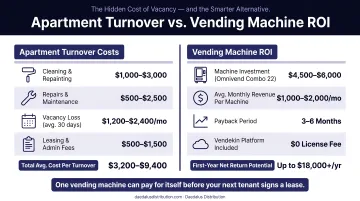
Modern machines also do something that older coin-operated units couldn't: they generate data. Operators using the Vendekin platform can see what's selling, what's sitting, and what needs to rotate — keeping product selections current rather than stagnant. A machine that consistently stocks what residents actually want stays relevant; one that doesn't gets ignored.
Why differentiation matters during tours:
A 22-inch touchscreen interface accepting Apple Pay and Google Pay in a clean, well-lit lobby makes a different impression than a dinged-up machine from the previous decade. That kind of detail signals to prospective tenants that management invests in the property — not just at move-in, but day to day.
KPIs impacted:
- Lease renewal rate and vacancy rate
- Time-to-lease for new units
- Tenant satisfaction/NPS
- Amenity utilization rate
When this advantage is strongest:
Markets with high rental inventory and comparable competing properties nearby. Mid-to-luxury properties where residents have higher baseline expectations for modern, low-effort amenities.
What Happens When Vending Machines Are Missing
The consequences are practical, not theoretical.
For property managers:
- Residents leave the building for minor needs, adding friction to daily life
- Common areas feel underdeveloped compared to nearby competitors
- A low-cost revenue opportunity goes uncaptured — one competitors may already be collecting
For vending operators:
- Apartment complexes are among the most stable, high-repeat-purchase placement categories available
- Without these accounts, consistent revenue sits unclaimed while competitors lock in building relationships
- Once a contract is established elsewhere, re-entry is rare — property managers seldom want two operators on-site
Existing operator relationships tend to stick. For vending operators, that makes early placement a real competitive edge — not just a nice-to-have.
How to Get the Most Value from Apartment Complex Vending Machines
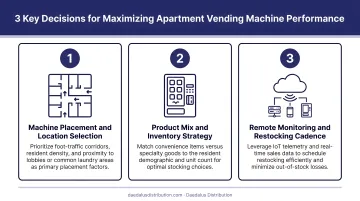
Three decisions drive the majority of outcomes:
1. Placement first. Machines in laundry rooms, fitness centers, and main lobbies consistently outperform machines in low-visibility hallways. Audit actual foot traffic patterns before finalizing locations — assumptions are often wrong.
2. Match product mix to the resident profile. A student housing complex has different purchasing habits than a luxury building. Granola bars, energy drinks, and ramen packets serve one demographic; premium protein bars, sparkling water, and single-serve coffee serve another. Use machine sales data to rotate underperformers regularly rather than guessing once at setup.
3. Invest in the right technology infrastructure. Machines without cashless payment will underperform — the Federal Reserve's 2025 Diary of Consumer Payment Choice found that adults aged 18–24 use mobile payments for 45% of all transactions and carry cash for only 10%. That age group is the core apartment renter demographic.
Daedalus Distribution's Vendekin machines — the Omnivend Combo 22, Omnivend Combo 10, and Elevend Multivend 22 — include built-in cashless payment (credit, debit, Apple Pay, Google Pay, tap-to-pay), cloud-based remote monitoring, and real-time sales reporting. All of that comes with the machine at no separate software fee.
For operators managing multiple apartment locations, that infrastructure eliminates the need for on-site visits just to check inventory. You can monitor stock levels, review sales data, and identify underperformers from anywhere — which keeps time costs flat even as the number of locations grows.
Conclusion
The value of apartment complex vending machines shows up in measurable places: resident satisfaction scores, lease renewal rates, and operator revenue statements. None of it is accidental. It follows from placement decisions, product selection, and having technology that supports the operation rather than creating new problems.
The advantages compound over time. As operators refine product mix using sales data and residents build habitual usage patterns, both machine revenue and resident satisfaction improve together — a direct result of treating the setup as an ongoing operation, not a one-time install.
A technology partner like Daedalus Distribution makes that ongoing management practical, with remote monitoring and sales data built into the machine from day one. Get the placement and the platform right, and the results follow.
Frequently Asked Questions
Can you put a vending machine in an apartment complex?
Yes — vending machines are commonly placed in apartment complexes through a revenue-share or location agreement between the operator and property management. The arrangement typically requires no capital investment from the property side, making it easy for both parties to move forward.
How many vending machines do you need to make $1,000 a month?
Using NAMA's industry-wide average of $524 in gross monthly sales per machine, roughly two well-placed machines would reach $1,000/month in gross sales. High-traffic apartment locations often outperform the industry average, so actual numbers depend on foot traffic, product mix, and machine placement quality.
What should I stock in an apartment complex vending machine?
Core categories include beverages, snacks (traditional and healthier options like granola bars and nuts), and household essentials such as laundry detergent pods for laundry room locations. Tailor inventory to your resident demographic and adjust it regularly based on sales data — not just once at setup.
Where is the best place to put a vending machine in an apartment building?
Laundry rooms, main lobbies, fitness centers, and pool areas consistently outperform lower-traffic hallway placements. Visibility, adequate lighting, and proximity to where residents naturally spend time are the three factors that matter most for machine performance.
Do apartment vending machines need cashless payment options?
Cashless and contactless payment is now a baseline expectation. Most apartment residents, especially younger demographics, rarely carry cash — and machines without card or mobile wallet acceptance will see substantially lower transaction volumes regardless of placement or product selection.
How do vending machines help with tenant retention?
On-site amenities reduce the small daily frictions that accumulate over a lease term and signal attentive property management. Residents whose needs are met within the building renew more often — and vending machines deliver that without ongoing effort from property staff.