 in Pennsylvania](https://file-host.link/website/daedalusdistribution-0jubjd/assets/refined-images/1781187495454000_1005851ef0e94fcfa33577bde5d74a30/360.webp)
Interest in starting a vending business spans a wide range of people: side-income seekers, career changers, small business owners diversifying revenue, and investors drawn to a model with relatively low overhead and predictable demand. The challenge is that most guides skip over Pennsylvania's specific compliance requirements and the realistic work involved in building a functional route.
This guide covers everything you need: niche selection, financial modeling, business registration, Pennsylvania tax rules, machine sourcing, location strategy, and the compliance requirements that catch first-time operators off guard.
Key Takeaways
- A vending machine business earns the margin between wholesale product cost and the retail price customers pay at the machine
- Pennsylvania requires business registration, a Sales, Use and Hotel Occupancy Tax License, and a food facility license for machines dispensing potentially hazardous foods — there is no state vending operator license or per-machine registration
- New machine costs range from around $3,000 for basic units to $15,000+ for smart touchscreen models — location quality drives profitability more than equipment choice
- The average vending machine generates $6,284 in annual sales (NAMA 2022–2023 Industry Census) — net profit depends heavily on location, product mix, and commissions
- Philadelphia and Pittsburgh carry additional local licensing and tax requirements beyond state-level obligations
What to Know Before Starting a Vending Machine Business in Pennsylvania
Vending Takes Real Work Before It Runs Itself
The "semi-passive income" framing is accurate eventually — not at the start. In the first few months, you're handling everything yourself: prospecting locations, negotiating placements, sourcing inventory, driving restocking routes, troubleshooting machines, and filing Pennsylvania tax returns.
Systems take time to build. Operators who treat vending as a set-and-forget side hustle underperform those who treat the first year as a proper business launch.
Realistic Income Benchmarks
NAMA's industry data puts average annual sales per machine at $6,284 — roughly $524/month in gross revenue. Your net income after inventory cost, location commissions, card processing fees, and fuel will be a fraction of that, and it varies by location type.
- A machine in a low-traffic office may barely cover costs
- A machine in a busy hospital corridor or warehouse break room can outperform that average substantially
- Locations — not machines — determine whether a route is profitable
Pennsylvania's Tax and Licensing Structure
Pennsylvania has one of the more complex local tax structures in the country. Two things catch new operators off guard:
- Sales tax rules for vending are product-specific — not all items are taxed the same way, and the formula for calculating what you owe is precise (more on this in the compliance section)
- Philadelphia and Pittsburgh have their own licensing layers on top of state requirements — separate research for each city is required before placing a single machine there
Why Start a Vending Machine Business in Pennsylvania?
Pennsylvania is one of the more practical states to launch a vending route. Its manufacturing sector alone puts shift workers in front of break-room machines daily — workers on tight schedules who aren't leaving the building to grab a snack.
Beyond manufacturing, the state offers:
- Philadelphia, Pittsburgh, Allentown, and Harrisburg deliver dense, consistent daily demand across offices, transit hubs, and retail corridors
- Major university campuses — Penn State, Temple, Pitt, Drexel — generate high-volume, year-round student traffic
- A large healthcare sector with hospitals running 24/7, where patients, visitors, and staff all need accessible food and beverage options at any hour
- No state vending operator license required — a single-machine operation can start for under $3,500
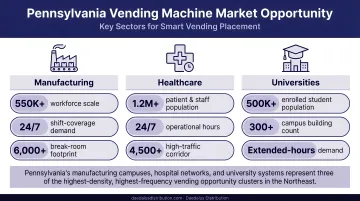
That demand sits inside a growing national market. The U.S. convenience services industry reached $22.4 billion in revenue in 2022, according to NAMA's Industry Census, with projections pointing toward continued growth. Pennsylvania's mix of industrial, academic, and healthcare locations gives new operators multiple entry points into that market.
That said, vending isn't passive income — not at the start. You'll need to cold-call property managers, commit to a reliable restocking schedule, and accept that most routes take a few months to stabilize. It's a poor fit for anyone expecting hands-off returns from day one.
How to Start a Vending Machine Business in Pennsylvania — Step by Step
The most common early mistakes: buying machines before securing a location, underpricing to win placements, and skipping tax registration. The steps below are sequenced to avoid all three.
Step 1 — Research the Market and Choose Your Niche
Match your vending format to the Pennsylvania markets you can realistically access:
| Format | Best Fit |
|---|---|
| Traditional snack/beverage | Offices, warehouses, apartment break rooms |
| Fresh food / micro-market | Hospitals, corporate campuses, large factories |
| Specialty (PPE, wellness) | Healthcare facilities, gyms, underserved niches |
| Bulk vending | Low-cost entry; schools, laundromats |
Before buying anything, visit your shortlisted locations in person. Note foot traffic patterns, observe whether existing machines are well-stocked and maintained, and identify nearby food alternatives that would compete with you.
Step 2 — Validate Demand and Build a Simple Financial Model
Secure at least a verbal commitment from a property manager before purchasing equipment. Confirm:
- Approximate daily foot traffic
- Whether the location already has vending (and how well it performs)
- The commission structure the location expects
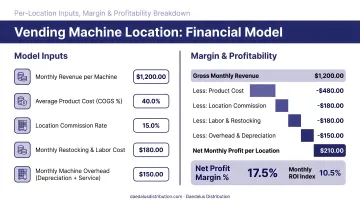
Then build a per-machine model. Key inputs:
- Gross revenue estimate based on realistic weekly sales volume
- Inventory cost (your wholesale cost per unit sold)
- Location commission as a percentage of gross sales
- Card processing fees — Vending Times reports that 71% of vending transactions in 2024 were cashless, with typical processing running around 2.6% + $0.10 per transaction
- Fuel and service costs for your restocking route
- Pennsylvania sales tax liability on applicable products
If a location doesn't clear a 25–30% gross margin after commissions and fees, it's not worth the machine placement.
Step 3 — Register Your Business and Set Up Finances
Business entity: Register an LLC with the Pennsylvania Department of State. The filing fee is $125. An LLC provides liability protection and pass-through taxation — it's the standard structure for vending operators.
Federal EIN: Obtain a free Employer Identification Number from the IRS. Required for tax filings and opening a business bank account.
Sales tax license: Register for Pennsylvania's Sales, Use and Hotel Occupancy Tax License through the PA Department of Revenue's myPATH portal. Under 61 Pa. Code § 31.28, one license covers all machines operated by the same entity — no per-machine registration is needed.
Banking and bookkeeping: Open a dedicated business bank account before your first sale. Mixing personal and business finances creates accounting headaches and complicates tax filing.
Step 4 — Source Machines and Stock Initial Inventory
Machine options by tier:
- Used machines — Available from $995–$2,500; lower upfront cost but higher breakdown risk and often no cashless payment capability
- New traditional machines — $2,999–$6,000+ range; typically include warranties and modern card readers
- Smart/digital touchscreen machines — Higher upfront investment; offer remote inventory tracking, real-time sales data, and cashless payment built in
Smart machines are worth the premium if you're managing multiple locations — remote inventory alerts, per-machine sales data, and route optimization tools reduce the time you spend physically checking stock. Daedalus Distribution carries the Omnivend Combo 22, Omnivend Combo 10, and Elevend Multivend 22 from Vendekin Technologies, all with built-in cashless payment (credit, debit, Apple Pay, Google Pay) and the Vendekin cloud management platform included at no separate license fee.
Machines ship nationwide from their South Carolina warehouse, with U.S.-based parts and service support included.
For initial inventory: Start with proven bestsellers for your specific demographic — energy drinks, bottled water, and popular snacks for offices and warehouses; protein bars, dairy, and fresh food options for gyms or medical settings. Use the first 30–60 days of real sales data before committing to larger orders.
Step 5 — Negotiate Location Agreements and Launch
In-person visits to property managers outperform cold email. Bring a brief one-page summary covering:
- You handle all installation, restocking, and maintenance at zero cost to them
- They receive a commission on sales
- The machine requires no staff involvement from their side
Always formalize placements with a written agreement that includes:
- Term length (one year with auto-renewal is standard)
- Commission rate and payment schedule
- Your responsibilities for maintenance and insurance
- A clear termination clause
Operating without a signed contract leaves your entire investment in that location unprotected.
Step 6 — Monitor Performance, Optimize, and Scale
In the first 60–90 days, track per-machine metrics weekly:
- Gross sales
- Gross margin after inventory cost
- Commission as a percentage of sales
- Card processing fees
- Spoilage rate
- Service visit frequency
Use this data to determine whether a location is worth keeping or whether the machine should be relocated. Stabilize one or two machines before adding more — once your restocking cadence and product mix are dialed in, add locations methodically, prioritising existing high-performing sites before acquiring entirely new placements.
Pennsylvania Permits, Tax, and Compliance Requirements
Business Registration and Tax Licenses
| Requirement | Details |
|---|---|
| Business registration | Required — PA Department of State; LLC filing fee $125 |
| Sales tax license | Required — one license covers all machines; register via myPATH |
| State vending operator license | Not required in Pennsylvania |
| Per-machine registration | Not required |
Pennsylvania Vending Sales Tax Rules (61 Pa. Code § 31.28)
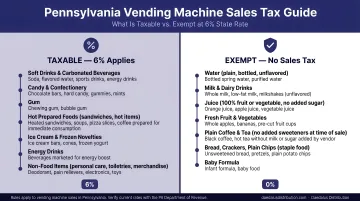
Not everything sold from a vending machine is taxed the same way.
Taxable at 6%:
- Soft drinks, brewed coffee, hot beverages (hot chocolate, hot tea)
- Hot or cold sandwiches and meals
- Heated food (pizza, soup, food dispensed warm or heated in operator-provided equipment)
- Food from salad bars
Exempt:
- Chips, pretzels, crackers, baked goods, candy, gum
- Milk products, juice beverages, iced tea, iced coffee, unflavored water
- Prepackaged ice cream and frozen water-based products
- Cold food when no heating equipment is provided
Tax calculation formula: (Total taxable receipts ÷ 1.06) × 0.06 = sales tax owed
Important: Under 61 Pa. Code § 31.28, sales from machines located on school or church premises are exempt from sales tax on food and beverages.
You must also display your name and address on each machine — this is a legal requirement, not optional.
Food Facility Permits
If your machines dispense potentially hazardous (TCS) foods, fresh food, or you operate micro-markets, you need a Retail Food Facility License from the Pennsylvania Department of Agriculture. The Pennsylvania Department of Agriculture lists a new facility license at $241, with renewal occurring annually.
Philadelphia and Pittsburgh Requirements
Philadelphia
- Commercial Activity License (currently no fee; no renewal required)
- Business Income and Receipts Tax (BIRT) registration — returns due April 15 annually
- Food preparation/serving license for machines dispensing perishable or prepared food
Pittsburgh
- Vending License: $137 (including technology fee) for new applications and renewals
- Vending Location Priority Permit: $67 total per location
- Allegheny County Health Department food permits — Class 1 for commercially prepackaged shelf-stable food; Class 2–4 for refrigerated or prepared food
Verify current requirements directly with each municipality before launch.
Product Restrictions
Beyond city permits, certain product categories carry their own state-level restrictions.
- Tobacco vending machines require a dealer license from the PA Department of Revenue at $25 per vending location; Pennsylvania restricts tobacco vending to specific adult-only establishments
- School vending must comply with USDA Smart Snacks in School nutrition standards plus Pennsylvania Department of Education requirements
- CBD/hemp products must meet Pennsylvania Department of Agriculture regulations
Frequently Asked Questions
Frequently Asked Questions
How many vending machines do I need to make $100,000 a year in Pennsylvania?
Using the NAMA industry average of $6,284 in annual gross sales per machine, reaching $100,000 in net income typically requires a well-optimized route of 20–30+ machines. Most operators take 12–24 months to build a route that size, depending on location quality and margins.
What permits or licenses do I need to start a vending machine business in Pennsylvania?
Pennsylvania has no state vending operator license or per-machine registration. You'll need to register your business with the PA Department of State, get a Sales, Use and Hotel Occupancy Tax License via myPATH, and — if selling fresh or perishable food — a Retail Food Facility License from the PA Department of Agriculture. Philadelphia and Pittsburgh have additional local requirements.
Do I need to form an LLC to start a vending machine business in Pennsylvania?
An LLC is not legally required, but it's the most common structure because it separates personal and business liability, protects your assets if the business is sued, and makes it straightforward to open a business bank account. The PA LLC filing fee is $125 through the Department of State.
What vending machine items are taxable in Pennsylvania?
Under 61 Pa. Code § 31.28, soft drinks, hot beverages, sandwiches, and heated food are taxable at 6%. Chips, candy, gum, milk, juice, and unflavored water are exempt. To calculate tax owed: (taxable receipts ÷ 1.06) × 0.06.
How much does it cost to start a vending machine business in Pennsylvania?
Machine costs range from $3,000–$6,000 for traditional units to $6,000–$15,000+ for smart or digital machines. Add $125 for LLC registration, $300–$600/year for insurance, and $200–$500 per machine for initial inventory.
What are the best locations for vending machines in Pennsylvania?
Manufacturing and warehouse facilities (particularly around Greater Philadelphia, Pittsburgh, and the Lehigh Valley), hospitals and urgent care centers, university campuses, apartment complexes, and office buildings consistently perform well. The best location combines high daily foot traffic, limited nearby food alternatives, and extended or 24/7 access hours.