Behind every airport vending machine is a layered supply chain: manufacturers who build the hardware, distributors who source and supply machines to operators in specific markets, and operators who place, stock, and maintain machines in terminals. This article serves two audiences—curious travelers wondering who builds these machines, and entrepreneurs exploring the airport vending business—by breaking down the entire ecosystem from factory floor to terminal gate.
TLDR:
- Airport vending machines are built by manufacturers like Sielaff and Vendekin, sold through authorized distributors such as Daedalus Distribution, and operated by companies who place and stock them in terminals
- Specialty operators like Farmer's Fridge and Best Buy Express use custom-commissioned machines designed for specific product categories
- Airport-grade machines require 24/7 durability, cashless payment systems, and remote monitoring—features standard office machines lack
- Placing a machine requires approval from the airport authority or master concessionaire, plus formal business credentials and insurance
- High foot traffic and premium pricing make airports among the most profitable vending locations, but commission fees typically range 15-25% of gross sales
Who Actually Makes Airport Vending Machines
The question "who makes airport vending machines" has three different answers depending on which layer of the supply chain you mean. Understanding the distinction between manufacturers, distributors, and operators matters whether you're considering entering this market or just curious about how these machines end up in terminals.
Manufacturers build the physical hardware—the metal frames, refrigeration systems, dispensing mechanisms, touchscreens, and payment readers. These companies engineer industrial-grade machines designed to withstand constant use in public environments.
Distributors and resellers source machines from manufacturers (often overseas) and supply them to operators in specific markets. In the United States, companies like Daedalus Distribution serve as authorized resellers, handling import logistics, warehousing, and providing U.S.-based parts and service support that direct overseas purchases cannot offer.
Operators are the businesses that actually place, stock, and maintain machines in airports. They negotiate placement agreements with airports, manage inventory, handle restocking logistics, and collect revenue. Some operators buy off-the-shelf machines from distributors; others commission custom-built units tailored to their specific product category.
Established Hardware Manufacturers
Legacy vending machine manufacturers like Sielaff have spent decades engineering airport-grade machines. Sielaff markets specific airport applications including the SiLine Snack/Combi S and M series, Public variants with anti-theft frames, and RO outdoor variants with weatherproofing and frost monitoring heaters. These machines feature 12 mm polycarbonate panels, reinforced locking, laminated safety glass, stainless steel kickplates, and IP24 weather protection for curbside installations.
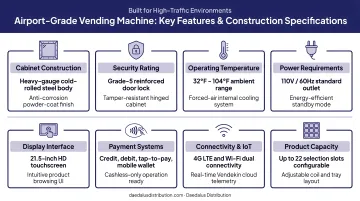
What separates industrial airport machines from standard office vending units? Construction durability and security. Airport machines weigh approximately 330 kg with anti-theft frames and include impact-resistant materials designed to withstand high-traffic public environments where vandalism and rough handling are constant risks.
Crane Merchandising Systems (CPI) provides payment platforms and custom unattended retail solutions widely used in vending, though the company markets payment technology rather than airport-specific machine models. Seaga manufactures commercial vending equipment but doesn't market airport-specific product lines.
Specialty Branded Operators and Their Custom Machines
Some companies have built entire vending businesses around proprietary systems designed for a single product category. Farmer's Fridge operates in 20+ U.S. airports including JFK, EWR, ORD, LAX, DFW, and BOS, dispensing fresh refrigerated meals in jars and bowls. Their machines feature custom hardware with touchscreen interfaces displaying full nutrition information, built-in jar recycling slots, refrigerated compartments with remote temperature monitoring every five minutes, and automatic lockout if temperatures drift out of spec. These machines represent custom-commissioned hardware built to Farmer's Fridge specifications rather than off-the-shelf units.
Best Buy Express operates approximately 200 electronics vending kiosks nationwide, with about 80% located inside airports across more than 50 U.S. hubs including ATL, DAL, MSP, and SFO. Each machine stocks around 50 SKUs including headphones, chargers, GoPro cameras, and razors—products tailored to the "forgotten essential" purchase dynamic that drives airport retail.
Uniqlo launched Uniqlo To Go vending at Oakland International Airport in 2017, dispensing Ultra Light Down jackets and Heattech tops. The rollout represented the apparel brand's entry into automated airport retail, though Uniqlo hasn't widely publicized expansion beyond that initial rollout.
These specialty operators demonstrate that the highest-margin airport vending often involves custom-built machines tailored to specific products rather than generic snack-and-soda units.
The Rise of Digital Vending Machine Manufacturers
A newer generation of manufacturers has entered the market focused on touchscreen interfaces, cashless payments, remote inventory management, and IoT connectivity. These digital-first companies are replacing legacy mechanical machines in high-traffic locations like airports where consistent uptime and payment flexibility are table stakes—not optional features.
Vendekin Technologies represents this modern category, manufacturing smart vending machines with cloud-based management platforms, contactless payment systems, and real-time inventory tracking. In the United States, Daedalus Distribution serves as the authorized master reseller for Vendekin, making it a primary source for operators looking to enter or upgrade airport vending operations.
Buying directly from an overseas manufacturer creates real operational risk—international shipping delays, customs paperwork, and time-zone friction when a machine goes down during peak hours. Daedalus addresses this with a U.S.-based parts and service center in Summerville, South Carolina. Operators get:
- Installation assistance and onboarding support
- Warranty coverage with domestic parts availability
- Technical support Monday–Friday, 9 AM–5 PM EST
In a high-revenue airport location, a machine offline for even a day is money left on the floor. That's what local distributor support is actually for.
What Types of Vending Machines Are Found in Airports
Airport vending machines span three primary categories, each tailored to distinct traveler needs and purchase behaviors.
Electronics and Tech Accessories
Travelers who realize mid-terminal that they've forgotten a charger, earbuds, or power bank will pay premium prices to solve the problem immediately. Best Buy Express machines carry branded products from Apple, Beats, Bose, Samsung, and Sony — positioned in high-traffic corridors where that purchase decision takes about 30 seconds.
Food and Beverage
This category ranges from traditional snack-and-combo machines to specialized fresh-food vending. Farmer's Fridge machines dispense refrigerated salads, grain bowls, and snacks at airports including JFK, ORD, and LAX — filling the gap for health-conscious travelers who want real meals beyond fast food.
Machines in this category must maintain precise temperature control, support short shelf lives, and comply with local health department regulations. Product mix also shifts by terminal:
- International terminals stock wider beverage selections to serve diverse traveler preferences
- Domestic gates lean toward quick-grab snacks, coffee, and single-serve drinks
Travel Essentials
When airport shops close overnight or travelers forget key items, travel essentials vending fills the gap. Hudson deployed ADA-compliant PPE and travel essentials machines to 27 airports across North America in 2020, stocking face masks, sanitizers, hygiene kits, and electronics accessories.
These machines accept credit cards and feature antimicrobial touchscreen protection — design choices that reflect the demands of high-touch, public health-conscious environments.
This category also includes pharmaceuticals, toiletries, baby products, and apparel (such as Uniqlo's airport machines), serving travelers who've lost luggage or forgotten essential items.
What Features Separate Airport-Grade Vending Machines from Standard Ones
Airport machines operate under conditions that would destroy standard office or school vending units within months.
Uptime Reliability and Industrial Durability
Airport vending machines run 24/7 in high-traffic, high-humidity environments with zero tolerance for downtime. A broken machine in a high-traffic terminal doesn't just mean lost sales—it means lost revenue during peak travel windows that can't be recovered. Airport-grade machines are built for this punishment, typically featuring:
- Reinforced locking mechanisms and anti-theft frames
- Laminated safety glass resistant to impact
- Stainless steel panels that hold up to constant contact and cleaning
Cashless Payment Technology
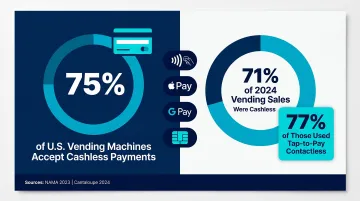
Approximately 75% of the 2.89 million U.S. vending machines accept cashless payments as of 2023, but in airports that percentage is effectively 100%. Most airport travelers—especially international visitors—don't carry local cash, making NFC contactless, Apple Pay, Google Pay, and EMV chip card acceptance mandatory. Cashless payments made up 71% of vending machine sales in 2024, with 77% of those transactions using tap-to-pay contactless methods—a trend that's even more pronounced in airports where speed and convenience drive purchasing behavior.
Remote Monitoring and Inventory Tracking
Airport operators often manage machines across multiple terminals or even multiple airports, making in-person inventory checks inefficient and costly. Modern airport-grade machines include IoT connectivity and cloud-based management platforms that provide real-time sales data, low-stock alerts, and remote diagnostics.
This means operators can optimize restocking routes, catch malfunctions before they cause lost sales, and avoid out-of-stock gaps during the busiest travel windows.
How to Get a Vending Machine Placed in an Airport
Placing a vending machine in an airport is not as simple as rolling a unit into a terminal and plugging it in. Airports are controlled commercial environments with formal procurement processes and strict vendor requirements.
Understanding Airport Management Structures
Airports are managed either directly by the airport authority or through a master concessionaire—a company that controls all food and retail contracts for terminals or the entire airport. HMSHost operates in nearly 80 North American airports as part of Avolta, while OTG Management operates 350+ in-terminal dining and retail locations across 10-11 airports. Before submitting a proposal, identify whether you need to contact the airport authority's concessions department or negotiate with the master concessionaire controlling your target terminal.
The Formal RFP Process
Airports typically require vendors to respond to formal Requests for Proposal (RFPs) or submit detailed proposals that include machine specifications, product offerings, proof of liability insurance, references, commission structure proposals, and maintenance plans. Chicago O'Hare's concessions guidelines categorize Automated Retail under Services and outline requirements including machine aesthetics that align with airport design standards, ADA compliance, and 24/7 operation commitments.
Your proposal must show that machines meet operational standards, fit passenger demographics, and address genuine traveler needs at the target location.
Revenue Share and Commission Models
Airports charge vending operators through one of three models: a flat monthly placement fee, a percentage of gross sales, or a combination of both. The O'Hare example shows a typical structure: the greater of a $100,000 Minimum Annual Guarantee (MAG) or 15% of sales as a license fee. Commission percentages range from 15-25% of gross sales depending on location, terminal type, and product category, though specific rates vary by airport and are often negotiable within RFP responses.
Understanding these fees is critical for financial modeling—a 20% commission on $5,000 in monthly sales means $1,000 goes to the airport before you account for product costs, restocking labor, and machine maintenance.
Strategic Placement Within Terminals
Not all airport real estate is equal. High-value placement spots include:
- Security exit corridors where passengers enter the secure area
- Boarding gate clusters with long passenger dwell times
- Baggage claim areas where travelers wait for luggage
- Overnight and red-eye terminal zones when most retail shops are closed
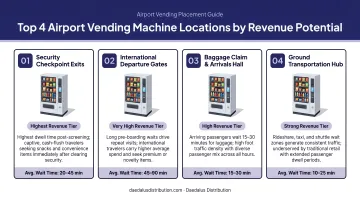
Location determines profitability—a machine near a popular gate cluster can generate 3-5 times the revenue of an identical unit in a low-traffic corridor.
Legal and Business Structure Requirements
Most airports require vendors to meet specific legal and operational standards before approval:
- Operate as a formal business entity (LLC or corporation, not a sole proprietor)
- Hold appropriate business licenses for the jurisdiction
- Carry product liability insurance (typically $1-2 million in coverage)
- Obtain health department permits for any food or beverage machines
These requirements protect the airport from liability and confirm that vendors have the financial stability to sustain long-term operations.
How Profitable Are Airport Vending Machines
Airports rank among the highest-revenue vending environments in the United States due to four key factors: captive audiences with limited alternatives, premium pricing tolerance, 24/7 operation, and high foot traffic volume.
Passenger Volume Context
To understand the opportunity, consider the scale: FAA data shows that in 2024, Hartsfield-Jackson Atlanta International (ATL) recorded 52.5 million enplanements, Dallas/Fort Worth (DFW) 42.4 million, Denver (DEN) 40 million, and O'Hare (ORD) 38.6 million. Even mid-tier airports see millions of annual passengers, creating constant demand for convenient retail options.
Cost Structure Breakdown
Starting an airport vending business requires understanding the complete cost picture:
- Machine purchase: Digital touchscreen machines range from mid-tier units around $3,000-$5,000 to specialized temperature-controlled or large-capacity models at $8,000-$12,000+. Pricing varies by manufacturer, feature set, and distributor.
- Airport placement fees/commissions: Expect 15-25% of gross sales or a combination of percentage fees plus minimum annual guarantees.
- Restocking and logistics: Product costs plus labor for regular restocking trips across terminals or airports.
- Maintenance: Replacement parts, service calls, and downtime management.
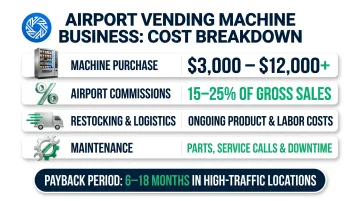
These inputs determine your payback period—the time it takes to recover your initial machine investment through net profits. In high-traffic airport locations, payback periods can range from 6-18 months depending on product mix, commission structure, and operational efficiency.
Realistic Revenue Per Machine
NAMA's 2023 industry census reports average vending sales per machine of approximately $6,284 annually across all locations—office buildings, schools, hospitals, and public spaces combined. Airport machines in high-traffic terminals typically generate higher revenue due to constant passenger flow and premium pricing, though no authoritative airport-specific benchmarks have been widely published.
Premium locations in major hubs can generate $1,000-$3,000+ per month. Electronics and travel essentials command higher margins than traditional snacks and beverages.
The Scaling Advantage
That revenue picture improves further as you scale. Once you've secured an approved vendor relationship with an airport authority or master concessionaire, adding machines to additional terminals or airports gets much easier — you've already demonstrated operational capability, established insurance and licensing, and proven your service standards.
From there, operators can grow from a single machine to a multi-terminal or multi-airport network, leveraging economies of scale in restocking logistics and service operations.
Frequently Asked Questions
How much does an airport electronic vending machine cost to buy?
Digital touchscreen vending machines typically range from $3,000–$5,000 for standard combo units to $8,000–$12,000+ for specialized electronics or temperature-controlled models. Pricing varies by manufacturer, feature set, capacity, and distributor, with airport-grade machines commanding premium prices due to enhanced durability and payment systems.
How much does it cost to place an airport electronic vending machine in an airport?
Airports typically charge either a monthly flat fee, a commission on gross sales (commonly 15–25%), or both. Many use a model requiring the greater of a Minimum Annual Guarantee (e.g., $100,000/year) or a sales percentage. Costs vary significantly by airport size, terminal location, and negotiated contract terms.
Do airport electronic vending machines make money?
Yes, airport machines are among the most profitable vending placements due to high foot traffic, captive audiences, premium pricing tolerance, and 24/7 operation. Profitability depends on location within the terminal, product mix, and commission structure, but well-placed machines can generate $1,000–$3,000+ monthly in high-traffic hubs.
How many airport vending machines would you need to make $100k a year?
Based on the NAMA industry average of $6,284 in annual sales per machine, you'd need roughly 16 machines to hit $100,000 in gross revenue. Airport machines in high-traffic terminals typically outperform that baseline, so 8–12 well-placed machines generating $8,000–$12,000 each may be enough.
How do I get approval to install an airport electronic vending machine?
First, determine whether the airport uses a master concessionaire or contracts directly with vendors. Then submit a formal proposal covering machine specs, product offerings, business credentials, liability insurance, and your proposed commission structure. Licensing requirements and insurance minimums vary by airport.
Do I need an LLC to own airport electronic vending machines?
Technically, no — but practically, yes. Airports almost universally require a formal business entity (LLC or corporation) plus product liability insurance as a condition of placement approval. An LLC also shields your personal assets and signals the financial credibility airports look for in vendor partners.