Tina Paine launched Wicked Healthy Vending with five machines in 2013. By 2021, she was operating nearly 50 machines across Massachusetts, growing at roughly eight machines per year. Leah Shin co-founded Gender Vender in Seattle — vending machines stocked exclusively with women-made products, donating 100% of profits to local women's organizations. These aren't outliers. They're part of a documented shift.
This guide covers why vending suits women entrepreneurs specifically, the real obstacles you'll face and how to handle them, strategies from operators who've built profitable routes, the technology that makes solo operation manageable, and the communities worth joining.
Key Takeaways
- Vending requires low startup capital, no storefront, and no employees — making it one of the most accessible business models for first-time operators
- Female decision-makers control many placement gatekeeping roles: 79.6% of HR managers and 68.6% of office supervisors are women
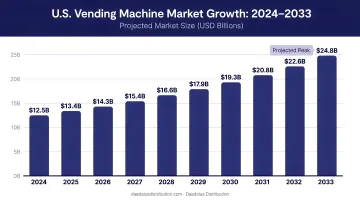
- The U.S. vending market is projected to reach $19.95B by 2033 — and early movers capture the best locations
- Smart machines with remote monitoring let solo operators manage growing routes without checking every location in person
- Contracts, professionalism, and WBENC certification are proven tools for closing the credibility gap
Why the Vending Machine Industry Is a Smart Move for Women
The barrier to entry is low
A vending business can launch with one machine, no storefront, no employees, and startup costs that fit a range of budgets. According to Forbes Advisor, new standard machines run $4,000–$6,500, with smart touchscreen models — the kind that offer cashless payment and remote monitoring — priced higher but designed to generate better margins from day one.
That makes vending realistic for women re-entering the workforce, transitioning careers, or building income alongside existing responsibilities — without taking on employees, a lease, or significant debt.
Flexible scheduling is built into the business model
Vending generates revenue between service visits. Machines don't need you there to sell. That means operators set their own route schedule — mornings before school pickup, evenings, weekends. Tina Paine's team ran morning-only shifts that freed up afternoons entirely. That flexibility comes standard. It's not something you ask for.
Women already control many placement decisions
Here's an underappreciated structural advantage: the people who decide where vending machines go are often women.
According to BLS occupational data:
- 79.6% of U.S. HR managers are women
- 68.6% of first-line supervisors of office and administrative support workers are women
When you're pitching a corporate office, apartment complex, or healthcare facility, the person across the table is frequently a woman. Peer-to-peer rapport matters in those conversations.
The market has room for new operators
The U.S. retail vending machine market was valued at $15.02B in 2024 and is projected to reach $19.95B by 2033, growing at a 3.2% annual rate. This isn't a saturated industry — it's an expanding one.
Add to that the growth of health-focused vending, specialty niches, and community-driven retail concepts, and there's genuine white space for operators who bring something different to the pitch.
Challenges Female Vending Entrepreneurs Face (And How to Overcome Them)
The industry has made progress — Automatic Merchandiser launched its Most Influential Women in Convenience Services Awards in 2022 specifically to recognize women making an impact in a field that had historically centered men. But progress isn't the same as solved.
The "Old Boys' Club" Is Real
When Tina Paine joined her local vending association, she found an all-male board with minimal communication and no clear pathway for newer operators. This isn't unique to her experience — it's a recognized pattern. The solution isn't to avoid industry organizations; it's to use them strategically while also building relationships outside of them.
The Credibility Gap Requires a Deliberate Response
Some location managers and suppliers will take a male vendor's word over yours, or assume you're less serious. The counter-strategy isn't to compensate with charm — it's to lead with documentation.
Paine credits her regulatory compliance background with differentiating Wicked Healthy from vendors who operate on handshakes. Her approach:
- Show up with a written placement agreement, not just a conversation
- Prepare a one-pager about your service — what you stock, how often you service the machine, how you handle issues
- Reference other locations you service to establish credibility quickly
Professionalism isn't performative here. It's protective.
Going Solo Comes With Operational Blind Spots
Leaving a corporate job — with its built-in colleagues, structure, and feedback loops — for a solo vending route is a bigger adjustment than most business guides acknowledge. That isolation can affect decision-making, motivation, and growth.
Community-building is a practical business tool, not just a morale boost. Local chambers of commerce, women's business groups, NAMA's Women in the Industry (WIN) network, and online forums like Reddit's r/vending and the Vending Machine Discussion Group (28,600+ members on Facebook) all deliver real operational value. That means shared leads, supplier tips, accountability, and perspective from people running the same routes.
Financing Gaps Are Real but Addressable
Research from Biz2Credit found that women-owned businesses received an average of $67,035 in funding in 2024 — meaningful progress, but still below male-owned business averages. The tools to close this gap include:
- Get WBENC-certified to validate your business as 51%+ women-owned and unlock procurement contracts with major corporations and institutions
- Use an SBA Women's Business Center for free or low-cost counseling tailored to women starting or growing businesses
- Apply through the SBA WOSB program, which directs at least 5% of federal contracting dollars to women-owned small businesses annually
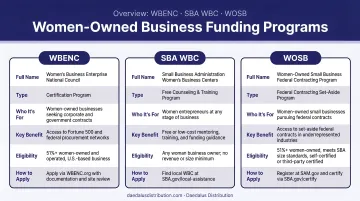
Most new operators aren't aware these programs exist — and that's exactly what makes them worth pursuing.
Key Strategies of Successful Female Vending Entrepreneurs
Location is the single most important decision
Before buying a machine, research the location. Every other decision follows from this one. Successful operators evaluate:
- Foot traffic and dwell time — how many people pass through, and how long they stay
- Demographic fit — who uses the space and what they actually want
- Decision-maker access — can you get a signed placement agreement before committing?
That last point matters more than most guides acknowledge. A signed agreement protects your investment and signals professionalism. Key terms to include: contract length, commission rate (typically 5–25% of revenue), operator responsibilities, and whether the placement is exclusive.
Product-market fit beats personal preference
New operators most often stumble by stocking what they'd personally want to buy. The smarter move is observing who actually uses the space.
A college-age apartment complex calls for Celsius, protein bars, and energy drinks. An older-demographic office building might move Diet Coke and Snickers faster than any health-focused alternative.
Neither answer is universal — the location tells you what to stock. Visit at different times, talk to the staff, check what's already nearby.
Scale deliberately, not ambitiously
The operators who build profitable routes follow a specific sequence:
- Start with one or two machines to learn operations without overwhelming yourself
- Track key metrics — gross sales per machine, net margin after commissions, spoilage rate, service frequency
- Add machines at proven locations before hunting new ones
- Hire part-time help (especially useful if you're managing other commitments during the day) only after the operational rhythm is established
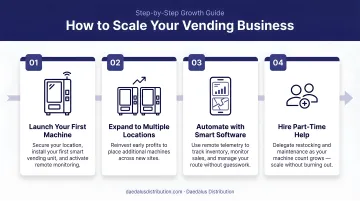
Let real sales data guide your expansion decisions — not assumptions about what should be working.
How Smart Vending Technology Helps Women Operators Scale
Remote monitoring replaces guesswork
Modern IoT-connected machines report inventory levels, sales data, and machine health in real time. Operators know which products are running low, which locations are underperforming, and when a machine needs service — without driving to check.
For solo operators running routes alongside other responsibilities, the time savings are concrete. You service machines when the data says to, not on a fixed schedule that wastes trips to full machines while empty ones sit.
Daedalus Distribution's Vendekin-powered machines — including the Omnivend Combo 22, Omnivend Combo 10, and Elevend Multivend 22 — include cloud-based inventory tracking and sales reporting with no separate software license fee. For operators watching margins closely, that's a meaningful difference.
Cashless payment isn't optional anymore
According to NAMA's 2022–2023 Industry Census, 75% of vending machines now accept non-cash payments. Cantaloupe's 2025 data puts cashless at 77% of vending transactions, split between card and mobile pay. Machines without it are simply leaving money behind.
All three Vendekin models sold by Daedalus include credit/debit, Apple Pay, Google Pay, and tap-to-pay as standard features. No retrofitting, no add-on cost.
Support quality determines profitability
A machine that's down for two weeks waiting on parts isn't generating revenue. When evaluating machine suppliers, ask specifically about:
- U.S.-based parts availability
- Average repair turnaround time
- What's covered under warranty and for how long
Daedalus operates from a U.S.-based parts and service center in Summerville, SC, with support available Monday–Friday. For solo operators, the difference between a supplier with domestic support and one without it shows up in your margins.
Building Your Network and Community as a Woman in Vending
The most effective location acquisition strategy isn't cold email or digital outreach. It's walking in. Tina Paine and other successful operators consistently identify in-person conversations as their most productive growth activity — a discipline where women operators tend to have a natural edge.
Key organizations and resources:
- NAMA WIN (Women in the Industry): networking, leadership development, and peer relationships across convenience services
- WBENC certification opens procurement opportunities with major corporations — eligibility requires 51%+ women ownership and demonstrated operational control
- SBA Women's Business Centers offer free to low-cost counseling nationwide; the SBA announced $30M in new WBC grant funding in 2024
- Local chambers of commerce are underused by most vending operators, but valuable for both location leads and credibility-building
- Facebook Vending Machine Discussion Group (28,600+ members), Reddit r/vending, and The Vending Club forum all offer active peer exchange
Tina Paine expressed interest in starting a dedicated Women in Vending group. That gap is real — and even informal peer accountability partnerships fill it effectively, often accelerating growth more than operators anticipate.
Frequently Asked Questions
Is the vending machine industry too male-dominated for women to break into?
The gap is closing. Female decision-makers increasingly control placement roles, and demand for health-focused and community-driven vending aligns with strengths many women bring to the business. More women are leading routes and supplier relationships now than at any previous point.
How much money does a woman need to start a vending machine business?
Entry costs vary by machine type and features. New smart machines — the kind that include remote monitoring and cashless payment — are the more scalable starting point; pricing from distributors like Daedalus Distribution is available on request. Starting with one machine to test a location before expanding is a common and practical approach.
Can I run a vending machine business part-time while working another job?
Yes — one to three machines is manageable alongside a full-time job. Tina Paine built Wicked Healthy Vending while keeping her corporate position for years. Remote monitoring cuts the time needed per machine significantly, making early-morning routes compatible with most schedules.
What types of vending products or niches work especially well for female entrepreneurs?
Health-focused and wellness vending, women-made or community-curated products, and specialty niches like OTC health items and fresh-food micro-markets have all shown strong reception. These categories also differentiate from legacy operators who stock the same 12 products in every machine.
How do I find my first vending machine location as a new female entrepreneur?
Walk in. Prepare a simple one-pager about your service — what you stock, how often you service the machine, how you handle problems — and visit local offices, gyms, apartment complexes, and healthcare facilities in person. Targeting locations where a female manager makes placement decisions can improve your reception significantly.
Are there grants or funding programs specifically for women starting a vending business?
Yes. SBA Women's Business Centers, the WOSB federal contracting program, WBENC certification, and grant databases through NAWBO and Hello Alice are all worth researching. Equipment financing may also be available through machine distributors — contact Daedalus Distribution to ask about purchasing options.