That demand profile is exactly why vending machine businesses thrive here. No storefront, no staff, no set hours — just machines placed in the right spots earning revenue around the clock. The model attracts everyone from hospitality workers looking for a manageable side income to entrepreneurs building a scalable route from scratch.
This guide covers how to actually do it: choosing a niche, scouting locations, handling Nevada's legal requirements, sourcing equipment, and running your first route profitably.
Key Takeaways
- Las Vegas offers 24/7 demand, year-round tourism, and more placement variety than almost any other U.S. market
- Location quality is the single variable that determines success; scout before you spend
- Startup costs range from under $1,000 for a used traditional machine to $6,000–$15,000+ for a new digital smart machine
- Nevada requires a State Business License, seller's permit, and potentially local and health permits
- Expect the first 60–90 days to be fully hands-on — passive income comes after locations and operations are proven
Why Las Vegas Is One of the Best Markets for Vending
Most vending markets go quiet at night. Las Vegas doesn't.
Casino floors stay open at 3 a.m., hotel corridors see foot traffic at every hour, and convention halls fill up for days at a stretch. Harry Reid International Airport processed nearly 55 million passengers in 2025 — making it one of the busiest airports in the country. That's not just tourist volume. It's continuous, around-the-clock demand for snacks, beverages, and convenience items.
The Location Opportunity
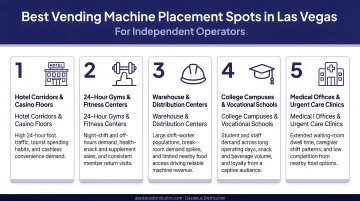
The strongest placement categories for independent operators aren't the casino floors — those are typically locked up by national operators with long-term exclusive contracts. The real opportunity sits in:
- Hospitality employee break rooms — large properties may employ hundreds of workers across multiple shifts
- Strip-adjacent apartment complexes — high-density residential buildings with residents who work irregular hours
- Urgent care and medical offices — steady daytime traffic, often no nearby food options
- Smaller independent hotels — less likely to have exclusive vendor agreements
- Service industry facilities — warehouses, laundry operations, back-of-house staff areas
The Demand Mix
Las Vegas draws domestic tourists, international visitors, 6 million convention attendees annually, and a local workforce that largely works nights and weekends. That demographic spread creates simultaneous demand across product categories — not just snacks, but energy drinks, personal care items, OTC medications, and even electronics accessories. It's one of the few U.S. markets where a single well-placed machine can serve a tourist, a hotel housekeeper, and a conventioneers all in the same afternoon.
That breadth of demand is what makes Las Vegas worth understanding before you place your first machine.
What to Know Before You Start
Expectations vs. Reality
The vending machine business has a reputation as passive income. That's true eventually — not on day one. The first 90 days involve:
- Scouting and visiting multiple potential locations (often multiple times, at different hours)
- Pitching property managers and negotiating placement contracts
- Sourcing equipment, arranging delivery, and handling installation
- Stocking machines, monitoring sell-through, and adjusting product mix
Income isn't immediate either. The first 30–60 days are effectively a data-gathering period. Net margin only becomes predictable once you've run a few restock cycles and know what sells where.
Understanding the Competition
Larger national operators and beverage brands like Coca-Cola hold exclusive contracts at most major casinos and flagship hotel properties. Don't compete there — you won't win, and you don't need to.
The sustainable opportunity for new operators is in secondary locations: mid-size employers, residential buildings, smaller medical facilities, and hospitality industry workplaces. These locations are often underserved, easier to access, and more willing to work with independent operators.
What This Business Actually Requires
Technical expertise isn't a requirement. The real demands are operational:
- Organization — tracking inventory, contracts, and service schedules across multiple locations
- Consistency — machines that run empty or malfunction lose sales and placement goodwill fast
- Basic financial tracking — knowing your gross margin, commission cost, and net per machine per month
Operators who track their numbers, show up on schedule, and manage locations like accounts are the ones who grow beyond a single machine.
How to Start a Vending Machine Business in Las Vegas — Step by Step
The most common mistake: buying a machine before securing a location. Follow these steps in order.
Step 1 — Choose Your Niche and Location Type
Match your product category to locations you can realistically access:
| Product Category | Best Las Vegas Location Types |
|---|---|
| Snacks & beverages | Employee break rooms, apartment complexes, gyms |
| Personal care & convenience | Hotel lobbies, Strip-adjacent residential buildings |
| OTC medications & health snacks | Urgent care centers, medical offices |
| Bulk vending (candy, gum) | Low-cost testing, family-friendly waiting areas |
Start with one category in one location type. Spreading too wide too early makes it harder to learn what works.
Step 2 — Validate Demand and Scout Locations
Don't trust assumptions. A busy-looking building doesn't always mean a profitable machine.
Visit shortlisted locations at multiple times of day — including nights and weekends, which matter in Las Vegas more than most markets. Look for:
- No nearby food or convenience alternatives
- Consistent daily occupancy (not just event-driven traffic)
- Extended access hours, ideally 24/7
- Secured indoor space that reduces vandalism risk
A location near a shift-change break room at 3 a.m. can outperform a high-visibility lobby that only draws traffic during peak hours. What you observe on-site will tell you more than any assumption.
Step 3 — Set Up Your Business and Finances
Before placing any machine, get your legal and financial foundation in place:
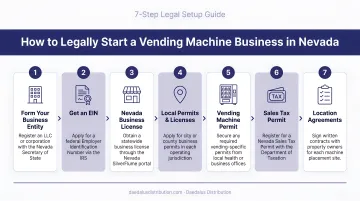
- Register an LLC in Nevada via the Nevada Secretary of State — most new operators choose this structure for liability protection
- Obtain an EIN from the IRS (free, done online)
- Open a dedicated business bank account — keep personal and business finances completely separate
- Obtain a Nevada State Business License — annual fee is $200 for LLCs
- Apply for a seller's permit through the Nevada Department of Taxation ($15 per location) — Clark County's sales tax rate is 8.375%, and you're required to collect and remit it on vending sales
- Get a local business license — either through Clark County Business Licensing (unincorporated areas) or City of Las Vegas Business Licensing (inside city limits), depending on where your machines are placed
- Apply for a Southern Nevada Health District (SNHD) Vending Machine Health Permit if selling food or beverages — the annual permit fee is $97.85 per machine, with an equivalent plan review fee
Always verify current requirements directly with Nevada and Clark County agencies before placing machines. Rules and fees can change.
Step 4 — Source Your Machines and Negotiate Placement Contracts
Machine types and approximate price ranges:
| Machine Type | Price Range | Best For |
|---|---|---|
| Bulk vending | $50–$500 | Low-cost testing, no electricity needed |
| Traditional combo | $3,500–$7,500 (new) | Standard snack/beverage locations |
| Smart digital | $2,000–$25,000+ | High-volume, cashless, remotely monitored routes |
For a 24/7 market like Las Vegas, cashless payment capability and remote monitoring are operational requirements, not optional upgrades. Cashless payments now account for 71% of all vending machine sales, and the average cashless transaction ($2.24) runs 37% higher than cash transactions ($1.78).
Daedalus Distribution carries the Omnivend Combo 22 and Elevend Multivend 22 — both include 22-inch touchscreen interfaces, full cashless payment support (credit/debit, Apple Pay, Google Pay, tap-to-pay), and the Vendekin cloud management platform at no separate license fee.
For high-volume placements like hotel corridors or convention-adjacent break rooms, the 22-inch models are the right fit. The Elevend Multivend 22 adds a built-in elevator system for fragile or premium items. Machines ship from Daedalus's warehouse in South Carolina with nationwide delivery.
Before purchasing any machine, secure a signed placement agreement. Key contract terms to nail down:
- Commission rate (typically 10%–25% of gross sales — run your margin math at every rate before agreeing)
- Term length and renewal conditions
- Operator responsibilities for maintenance and restocking
- Termination clause with reasonable notice period
Step 5 — Stock, Configure Payments, and Launch
- Source initial inventory from wholesale suppliers or warehouse clubs — don't overstock on the first cycle
- Start with a focused product selection and let actual sell-through data guide expansion
- Track everything in the first 30 days: which products move fastest, which sit, and what your real gross margin looks like after inventory cost, commission, and card processing fees
Step 6 — Monitor, Optimize, and Scale
Once your machines are running, track these metrics weekly per machine:
- Gross sales
- Cost of goods sold
- Net margin after commission and processing fees
- Spoilage rate
- Service visit frequency
Use remote monitoring tools to avoid unnecessary trips. The Vendekin platform provides real-time inventory alerts, sales data by product, and route optimization — critical for managing a Las Vegas route where machines may need restocking at 2 a.m. to stay full during overnight peaks.
Scale in order: maximize performance at existing locations before pursuing new ones. Upgrade traditional machines to digital equipment only where proven sales volume justifies the investment.
Las Vegas Legal Setup and Compliance
Licensing Checklist
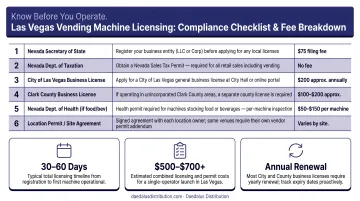
| Requirement | Agency | Notes |
|---|---|---|
| State Business License | Nevada Secretary of State | $200/year for LLCs |
| Seller's Permit | Nevada Dept. of Taxation | $15/location; 8.375% Clark County sales tax |
| Local Business License | Clark County or City of Las Vegas | Depends on machine location |
| Health Permit | Southern Nevada Health District | $97.85/machine/year for food/beverage machines |
ADA Compliance
Machines placed in covered facilities must meet ADA standards. Confirm compliance before installation — especially in hotels, medical facilities, and government-adjacent buildings.
Key requirements:
- Clear floor space of at least 30" × 48"
- Forward and side reach heights between 15" and 48"
- Operable parts usable with one hand
- Activation force of no more than 5 pounds
FDA Calorie Labeling
Operators with 20 or more vending machines federally are required to display calorie information. Operators below that threshold are exempt but can voluntarily register with the FDA. If you're starting small, this won't apply yet — but keep it in mind as you grow.
Conclusion
Starting a vending machine business in Las Vegas is straightforward when done in the right order: location first, machine second, operations third. The city's demand profile — 42.5 million visitors, a 24/7 economy, and a massive hospitality workforce — rewards operators who invest time upfront in finding placements that actually perform.
Long-term success comes from treating the performance data seriously. Review it weekly, adjust your product mix based on what's actually selling, and don't scale until your first machines are stable and profitable. The operators who build profitable routes in this city aren't necessarily the ones who move fastest — they're the ones who validate before they scale, and use their sales data to make every restocking trip count. Smart, IoT-connected machines make that discipline significantly easier by putting real-time inventory and revenue data at your fingertips from day one.
Frequently Asked Questions
Do you need a license to run a vending machine business in Las Vegas?
Yes. Nevada requires a State Business License, a seller's permit for sales tax collection, and a local business license from either Clark County or the City of Las Vegas depending on where your machines are located. If you're selling food or beverages, you'll also need a Southern Nevada Health District Vending Machine Health Permit — verify current requirements directly with each agency before placing machines.
What are the best locations for vending machines in Las Vegas?
For independent operators, the strongest opportunities are hospitality employee break rooms, Strip-adjacent apartment complexes, urgent care centers, smaller independent hotels, and service industry facilities. Major casino floors typically have long-term exclusive contracts with established operators, making them difficult to access for new entrants.
How much does it cost to start a vending machine business in Las Vegas?
Entry-level costs start under $1,000 for a used traditional machine with initial inventory. New digital smart machines run $6,000–$15,000+, better suited for high-volume Las Vegas locations. Factor in permits, insurance, delivery, and a cash reserve for repairs when building your startup budget.
How much can a vending machine earn per month in Las Vegas?
The national average is roughly $524 per machine per month in gross sales, based on NAMA's 2023 industry data showing $6,284 in average annual sales per machine. Well-placed machines in high-traffic, 24/7 Las Vegas locations can outperform that average — but location quality is the deciding variable.
Do I need to pay commission to property owners for vending machine placement?
Most property owners expect a commission of 10%–25% of gross sales. Always formalize this in a written placement agreement and calculate your net margin at the agreed rate before signing.
Can I start a vending machine business in Las Vegas as a side hustle?
Yes — starting with one or two machines is manageable alongside a day job. The early months require real time investment in location scouting, contracts, and inventory management — but once machines are placed and running, the time commitment drops significantly.