People from all kinds of backgrounds are drawn to vending for good reason. Low overhead, no storefront, no employees, and the ability to scale at your own pace make it a genuinely accessible business model. But "accessible" doesn't mean automatic — and Texas's market is competitive enough that how you start matters as much as whether you start.
This guide covers everything Texas-specific: licensing requirements, location strategy, machine selection, and the exact sequence of steps to launch correctly the first time.
Key Takeaways
- A vending machine business earns revenue from automated sales at placed locations — typically operated solo with no staff required
- Texas requires business registration, a sales tax permit, and a coin-operated machine tax sticker per machine — no statewide operator license needed
- Startup costs range from a few thousand dollars (one used machine) to $15,000+ for a multi-machine setup with modern digital equipment
- Location quality drives revenue more than any other variable; high foot traffic consistently outperforms product selection
- Most operators start with 1–3 machines and validate locations before scaling
- Reaching $100K/year typically requires 15–30+ well-placed machines
What Is a Vending Machine Business?
A vending machine business works by placing automated machines in high-traffic locations and earning revenue from each sale — with no storefront, no staff, and no fixed hours required.
Two Operating Models in Texas
Texas distinguishes between two types of operators, and the legal requirements differ:
- Owner-operators placing machines in other businesses' locations — requires a General Business License from the Texas Comptroller, with tiered fees based on filing date ($200–$400+ for 50 or fewer machines)
- Business owners placing machines only within their own premises — requires a Registration Certificate instead ($150–$300 depending on filing date)
This distinction matters because many new operators assume the rules are the same in both cases. They aren't.
Machine Types
Once you know which operator model applies to your situation, the next decision is machine type — which affects both startup cost and long-term revenue potential:
- Bulk machines — gumball/candy dispensers, low cost, low revenue
- Mechanical machines — basic snack or drink dispensers, limited features
- Electronic machines — accept card payments, track inventory, support a wider product range
- Specialty machines — fresh food, frozen items, high-value products, higher compliance requirements
Electronic and specialty machines carry higher upfront costs, but cashless-capable machines typically generate 20–30% more revenue per location than cash-only units — a gap that widens as card and contactless payments become the default for most consumers.
Why Texas Is a Strong Market for Vending Machines
The case for Texas isn't just population size — it's workforce density in exactly the right sectors.
According to the U.S. Bureau of Labor Statistics, Texas had 14.4 million nonfarm jobs as of April 2026, including 976,700 manufacturing jobs and 2.8 million trade, transportation, and utilities jobs. These are shift workers, warehouse employees, and logistics staff who stay on-site for long stretches — the exact profile that drives consistent vending sales.
Metro Placement Opportunities
The two strongest prospecting metros for new operators:
| Metro | Total Nonfarm Jobs | Manufacturing Jobs | Trade/Transport/Utilities Jobs |
|---|---|---|---|
| Dallas-Fort Worth | 4,309,200 | 308,800 | 893,100 |
| Houston | 3,471,300 | 238,700 | 702,400 |
Beyond raw headcount, Texas offers two structural advantages worth factoring into your business case:
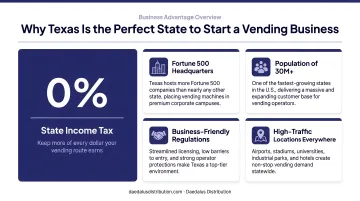
- 55 Fortune 500 companies are headquartered here, creating large campus environments where workers buy repeatedly throughout the day
- No personal or corporate income tax — unlike California's top individual rate of 13.3% or New York's 10.9%, every dollar of vending profit stays with the operator at the state level (sales tax compliance still applies)
Texas Licensing, Permits, and Compliance
This is where most new operators make mistakes — either overpaying for irrelevant permits or skipping required ones entirely.
Business Registration
Form an LLC with the Texas Secretary of State — the filing fee is $300. Also obtain a free EIN from the IRS (takes about 10 minutes online) and open a dedicated business bank account before making any purchases. An LLC isn't legally required, but it protects personal assets from product liability claims and machine malfunction disputes. Many property owners also require proof of a business entity before signing a location agreement.
Sales Tax
Texas charges 6.25% state sales tax plus up to 2% local tax, for a maximum combined rate of 8.25%. Vending operators are treated as itinerant vendors and must collect local tax based on where each machine is located — not where the business is registered.
A separate sales tax permit (Form AP-201) is required for each active place of business. This is one of the most common compliance gaps for new operators who assume a single permit covers all locations.
Coin-Operated Machine Occupation Tax
The $60 annual occupation tax and corresponding decal apply to coin-operated amusement, music, skill, or pleasure machines — not to standard snack and beverage vending machines. If you're operating traditional vending only, this specific tax generally doesn't apply. Standard business registration (covered above) is still required regardless.
Food Permits
Machines dispensing temperature-controlled perishable foods (TCS foods — dairy, fresh meals, refrigerated items) require a food establishment permit through the Texas Department of State Health Services, costing $258/year for operators in the $0–$49,999 annual food sales tier. Standard packaged snack and shelf-stable beverage machines generally don't require this permit — but verify with DSHS before stocking any fresh or refrigerated products.
City-Specific Requirements
Local rules layer on top of state requirements. Key points by city:
- San Antonio — Coin-operated amusement machines must display an Occupational Tax Decal; register at 100 W. Houston St., San Antonio, TX 78205
- Houston — Has an official process for Coin-Operated Amusement Machine Decals for amusement machines specifically
- Austin — Vending machines dispensing only non-hazardous food generally do not require a city permit (the 20-foot spacing rule in Austin code applies to mobile food establishments, not private vending machines)
Always check city requirements before signing any location contract.
How to Start a Vending Machine Business in Texas – Step by Step
Most new operators fail not from bad execution, but from poor sequencing — buying machines before securing locations, or skipping legal setup until a problem forces the issue. Here's the correct order.
Step 1 – Scout and Secure High-Traffic Locations First
Location is the single highest-leverage decision in a vending business. A decent machine in a high-traffic location consistently outperforms a premium machine sitting in an underserved spot.
Where to prospect in Texas:
- Industrial facilities and distribution centers (DFW and Houston corridors are particularly strong)
- Manufacturing plants and warehouses
- Auto dealerships and service centers
- Medical offices and outpatient clinics
- Apartment complexes and gym facilities
Approach property managers directly, offer a revenue-sharing arrangement: operators typically pay 5–25% of sales to the location owner. and get a signed location agreement before purchasing any machine. Verbal agreements offer no protection.
Step 2 – Choose the Right Products and Machine Type
Product selection should follow the location's user profile:
- Office workers — healthy snacks, energy drinks, premium coffee
- Warehouses and industrial sites — hearty snacks, cold beverages, high-calorie options
- Gyms and fitness facilities — protein bars, water, electrolyte drinks
- Medical offices — light snacks, bottled water, shelf-stable items
On the machine side, modern all-digital machines now outperform cash-only units in most commercial settings. Federal Reserve data shows cash accounted for just 14% of U.S. consumer payments by number in 2024, while credit and debit cards combined for 65%. Machines without card readers are leaving the majority of potential transactions on the table.
Remote inventory monitoring lets operators check stock levels and sales data without driving to each location, reducing unnecessary service trips and preventing revenue loss from empty slots. Daedalus Distribution's Vendekin machines (the Omnivend Combo 10, Omnivend Combo 22, and Elevend Multivend 22) include touchscreen interfaces, cashless payment acceptance (credit, debit, Apple Pay, Google Pay, tap-to-pay), and the Vendekin cloud-based management platform at no separate license fee. Operators can track inventory and sales remotely from day one.
Step 3 – Register the Business and Get Compliance in Order
Complete in this order:
- File LLC with the Texas Secretary of State — $300 filing fee
- Obtain EIN from the IRS — free, online, takes 10 minutes
- Open a business bank account — before any business purchases
- Apply for sales tax permit(s) — one per active vending location via Form AP-201
- Obtain appropriate business license or registration certificate — based on your operating model
- Assess food permit need — required only if stocking TCS foods
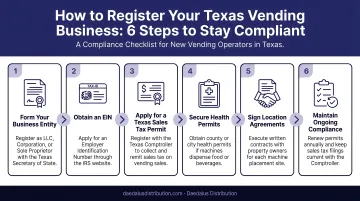
Do this before the first machine goes live. Fixing compliance issues after the fact is more expensive and complicated than getting it right upfront.
Step 4 – Purchase and Place the Machines
New machines typically cost $3,000–$10,000+ per unit depending on size and features. Starting with 1–3 machines in confirmed, signed locations before expanding is the right approach — it limits financial exposure while you learn which locations actually perform.
Before placing any machine, verify:
- ADA accessibility (3-foot accessible route minimum, controls operable with 5 lbf force maximum)
- Electrical and fire code compliance for the specific location
- Whether the property owner requires a certificate of insurance
Step 5 – Build a Restocking and Maintenance Routine
Map your service route to cluster nearby locations and minimize drive time. Set restocking frequency based on actual sales volume — high-traffic machines may need weekly visits; slower locations can go every two weeks.
On each visit:
- Check and rotate products for expiration dates
- Pull slow-moving SKUs and replace with higher-velocity items
- Empty cash boxes and record collections
- Run a quick mechanical check (card reader, dispensing mechanism, temperature if applicable)
Neglected machines — broken, empty, or stocking expired products — are the leading cause of lost location contracts. A machine that consistently fails the location owner's tenants doesn't stay in that location long.
Step 6 – Track Performance and Scale Deliberately
Once your route runs smoothly, the operational data you've been collecting becomes your growth roadmap. Monitor revenue per machine, cost of goods, and location-level profitability monthly. If a location underperforms consistently after 60–90 days, relocate the machine rather than waiting it out.
Scaling from 3 machines to 10, then to 25+, requires:
- Stable supplier relationships for product sourcing
- Reliable route logistics, ideally supported by telemetry data from your machines
- A reinvestment discipline — putting early profits back into equipment rather than drawing income prematurely
- A clear threshold for when to add a second service vehicle or hire part-time help
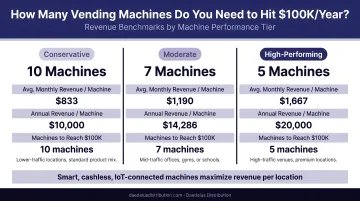
NAMA's industry benchmark puts the typical operator at $6,000+ per machine per year, roughly $500+ per month. At that rate, reaching $100K in annual gross revenue implies around 17 productive machines. For new operators with early placement inconsistencies, targeting 20–30 well-placed machines gives you the buffer to hit that number reliably — and the scale where route logistics and supplier relationships start generating real compounding returns.
Conclusion
Starting a vending machine business in Texas is a real opportunity — the workforce density, industrial base, and tax environment all support it. But the operators who succeed are the ones who treat it as a business from day one: securing signed location agreements before buying equipment, getting compliance right early, and choosing machines that match where consumer payment behavior actually is.
Long-term profitability comes from disciplined site selection, consistent maintenance, and scaling only once operations are stable. Texas gives you the market access — cashless-ready machines, reliable restocking, and tight location management are what convert that access into consistent revenue.
Frequently Asked Questions
How much does it cost to start a vending machine business in Texas?
Startup costs range from roughly $3,700 (one used machine plus LLC filing and permits) to $16,000+ for a multi-machine setup with new digital equipment. The LLC filing fee alone is $300, and new machines typically run $3,000–$10,000 per unit depending on features and size.
How many vending machines do you need to make $100K in Texas?
NAMA's industry benchmark puts average operator revenue at $6,000+ per machine per year. At that rate, $100K in gross revenue implies roughly 17 productive machines — though most planners target 15–30+ to account for weaker early placements and commission costs.
Does Texas require a license to operate vending machines?
Texas has no statewide vending operator license. Operators placing machines in other businesses' locations need a General Business License; those placing machines only in their own locations need a Registration Certificate. All operators must register for a sales tax permit.
Do you need an LLC to own or operate a vending machine in Texas?
An LLC isn't legally required — sole proprietors can operate. Forming one is strongly recommended, though, to protect personal assets from liability claims, and many property owners require proof of a registered business entity before signing a location agreement.
What are the best locations for vending machines in Texas?
Top-performing locations include industrial facilities and distribution centers (especially in DFW and Houston), manufacturing plants, auto dealerships, medical offices, and apartment complexes. Prioritize consistent daily foot traffic over high-visibility spots where people pass through without stopping.
Do I need a health permit to sell food from vending machines in Texas?
A food establishment permit from the Texas Department of State Health Services ($258/year) is required only for machines dispensing temperature-controlled perishable foods (TCS foods). Standard packaged snacks and shelf-stable beverages don't require this permit — but confirm with DSHS before stocking any fresh or refrigerated items.