 in New Jersey](https://file-host.link/website/daedalusdistribution-0jubjd/assets/refined-images/1781189430157000_0e223d6813b44459976619b37f7e6d16/360.webp)
Introduction
Vending machine businesses have gained real momentum across New Jersey, driven by high foot traffic in commercial hubs like Newark, Jersey City, and Trenton and consistent demand for quick, convenient access to food and beverages. As the most densely populated state in the U.S. at 1,298.2 people per square mile, New Jersey delivers concentrated customer bases within short driving distances—a structural advantage for vending operators.
That density translates directly into opportunity.
More operators are entering the market because startup costs are low compared to brick-and-mortar retail, the income is largely passive, and the business scales on your schedule. With 364 vending businesses generating $204.7 million across the state, there's both established demand and room for new operators who understand compliance and location strategy.
This guide covers everything from NJ-specific licensing and permits to machine selection, location strategy, and daily operations—designed for first-time operators who want to launch properly.
Key Takeaways
- A vending machine business involves placing machines in commercial locations, restocking products, and managing compliance—you can run it solo or scale over time
- NJ requires an NJ-REG filing (15 days before launch), a Sales Tax Certificate of Authority (6.625%), and health permits for any food or beverage machines
- Startup costs range from $3,000–$8,000 for a single used machine to $15,000+ for new digital units with cashless payment
- Earning potential varies by location—average machines generate $525/month, while high-traffic placements can reach $1,500+
- Prioritize niche selection, strong locations, proper registration, and a consistent restocking schedule from day one
What Is a Vending Machine Business?
A vending machine business involves placing automated retail machines in physical locations, stocking them with products, and earning revenue each time a customer makes a purchase. There's no storefront to manage and no staff at the point of sale — just machines working for you around the clock.
Two operating approaches:
- Owner-operated: You run a small route solo — handling restocking, maintenance, and collections yourself, keeping overhead low
- Scaled: Multiple machines spread across multiple locations, with hired help for restocking and service as volume grows
Product categories range from traditional snacks and beverages to fresh food, personal care items, and specialty goods. That niche choice matters more than most new operators expect — it directly shapes your permit requirements, machine type, and where you can realistically place machines in New Jersey.
What to Know Before You Start a Vending Machine Business in New Jersey
Set expectations clearly: many new operators underestimate how hands-on the early phase is. You will personally scout locations, negotiate placement agreements, register with state agencies, and handle restocking before any systems are in place.
Time and income reality:
- Revenue builds gradually
- A single machine in moderate-traffic locations may take several months to cover its cost
- Income is not guaranteed without intentional location selection and product curation
Layered on top of those financial realities are regulatory hurdles unique to New Jersey.
NJ-specific friction points:
- Municipal regulations vary significantly by city—Newark, Jersey City, and Atlantic City each impose distinct local requirements on top of state rules
- Food vending machines require health permits that involve inspections, adding weeks to your launch
- NJ operates under "home rule," giving municipalities broad regulatory powers
Success depends more on location quality and restocking discipline than on technical know-how. Get your compliance groundwork done first — it's far cheaper than fixing violations after the fact.
Why Start a Vending Machine Business in New Jersey? (When It Makes Sense)
New Jersey is one of the most densely populated states in the U.S., which translates to a high concentration of viable locations—office parks, hospitals, transit hubs, universities, and manufacturing facilities—within short driving distances.
Market opportunity:
The U.S. vending machine operators industry is valued at $7.9 billion in 2026, with the average vending machine generating approximately $525 in monthly revenue. In well-placed locations, high-traffic machines can earn significantly more.
NJ-specific advantages:
- Indoor locations dominate, keeping demand steady year-round with no seasonal slump
- Bergen, Essex, Middlesex, and Hudson counties hold dense office and industrial zones that foot traffic data suggests are underserved by vending
- Newark's Adams St & Ferry St logs 25,385 pedestrians daily; Jersey City's Grove St & Newark Ave sees 19,601 — numbers that translate directly into machine revenue
- The customer base spans income levels and industries, from hospital staff and transit commuters to warehouse workers and college students
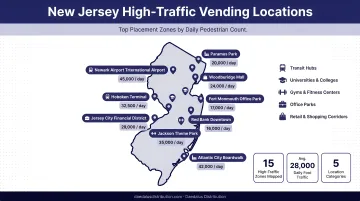
If you can secure placements in even one or two of these high-traffic corridors, the revenue case is straightforward. The sections below walk through exactly how to get started.
New Jersey Licensing, Permits, and Compliance
NJ operates with both state-level and municipal-level requirements. You must meet state mandates first, then verify additional local requirements for each city or township where machines will be placed.
Business Registration (NJ-REG)
All vending machine operators must register with the New Jersey Division of Revenue and Enterprise Services using the NJ-REG form. This must be filed at least 15 business days before beginning operations.
Registration details:
- Formation fees: $125 for LLCs or corporations; no separate NJ-REG filing fee for sole proprietors or partnerships
- Registration also covers sales tax enrollment
- Complete steps in order: obtain an EIN, file your certificate of formation (if applicable), then submit NJ-REG online
Sales Tax Certificate of Authority
NJ charges 6.625% state sales tax on most vending machine sales, including food and beverages. Operators must collect and remit this tax.
Tax advantages for vending:
- Items sold for $0.25 or less are exempt from sales tax
- Operators report and pay sales tax on 70% of the retail selling price — the wholesale-price method — which reduces overall tax liability
Filing requirements:
| Frequency | Threshold | Form |
|---|---|---|
| Monthly | If >$30,000 collected in prior year AND >$500 collected in current month | ST-50 |
| Quarterly | Standard for all filers; mandatory if monthly thresholds not met | ST-50 |
Resale Certificate: Use Form ST-3 when purchasing inventory to avoid paying tax at the supplier level.
Health Permits for Food and Beverage Machines
Machines dispensing potentially hazardous foods (temperature-controlled or fresh items), micro markets, and bulk food dispensing units require a Retail Food Establishment License from the NJ Department of Health.
Compliance requirements:
- Annual inspections by local health authority
- Machines must have automatic shutoff controls if temperatures exceed safe limits
- At least one person in charge must hold a certified food protection manager credential (ServSafe or equivalent)
Example permit fees:
| Municipality | Permit Type | Fee |
|---|---|---|
| Jersey City | Class A (Milk, Perishables) | $140/year |
| Jersey City | Class B (Soda, Candy) | $105/year |
| Atlantic County | Retail Food Establishment Plan Review | $25–$150 |
Local Permits and Municipal Variation
NJ's "home rule" framework grants municipalities broad regulatory powers. Cities like Newark, Jersey City, and Atlantic City each impose additional requirements.
City-specific examples:
| City | Requirement | Fee |
|---|---|---|
| Newark | Food Vending Machine License (requires Certificate of Occupancy and Police Warrant Check) | $50/machine |
| Atlantic City | Vending Unit / Mercantile License | $250/unit |
| Jersey City | Vending Machine License (Health Dept) | $42–$140 based on class |
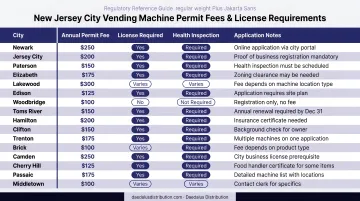
Always verify local requirements with the City Clerk or local health department before placing machines in any new municipality.
Product-Specific Restrictions
Alcohol: NJ law prohibits alcohol sales through vending machines entirely.
Tobacco and vapor products:
- May only be sold in adult-only venues under specific licensing
- Requires $50/machine annual license under N.J. Stat. Ann. § 54:40A-4
- Machines must conspicuously post signage stating that selling tobacco to persons under 21 is penalized
Standard snacks and beverages: No category-level restrictions, but must comply with labeling and sales tax rules.
How to Start a Vending Machine Business in New Jersey – Step by Step
The steps below are designed to build in the right order. Many new operators either rush into purchasing machines before securing locations or delay launch by over-planning. Follow this sequence to avoid both pitfalls.
Step 1 – Research the NJ Market and Choose Your Niche
Identify what you will sell before buying any equipment.
Product categories:
- Traditional snacks and beverages: Proven but competitive
- Healthy options: Growing in urban NJ markets with less saturation
- Fresh food: Requires health permits but commands higher prices
- Specialty items: Beauty, electronics accessories, personal care
Align products with locations:
- Manufacturing facility in Middlesex County: hearty snacks, energy drinks, hot beverages
- Bergen County office park: healthy snacks, premium coffee, fresh salads
Step 2 – Write a Simple Business Plan and Set Financial Targets
A business plan at this stage should cover:
- Startup budget
- Target number of machines in year one
- Expected commission rates to location hosts (typically 10–20% of gross sales)
- Monthly revenue per machine needed to break even
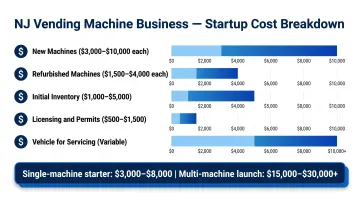
Realistic cost breakdown:
| Expense Category | Cost Range |
|---|---|
| New machines | $3,000–$10,000 each |
| Refurbished machines | $1,500–$4,000 each |
| Initial inventory | $1,000–$5,000 |
| Licensing and permits | $500–$1,500 (depending on municipality) |
| Vehicle for servicing | Varies |
Step 3 – Register Your Business and Complete NJ Compliance Requirements
State-level:
- Register your business entity (LLC recommended for liability protection) with the NJ Division of Revenue
- File NJ-REG form to obtain Sales Tax Certificate of Authority
- Complete this before placing any machines or signing location agreements
Food/beverage operators:
- Apply for health permits through NJ Department of Health or local health department in each municipality where machines will operate
- Factor inspection timelines into your launch schedule
Step 4 – Identify and Secure Locations
Target high-foot-traffic locations with a captive audience.
Best location types in NJ:
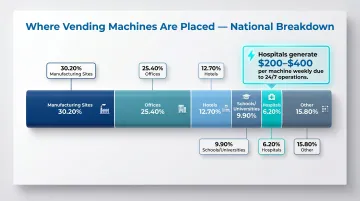
Manufacturing sites account for 30.20% of vending placements nationally, followed by offices (25.40%), hotels (12.70%), schools/universities (9.90%), and hospitals (6.20%). Hospitals are particularly profitable due to 24/7 operations and long dwell times, capable of generating $200–$400 weekly per machine.
Proven performers in NJ:
- Office buildings
- Hospitals and medical centers
- Universities and colleges
- Manufacturing plants
- Gyms and fitness centers
- Transit hubs (NJ Transit stations)
- Apartment complexes
Prioritize: Locations where the next nearest food option requires leaving the building.
Approach property owners or facility managers with:
- Your proposed product mix
- Commission structure (10–20% is standard; high-traffic retail locations may command 15–25%)
- Brief explanation of your service and maintenance commitment
Get everything in writing: Contract should cover commission rate, machine ownership, maintenance responsibilities, electricity costs, and termination terms.
Step 5 – Source Your Vending Machines
Decide between new and refurbished machines based on your budget.
New machines:
- Modern features: cashless payment, remote monitoring, touchscreen interfaces
- NJ's urban workforce increasingly expects these capabilities
- Cost: $3,000–$10,000+
Refurbished machines:
- Reduce upfront cost
- May lack modern features
- Limited warranties
- Cost: $1,500–$4,000
Modernize from the start: Daedalus Distribution offers all-digital Vendekin vending machines with touchscreen technology and remote inventory tracking—a practical option for operators who want real-time sales visibility and route management built in from day one.
Step 6 – Stock Your Machines and Set Pricing
Your product mix should match the location. A gym location calls for protein bars and electrolyte drinks; a hospital floor needs quick snacks and coffee. Start with a tight selection of proven sellers and expand only once you see what moves.
Product mix:
- Curate based on location type and customer profile
- Start with proven sellers rather than overstocking variety
- Plan for expiration dates and minimum sell-through rates if stocking perishables
Pricing strategy:
- Price products 10–20% above retail (standard for vending convenience)
- Stay within the range customers at that location will accept
- Cashless payment is expected in most NJ commercial locations today — prioritize it from the start
Step 7 – Launch Operations and Build a Restocking Routine
Route efficiency matters more than most new operators expect. Build your restocking schedule around machine volume, then organize stops geographically to cut drive time.
Restocking schedule:
- High-traffic machines: 2–3 times per week
- Lower-volume machines: weekly visits
- Group stops by geography to minimize drive time between locations
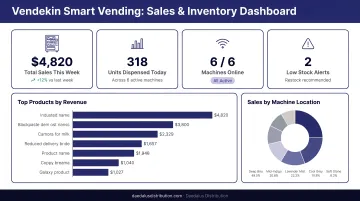
Tracking system:
Set up a simple sales tracking system from day one. Whether using a vending management app or a spreadsheet, track:
- Revenue per machine
- Product performance
- Machine downtime
Use this data to identify problems early and make smarter product decisions backed by actual sales numbers.
Step 8 – Monitor Performance and Stabilize Before Expanding
Track key metrics for the first 60–90 days:
- Revenue per machine per month
- Best-selling products
- Restocking frequency
- Any maintenance issues
Use this data to:
- Adjust your product mix
- Inform decisions about adding more machines
Stabilize your operations first: Consistent restocking, prompt machine maintenance, and reliable service to location hosts must be in place before pursuing new locations. Operators who scale too quickly before systems are in place often see service quality drop and location contracts fall through.
Frequently Asked Questions
Do I need a vending machine license in NJ?
NJ does not require a specific "vending operator license," but you must register your business using the NJ-REG form with the Division of Revenue, obtain a Sales Tax Certificate of Authority, and secure health permits if selling food or beverages. Local municipalities may impose additional licensing requirements.
How much is a vending machine permit in NJ?
There is no standalone "vending machine permit" at the state level, but expect these costs:
- Business registration: $125 for LLCs (NJ-REG)
- Health permits: ~$105–$250 per food vending location
- Local business licenses: $50–$250 depending on municipality
How much money can a vending machine make you a month in NJ?
Well-placed machines in high-traffic NJ locations — office parks, hospitals, transit hubs — can earn $500–$1,500+ per month. Low-traffic spots typically bring in $150–$300. The national average sits around $525/month.
How much does it cost to start a vending machine business in NJ?
A single-machine starter setup (new entry-level machine + inventory + licensing) typically costs $3,000–$8,000. A multi-machine launch with new digital equipment can run $15,000–$30,000+. Costs depend on machine type, number of units, and product category.
Do I need a health permit to sell food from a vending machine in NJ?
Yes. Machines dispensing potentially hazardous or fresh food items require a Retail Food Establishment License through the NJ Department of Health or local health department, with annual inspections. Prepackaged non-perishable snacks have fewer requirements, but confirm with your local health authority.
What are the best locations for vending machines in New Jersey?
High-performing location types include office parks in Bergen and Middlesex counties, hospitals and medical centers, university campuses, manufacturing facilities, NJ Transit stations, and apartment complexes. Foot traffic volume and a captive audience are the two most important location criteria.