The model attracts career changers, side-hustle seekers, and small business owners for a practical reason: it doesn't require a storefront, employees, or specialized skills to begin. You place machines, stock them, and earn the margin between your cost and the sale price.
That said, California's regulatory environment is more layered than most states. This guide walks through both the business-building process and the state's specific permit and compliance requirements — so you know exactly what starting here actually involves.
Key Takeaways
- Place machines in locations you don't own, stock products, and earn the margin — start with one machine and scale from there.
- California requires a free CDTFA seller's permit, a local business license, and a county health permit for regulated food sales — no single statewide vending license exists.
- Startup costs run roughly $1,500–$6,000+ depending on machine type; location quality drives profit more than machine quality.
- Secure a confirmed location before buying any equipment — purchasing first is the most common and most costly early mistake.
What Is a Vending Machine Business?
You place machines in locations owned by others, stock them with products, and earn the difference between your wholesale cost and the retail sale price. Most operators in California start with one or two machines and reinvest early revenue to expand their route.
Machine Types Available to California Operators
| Type | Examples | Regulatory Note |
|---|---|---|
| Packaged snacks & beverages | Chips, candy, bottled drinks | Lowest compliance hurdle |
| Combo machines | Snacks + drinks in one unit | Same as above |
| Specialty machines | Coffee, hot food, frozen items | Higher compliance under California Retail Food Code |
| All-digital smart machines | Touchscreen, IoT-connected | No additional regulatory category, but preferred by commercial locations |
One expectation to set early: this business is not passive at the start. The first few months require hands-on work — location scouting, permit applications, machine setup, and route learning. Once placements are stable and your restocking schedule is dialed in, the day-to-day workload drops significantly — most operators manage established routes in just a few hours per week.
Why Start a Vending Machine Business in California?
California's population density creates consistent foot traffic in offices, healthcare facilities, warehouses, and residential buildings. Year-round mild weather eliminates the seasonal dips common in colder markets. The state also offers large-format opportunities that few others can match: logistics hubs in the Inland Empire, tech campuses in the Bay Area, and hospital systems statewide where vending demand runs continuously.
Structural advantages of the model itself:
- No storefront or staff required to start
- Predictable recurring demand once strong locations are secured
- Physical assets that generate income and can be relocated if a location underperforms
That said, California's advantages come with real tradeoffs worth knowing before you commit capital.
Honest California-Specific Tradeoffs
- Compliance touches multiple agencies — the CDTFA, county health departments, local business licensing offices, and California's own accessibility standards
- Premium locations in dense metro areas are actively courted by established operators, so expect competition for the best spots
- California charges an $800 annual LLC franchise tax that doesn't apply in most other states
None of these are dealbreakers. But going in prepared makes the difference between a smooth launch and a costly surprise.
What to Know Before You Start
Time and capital reality in early-stage California vending:
- Months one through three are hands-on — expect time spent on scouting, permits, machine delivery, and restocking
- Income typically stabilizes 60 to 90 days after placing a first machine
- NAMA's industry data puts average annual gross sales per machine at $6,284 — roughly $524/month — but that varies significantly by location quality
Two practical realities shape the early months of any California vending operation.
First, compliance isn't optional — and it's enforced. Machines operating without required permits can be fined or removed. Property managers at professional locations typically require proof of licensing and insurance before approving placement, so completing compliance paperwork before approaching sites gives you a real advantage in those conversations.
Second, income takes time to build. Reaching $1,000 or more per month in net income typically requires five to ten well-placed machines — a portfolio that takes six to twelve months to build from scratch. That timeline is normal; most operators who quit early do so right before the business starts producing consistent returns.
How to Start a Vending Machine Business in California — Step by Step
The steps below follow the order that reduces wasted time and money. Unlike most businesses, the most important early decision in vending is not what to buy — it's where to place the machine.
The most common early mistake: Purchasing equipment before securing a confirmed location. In California's competitive commercial real estate environment, this can leave a machine sitting idle for weeks while the operator scrambles to find a willing property manager.
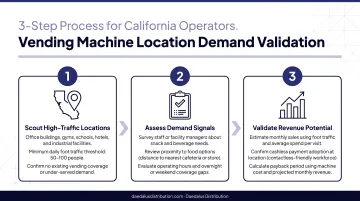
Step 1 — Choose Your Niche and Validate Demand
Niche and machine type should follow what locations are realistically accessible in your area of California. A Bay Area operator near tech campuses faces different opportunities than one near the Inland Empire's distribution centers or Los Angeles apartment complexes. The location type determines the product type, not the reverse.
To validate demand before spending:
- Visit shortlisted locations in person and observe whether existing machines are actively used
- Look for areas with no nearby food alternatives and consistent daily foot traffic
- Target captive audiences — hospital waiting rooms, warehouse break rooms, and apartment building common areas are historically strong starting points
Step 2 — Secure a Location Before Buying a Machine
Contact property managers, building owners, or office managers directly with a brief one-page overview of your service. Emphasize that installation, stocking, and maintenance are fully handled by you at no cost or hassle to them. In-person outreach outperforms cold email for vending placement pitches.
Written placement agreements are standard in professional California locations. Key terms to include:
- Agreement length (one year recommended)
- Commission rate (typically 10–15% of gross sales in California)
- Exclusivity clause, if negotiable
- Maintenance responsibilities
- 30-day termination notice period
Verbal agreements leave you with no protection if a property manager changes their mind.
Step 3 — Register Your Business and Set Up Finances
Most operators register an LLC through the California Secretary of State at bizfileonline.sos.ca.gov. California's $800 annual LLC franchise tax is a fixed operating cost unique to this state — factor it into your year-one budget. Also obtain an EIN from the IRS at irs.gov and open a dedicated business bank account.
Formal registration matters for practical reasons in California:
- Commercial property managers typically require proof of a registered business entity before approving a placement agreement
- General liability insurance is expected at most professional locations — registration makes obtaining it straightforward
- An LLC separates personal and business liability, which protects you if a dispute arises
Step 4 — Get California Permits and Compliance in Order
Three compliance layers apply before any machine goes live:
- CDTFA Seller's Permit — free, required for all operators, covers all machines statewide
- Local city or county business license — required in most California cities; fees and requirements vary by jurisdiction
- County health permit — required only when selling regulated food (refrigerated, frozen, heated, or prepared items)
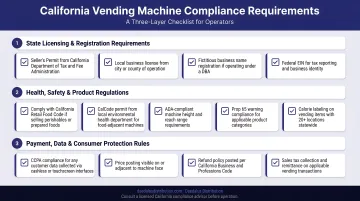
One compliance point most operators overlook: California Building Code Chapter 11B sets accessibility standards for vending machines that frequently exceed federal ADA requirements. At least one machine of each type at a given location must comply with Section 11B-309, which governs reach height, controls, and payment interfaces. This affects machine eligibility for offices, hospitals, and government buildings — evaluate it before purchasing equipment. Contact Daedalus Distribution at contact@daedalusdistribution.com for compliance specifications on Vendekin machines.
Step 5 — Purchase Your Machine and Set Up Payments
Approximate price ranges:
| Machine Type | Price Range |
|---|---|
| Used traditional machines | ~$1,000–$3,000 |
| New traditional machines | ~$3,000–$6,000 |
| Smart/digital machines | $6,000+ |
Used machines reduce upfront costs but often lack cashless payment capability — and that's a real problem in California's urban markets. According to Cantaloupe's 2025 Micropayment Trends Report, cashless payments made up 71% of all vending machine sales in 2024, up 17% from 2023. Contactless (tap-to-pay) was 77% of those cashless transactions.
For operators managing multiple California locations, all-digital touchscreen machines — such as the Omnivend Combo 22 or Elevend Multivend 22, available through Daedalus Distribution — include built-in remote inventory tracking and sales reporting at no additional license fee. That visibility matters when routes cover long distances: you can check stock and sales data without driving to each machine.
Card processing fees of approximately 2–4% per transaction should be factored into pricing before launch.
Step 6 — Stock, Price, Launch, and Stabilize
Start with proven bestsellers and a focused product selection. Track what sells in the first three to four weeks and adjust based on real data.
California vending sales tax rules to factor in from day one:
- Cold food products and hot drinks: taxed at 33% of gross receipts (not the full sale price)
- Hot prepared food and carbonated beverages: fully taxable
- Packaged shelf-stable snacks and sealed beverages: standard treatment — consult CDTFA Publication 118 for current guidance
Basic pricing formula: Product cost should target roughly 50% of the selling price. Factor in commission (10–15%), card processing (2–4%), and California sales tax before setting final prices. Compare against local convenience store pricing — vending prices should be at or slightly above nearby alternatives, not dramatically higher.
California Permits, Licensing, and Compliance
California vending compliance runs through three tracks: state tax registration, local business licensing, and health permits where applicable. No single statewide vending license covers all of these — each requires a separate step.
CDTFA Seller's Permit and Sales Tax
All California vending operators must register with the California Department of Tax and Fee Administration (CDTFA) before placing machines. Registration is free at cdtfa.ca.gov, and one permit covers all machines statewide regardless of how many locations you operate.
California's vending-specific sales tax rules are worth reviewing carefully. Under California Sales and Use Tax Law Section 6359.2:
- Cold food products and hot drinks (coffee, tea, hot chocolate): 33% of gross receipts is taxable
- Hot prepared food: fully taxable
- Carbonated beverages: fully taxable
Maintain separate sales records by tax category. CDTFA Publication 118 is the controlling reference — review it before launch.
Local Licenses and Health Permits
After state registration, obtain a business license from each city or county where machines are installed. Requirements and fees vary across California's hundreds of municipalities.
Approximate compliance cost reference:
| Requirement | Cost |
|---|---|
| CDTFA Seller's Permit | $0 |
| City/County Business License | $25–$300+ annually per jurisdiction |
| County Health Permit (regulated food only) | $100–$500+ per location |
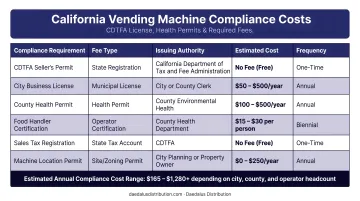
Health permit trigger: County environmental health permits are required when machines sell refrigerated, frozen, heated, or prepared food — including fresh meals, hot coffee, or brewed drinks. Machines selling only packaged shelf-stable snacks and sealed bottled beverages typically do not require a health permit. This distinction significantly affects both compliance cost and setup timeline, and is why most new operators start with packaged products.
California Accessibility and Additional Requirements
California Building Code Chapter 11B requires that at least one of each machine type at a given location comply with Section 11B-309. These standards apply to offices, medical buildings, government facilities, and similar commercial spaces where local building officials enforce Title 24.
ADA/accessibility specs (Section 11B-309):
- Reach heights between 15 and 48 inches
- Operable parts usable with one hand
- Maximum activation force of 5 pounds
Restricted product categories:
- Tobacco: Requires a separate CDTFA Cigarette and Tobacco Products Retailer's License for each machine location, renewed annually, with strict age-21-plus enforcement
- Alcohol: Subject to significant California ABC licensing restrictions and age verification challenges — verify current California ABC rules at abc.ca.gov before pursuing either product category
How to Select Locations and Manage Your Route in California
Highest-Performing Location Types
- Office buildings and tech campuses — particularly Bay Area, where long on-site hours and limited nearby food options drive consistent use
- Healthcare facilities — high patient dwell time, captive audience, willingness to pay for convenience; California had 40.1 million outpatient visits in 2020 alone
- Warehouses and distribution centers — Inland Empire and Central Valley shift workers with few nearby food alternatives
- Apartment complexes — dense urban markets including Los Angeles, San Francisco, and San Diego
Professional commercial locations in California expect cashless payment, remote monitoring, and reliable service as standard — meeting these expectations is the entry point, not a competitive edge. Route management is where operators gain real advantage.
Route Management Principles for California
California's major metros are geographically large. Practical route management matters from the start:
- Group machine locations to minimize drive time between stops
- Use remote inventory tracking to avoid unnecessary check-in trips
- Plan for part-time help before you're already overextended at five or more machines
Digital machines with built-in remote monitoring — such as those distributed by Daedalus Distribution — are well-suited for California routes that span long distances across a single metro area. Knowing which machines need restocking before you drive cuts wasted trips and improves your margin per stop.
Realistic Revenue Benchmarks
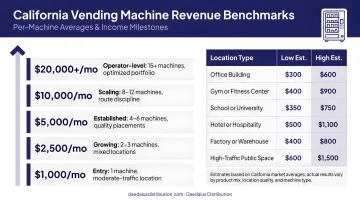
NAMA reports average annual gross sales of $6,284 per machine in 2023 — up from $4,032 in 2020. Key benchmarks to plan around:
- $200–$600/month in gross sales per machine at a strong California location
- 3–6 machines typically needed to reach $1,000/month in net income
- Location quality is the growth bottleneck at this stage — not operations or logistics
Frequently Asked Questions
Do you need a license to own a vending machine in California?
California has no single vending machine license. All operators need a free CDTFA seller's permit, most need a local city or county business license, and those selling regulated food must obtain a county health permit. That combination is what most people mean when they ask about a "vending license" in California.
How much is a vending machine license in California?
The CDTFA seller's permit is free. City or county business licenses typically run $25–$300 or more annually depending on the jurisdiction. County health permits for regulated food vending range from $100–$500 or more per location.
How many vending machines do you need to make $1,000 a month?
It depends almost entirely on location quality. A machine in a high-traffic California location — hospital, large office building, busy apartment complex — can generate $200–$500 per month in gross sales. Reaching $1,000 per month in net income typically requires three to six well-placed machines, and that level usually takes six to twelve months to build starting from zero.
Do vending machines need a health permit in California?
Only when machines sell regulated food — refrigerated, frozen, heated, or prepared items including coffee machines require county environmental health department approval. Machines selling only packaged shelf-stable snacks and sealed bottled beverages typically do not require a health permit.
How much does it cost to start a vending machine business in California?
A single used machine with initial inventory can launch for approximately $1,500–$3,500; new machines range from $3,000–$6,000 or more. Add compliance costs ($0–$500 depending on product type), general liability insurance, and a repair reserve. Total first-machine startup costs in California typically fall between $2,000 and $7,000.
Conclusion
A successful California vending launch comes down to three parallel workstreams:
- Securing the right location before anything else
- Getting California's layered compliance requirements in order before machines go in
- Matching the machine to the product type and placement context
Working through these in order cuts off the mistakes that typically cost new operators the most time and money.
Long-term success here comes from treating this as a real business from day one — tracking sales and costs per machine, building strong relationships with property managers, and expanding deliberately. Add new locations only after existing ones are consistently profitable and running smoothly. That discipline is what separates operators who build durable routes from those who burn out after their first few placements.