Introduction
The global intelligent vending machine market is projected to reach $55.52 billion by 2030, growing at 14% annually as the industry shifts toward software-centric business models. Machine prices have dropped as touchscreens, cashless readers, and remote monitoring have become standard equipment rather than premium add-ons.
Smart vending machine costs vary widely—from $2,000 to over $25,000—depending on machine type, technology tier, product handling requirements, and ongoing operational expenses. Many buyers struggle to understand why two machines that look nearly identical on the outside can differ by $10,000 in price. That gap comes down to internal technology and automation capabilities.
This guide covers:
- Price tiers by machine type
- Key factors that drive costs up or down
- Total cost of ownership beyond the sticker price
- How to match your budget to the right machine for your location and revenue goals
Key Takeaways
Key takeaways on smart vending machine costs:
- Entry-level models with cashless payments and basic monitoring start around $2,000–$6,000
- $8,000–$15,000 covers mid-range touchscreen units with advanced inventory tracking
- High-end AI-powered machines with specialty product handling reach $15,000–$25,000+
- Recurring costs—software fees, payment processing, connectivity—can add hundreds to thousands annually to total cost
- Budget decisions hinge on location, product type, and revenue goals — not just upfront price
How Much Does a Smart Vending Machine Cost?
Smart vending machines don't have a fixed price. Two machines with similar exteriors can differ by $10,000+ based on technology, product handling complexity, and automation level. Misunderstanding cost drivers leads to common mistakes: underbudgeting for necessary features, choosing the wrong tier for your location's traffic level, and getting blindsided by recurring software and payment processing fees.
The four tiers below—new entry-level, mid-range, high-end, and used/refurbished—each serve different operator goals. Understanding where your needs land prevents costly over- or under-investment.
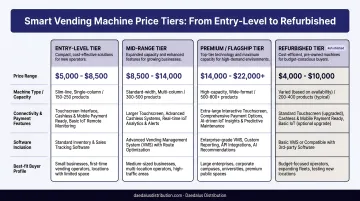
Entry-Level Smart Vending Machines: $2,000–$6,000
What's included at this tier:
- Cashless payment support (credit/debit cards)
- Basic remote monitoring and telemetry
- Standard mechanical dispensing
- No touchscreen or advanced analytics
Best-fit use cases:
Entry-level smart machines suit small offices, employee break rooms, and low-to-moderate traffic locations where operators want a practical upgrade from cash-only machines without complexity. These machines provide the core benefit of cashless payments—which increases average ticket sizes by 37% ($2.24 vs. $1.78 for cash)—without the added cost of touchscreens or AI-powered analytics.
Representative models include the AMS Slim Gem ($4,595) and Seaga ENV4S ($4,495).
Mid-Range Smart Vending Machines: $8,000–$15,000
What's included at this tier:
- Full-color touchscreen interface (10" to 22")
- Multi-item purchasing capability
- Advanced inventory tracking and sales analytics
- Stronger user experience and engagement features
- Guaranteed vend technology
Best-fit use cases:
Mid-range machines suit gyms, campuses, hospitals, and other higher-traffic environments where presentation and engagement directly affect revenue. The touchscreen interface enables upselling, product browsing, and nutritional information display—features that drive measurable gains in average transaction value.
This tier also covers smart combo machines and coffee vending units. Examples include the Crane Merchant Media 471 ($10,995), Seaga Envision IQ ($15,200), and Vendekin touchscreen units distributed by Daedalus Distribution, which include U.S.-based parts and service support. The Necta Krea Touch ($7,775) represents the lower end of this range.
High-End and Specialty Smart Vending Machines: $15,000–$25,000+
What's included at this tier:
- AI-powered product recognition and automated checkout
- Advanced product handling (temperature-controlled, fresh food, frozen, or specialty dispensing)
- Premium customization and branding options
- Robotic dispensing mechanisms for delicate items
- Dual-zone temperature control
Best-fit use cases:
High-end machines suit premium retail concepts, high-visibility placements, and operators running specialty categories that demand sophisticated product handling. Fresh food vending, frozen meal dispensing, and grab-and-go autonomous retail concepts require this tier. AI-powered systems add $4,000+ to the base machine cost and eliminate manual checkout entirely—a worthwhile trade-off for high-volume locations where labor costs are a concern.
Examples include the Fastcorp DIVI robotic frozen vending machine and AI grab-and-go units deployed in airports and corporate campuses.
Used or Refurbished Smart Vending Machines: $1,200–$4,000
The appeal and risks:
Used machines lower entry costs by 50–70% compared to new equipment—a refurbished AMS 35 snack machine retails for approximately $2,395. This makes them attractive for testing new locations or expanding on a tight budget.
Key risks include:
- Limited warranty coverage (typically 90 days on parts)
- Software compatibility issues with modern payment systems
- Reduced upgrade paths for new features
- Unknown service history and remaining component life
Before purchasing used equipment:
- Verify that cashless payment hardware is current (MDB-compatible readers like the Nayax VPOS Touch or Cantaloupe G11 cost $359–$399 to retrofit if missing)
- Confirm replacement parts availability for the specific model
- Understand what "refurbished" means—was the machine tested, or just cleaned?
- Check whether the seller provides any technical support post-purchase
Key Factors That Affect Smart Vending Machine Cost
Two machines at the same price tier can perform very differently depending on these variables. Understanding what drives pricing helps operators avoid overpaying for features they don't need — or underspending on ones that directly impact revenue.
Technology and Features
The feature set is the single biggest cost driver:
Basic tier ($2,000–$6,000):
- Cashless card readers ($359–$399 each)
- Basic telemetry and remote monitoring
- Standard mechanical dispensing
Mid-tier ($8,000–$15,000):
- Touchscreen displays (7" upgrade adds ~$850)
- NFC/mobile payment systems (Apple Pay, Google Pay)
- Real-time inventory dashboards
- Advanced sales analytics and reporting
High tier ($15,000–$25,000+):
- AI-powered product recognition (adds $4,000+)
- Computer vision for automated checkout
- Advanced user interface customization
- Predictive analytics and route optimization
Each step up adds hardware costs, software licensing fees, and more involved maintenance — so it pays to match the tier to your actual location volume and revenue goals.
Product Type and Machine Purpose
Machines built for packaged snacks are simpler and cheaper than those handling perishable or specialty products:
Cost by product category:
- Packaged snacks/drinks: Standard mechanical dispensing, no temperature control ($2,000–$8,000)
- Fresh food/dairy: Refrigeration systems, specialized delivery mechanisms ($8,000–$15,000)
- Frozen items: Dual-zone cooling, robust insulation, specialized motors ($12,000–$20,000)
- Brewed beverages: Ingredient storage, brewing mechanisms, water filtration, cleaning cycles ($7,000–$12,000)
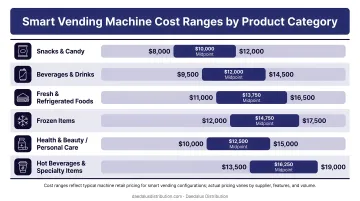
Smart coffee machines show how product requirements drive price. The Necta Krea Touch ($7,775) handles bean-to-cup brewing, milk frothing, and automated cleaning cycles — none of which a standard snack machine needs.
Capacity and Configuration
Machine capacity affects both upfront cost and ongoing operational efficiency:
- Higher-capacity machines cost more upfront but generate better ROI in high-traffic locations
- More product slots reduce out-of-stock situations
- Larger capacity reduces restocking frequency and service trip costs
- Better route economics with fewer stops per week
In high-traffic locations, an extra $3,000 for a larger-capacity machine may pay for itself within 6–12 months through reduced service costs and fewer missed sales.
Customization and Branding
Custom wraps, branded screen interfaces, lighting configurations, and layout changes add cost but can improve engagement:
Strategic value of customization:
- Custom vinyl wraps: $300–$1,000 depending on complexity
- Branded touchscreen interfaces: Included with some platforms, extra cost for others
- Custom lighting: $200–$500 for LED accent lighting
- Logo integration and color matching: Varies by manufacturer
In high-visibility placements — corporate lobbies, gyms, retail environments — customization earns its cost by making the machine look like it belongs rather than like an afterthought.
New vs. Used and Manufacturer Support
New machines offer:
- Updated software compatible with current payment systems
- Full manufacturer warranty (typically 1–3 years)
- Longer operational life (10+ years)
- Access to software updates and new features
Used machines carry a lower entry price ($1,200–$4,000) but often come with compatibility gaps in modern payment systems and little to no warranty coverage. For most operators building a reliable route, the risks tend to outweigh the savings.
Post-purchase support has a direct impact on downtime — and downtime costs money. Operators with access to U.S.-based service centers and in-stock parts get machines back online faster than those waiting on overseas shipping for a single component.
Total Cost of Ownership: Beyond the Purchase Price
The purchase price is only part of the investment. Operators who budget only for the machine itself often face unexpected costs within the first year. Understanding the full picture upfront prevents those surprises.
Initial Purchase (One-Time)
Machine unit cost is the most visible expense, but the categories below are what catch most first-time operators off guard.
Installation and Setup (One-Time)
Typical setup costs:
- Freight and delivery: $200–$1,000 depending on distance and machine weight
- Liftgate service (for locations without loading dock): $200–$500
- Professional installation and electrical hookup: $100–$500
Some distributors bundle installation into the purchase price; others charge separately. Confirm what's included before finalizing your purchase.
Payment Processing Fees (Recurring)
Cashless transactions carry a small percentage fee per transaction:
Typical processing fees:
- Nayax: 5.95% for transactions under $5, or 2.5% + $0.10 for transactions over $5
- Cantaloupe: 5.95% flat rate per transaction
At $500 monthly revenue, 5.95% processing fees cost approximately $30/month or $360 annually. This scales fast at high sales volumes—a machine generating $1,500/month pays $1,071 annually in processing fees.
Software and Connectivity (Recurring)
Many smart vending platforms charge monthly SaaS fees for remote monitoring, inventory dashboards, and analytics access:
Typical monthly costs:
- Software/SaaS fees: $7.95–$9.99 per machine per month (e.g., Nayax, Cantaloupe)
- Cellular connectivity: $1–$14 per month depending on data usage
Some platforms bundle software access with the machine purchase. Daedalus Distribution's Vendekin machines include cloud-based management software with no separate software license fees—inventory tracking, sales reporting, and remote monitoring are included.
Over 12 months, a $9.95/month software fee adds $119.40 per machine to operating costs. For a 10-machine route, that's $1,194 annually in software fees alone.
Maintenance, Repairs, and Restocking (Recurring/Periodic)
Annual maintenance costs:
- Newer machines: $50–$150 annually for routine servicing
- Older or complex machines: $400–$900 annually
- Component wear: Card readers, touchscreens, and dispensing motors will need replacement over time
Remote monitoring reduces unnecessary service trips by up to 30%, cutting fuel and labor costs. That said, it doesn't eliminate maintenance entirely, as mechanical parts still wear and require periodic replacement.
Smart Vending Machines vs. Traditional Vending Machines
Key differences in upfront cost:
- Traditional machines: $2,000–$4,000 for basic mechanical snack machines
- Smart machines: $2,000–$25,000+ depending on technology tier
Traditional machines rely on cash handling and manual restocking checks. Operators must physically visit each location to check inventory levels and collect cash, with no visibility into machine performance between visits.
Where the higher smart vending price pays off:
Smart machines provide clear operational advantages:
- Cashless payments accounted for 71% of all vending sales in 2024 — and adding cashless capability increased sales by 110% on historically low-performing machines
- Real-time inventory data lets you know exactly what needs restocking before you leave the warehouse, cutting fuel and labor costs by up to 30%
- Touchscreen interfaces enable multi-item purchases and product browsing, raising average transaction value by 37%
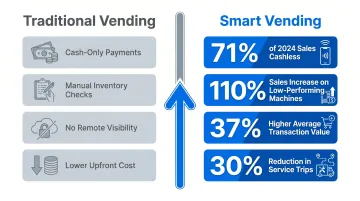
In high-traffic locations, these advantages often recoup the smart machine price premium within 12–18 months.
When traditional machines still make sense:
For low-traffic locations — break rooms with under 50 daily users, small offices, or seasonal sites — the ROI math shifts. If a location generates $200/month in sales, a $10,000 smart machine takes years to pay back. In those cases, a basic $2,000–$3,000 mechanical machine keeps overhead low while still serving the location.