Introduction
University campuses are among the most overlooked goldmines in vending. Thousands of students packed into a defined footprint, moving between buildings at predictable times, spending on food and drinks around the clock — and almost none of them carry cash.
According to the Federal Reserve's 2025 Diary of Consumer Payment Choice, adults aged 18–24 used mobile phones for 45% of payments and cash for just 10%. Put a cash-only machine in front of that demographic and you've already lost the sale.
This guide covers everything operators need to run cashless vending on campus:
This guide covers everything operators need to run cashless vending on campus:
- Why the university market is worth pursuing
- What features colleges actually require in their RFPs
- Where to place machines for maximum sales
- What to stock for a student demographic
- How to win and keep a campus contract
Key Takeaways
- University campuses are among the strongest vending locations: high foot traffic, round-the-clock demand, and students who rarely carry cash
- Most university RFPs now require debit/credit card readers and campus card integration as baseline requirements
- Dorms, libraries, and student unions are the highest-performing placement zones
- Revenue share models vary widely — some schools require 20–50% of gross sales, others set minimum annual guarantees
- Winning a campus contract means submitting a formal proposal to facilities or procurement, not just showing up
Why University Campuses Are a Prime Market for Cashless Vending
A Demographic Built for Cashless
NCES data shows 762 U.S. institutions enroll between 5,000 and 19,999 students, with 196 institutions at 20,000 or more. That's a massive pool of captive, high-frequency buyers — students who eat, snack, and buy throughout the day across multiple buildings.
And they don't use cash. The Federal Reserve's payment data confirms that 18–24 year-olds now handle the majority of their transactions digitally. A machine that requires exact change is invisible to this cohort.
24/7 Demand That Dining Halls Can't Cover
Campus dining operates on a schedule. Students don't. A University of Vermont study found that late-night dining ran from 10:00 PM to 12:30 AM — and 35.9% of respondents cited snacking as their primary reason for attending. Only 19.7% of students who wanted healthier options were satisfied with what was available.
That gap is where vending fills in. No staffing costs, no closing hours, no capacity limits — and no one standing in line at midnight waiting for the dining hall to reopen.
Commissions Give Universities a Reason to Say Yes
Universities collect commissions or minimum guarantees from vending operators, which makes them genuinely receptive to proposals — provided the operator comes with a professional pitch. Come prepared with placement data, machine specs, and a clear revenue-share structure, and the conversation moves fast.
The Incumbent Advantage Is Beatable
That contract opportunity is more accessible than it looks. Many campuses still run older machines with limited payment options. NAMA's 2022–2023 industry census reports that roughly 75% of U.S. vending machines accepted non-cash payments — meaning roughly one in four still doesn't. Operators who arrive with modern cashless hardware have an immediate, tangible differentiator over whoever currently holds the contract.
Must-Have Features in a Cashless University Vending Machine
Universities don't just prefer cashless — many now mandate it. Before you pitch a campus, your machines need to check specific boxes.
Payment Acceptance
University RFPs consistently require:
- **Credit and debit card readers** (standard at virtually every institution that has issued a recent RFP)
- NFC contactless / mobile wallets — Apple Pay and Google Pay are table stakes in 2025
- Campus card (closed-loop) integration — the University of Maine System required Transact POS compatibility; UAFS required student card readers alongside standard cashless options
Cantaloupe's 2025 Micropayment Trends Report found that 77% of cashless vending sales in 2024 were contactless, and mobile payments grew more than 300% year-over-year. The machines that support all tender types capture all the revenue.
Touchscreen Interface
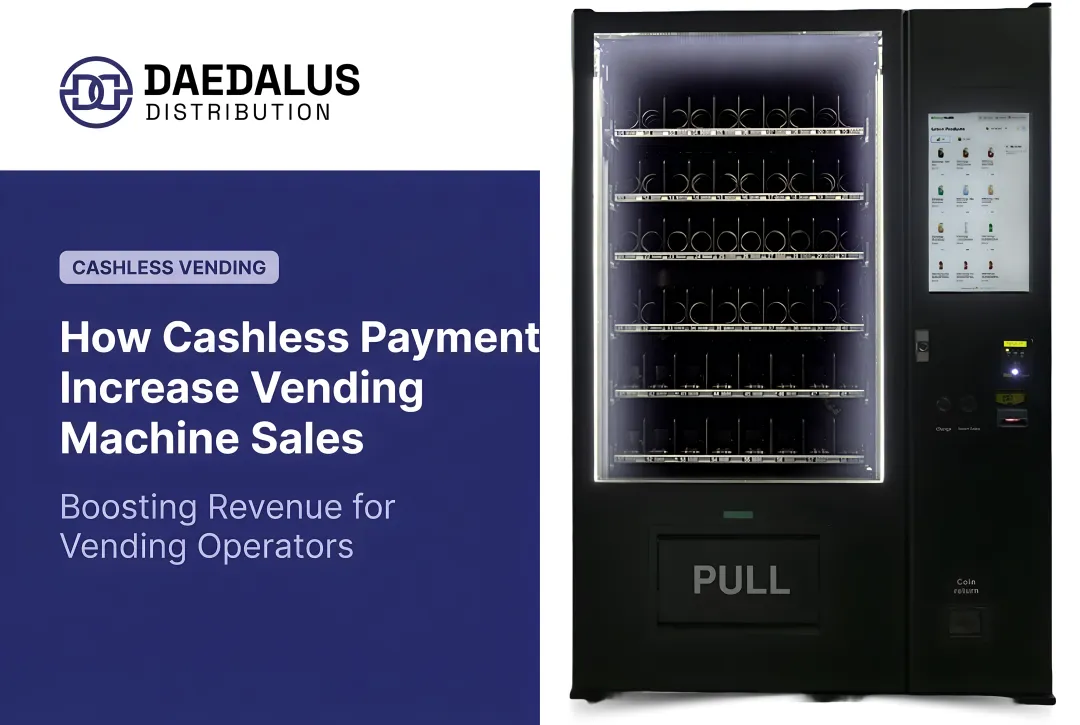
Students interact with touchscreens all day. A clean digital interface reduces transaction friction and speeds up purchases. The Vendekin machines available through Daedalus Distribution — including the Omnivend Combo 22 and Elevend Multivend 22 — feature 22-inch touchscreen displays, while the compact Omnivend Combo 10 offers a 10-inch screen for tighter locations.
Remote Monitoring and Telemetry
Machines spread across a large campus create real operational challenges. Remote monitoring solves them. The Vendekin platform, included with every machine at no separate license fee, provides:
- Inventory alerts to flag low-stock before it becomes a lost sale
- Real-time sales reporting by machine
- Machine-health monitoring for operational issues
Mineral Area College required telemetry and remote monitoring by name in their RFP, and similar mandates appear across other institutional contracts.
Product Versatility
The Elevend Multivend 22 is built for dairy, beverages, snacks, and fragile items, with a built-in elevator system for safe dispensing. For campuses that want to offer fresh food, protein shakes, or temperature-sensitive products, machine capability matters as much as payment technology.
Reliability and Service Support
Universities have zero tolerance for machines that go dark for days. Look for equipment backed by a U.S.-based service center with parts availability. Daedalus Distribution operates from Summerville, South Carolina, with support available Monday through Friday. Downtime on a busy campus reflects on the operator and can cost you the contract renewal.
Best Locations to Place Cashless Vending Machines on Campus
Mapping High-Traffic Zones
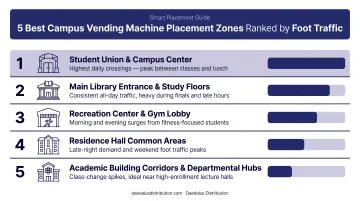
Five placement zones consistently appear across university vending RFPs and produce the most consistent foot traffic:
- Dormitory lobbies — 24/7 captive audience after dining hours close; high impulse purchase rate
- Libraries and study areas — late-night snack and energy drink demand; Purchase College's RFP specifically listed library placements
- Classroom corridors — grab-and-go purchases during passing periods between lectures
- Student union and recreation centers — high social traffic with diverse product needs
- Athletic facilities — post-workout nutrition demand; protein bars and drinks move well here
What Else Affects Placement Viability
Foot traffic is the starting point, not the whole answer. Before committing to a location, confirm:
- Power access — standard outlet availability and amperage
- Connectivity — Wi-Fi or cellular signal strong enough for cashless transactions and remote telemetry (University of Maine System required either cellular or encrypted wired/wireless network access)
- Lighting and sightlines — poor visibility kills impulse purchases
- Clearance for restocking — narrow corridors that create congestion during fills create complaints
When building a campus proposal, pull enrollment data and campus maps to show exactly which buildings have the highest student density. A proposal that cites specific building traffic counts and maps student density to machine locations gives procurement committees concrete justification to approve your bid over a generic one.
What to Stock: Product Mix That Moves on Campus
The Core Categories
A peer-reviewed 2021 study on college students and campus vending found that 85% of participants used campus vending machines. Top purchased items:
- Sweets and candy: 45%
- Salty snacks: 39%
- Cereal and granola bars: 11%
Those numbers tell you what students want. But university RFPs increasingly tell you what you must offer. The University of Maine System required one-third of products to qualify as healthy alternatives; St. Johns River State College required 50% healthy options.
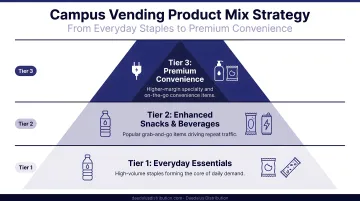
A balanced campus mix covers three tiers:
- Everyday demand — chips, bottled water, energy drinks, coffee
- Wellness-aligned options — protein bars, nuts, low-sugar beverages (meets RFP mandates and serves health-conscious buyers)
- Convenience items — phone chargers, earbuds, personal care, study supplies (differentiates your machines and increases basket value)
Getting the initial mix right is step one. Keeping it optimized is what separates consistently profitable machines from underperformers.
Treat Product Selection as Ongoing, Not One-Time
IoT-connected machines log every transaction in real time, giving operators a clear view of exactly which SKUs move and which sit. Daedalus's Vendekin-powered machines surface this data through the included cloud management platform — no manual tracking required. Demand shifts across the academic calendar too; products that crawl in September may spike during finals. Operators who act on that data consistently outperform those restocking on instinct.
How to Land a University Vending Contract
Understanding the Approval Process
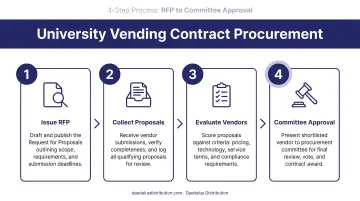
Universities don't let operators walk in and plug in machines. Most run a formal procurement process:
- Identify the right department — facilities management, dining services, or student affairs depending on the institution
- Watch for RFPs — many schools issue a Request for Proposal with specific requirements, evaluation criteria, and deadlines
- Submit a complete proposal — missing components will disqualify you before anyone reads your pitch
- Present to a committee — larger institutions often require a presentation or Q&A round
What Belongs in Your Proposal
A competitive campus vending proposal should include:
- Campus map with proposed machine locations and foot traffic rationale
- Machine specs, screen size, and photos
- Payment capabilities (cashless, contactless, campus card compatibility)
- Revenue share offer or monthly fee
- Restocking frequency commitment
- Maintenance and uptime plan
- References from other institutional placements if you have them
Understanding Revenue Share Models
Revenue structures vary more than most operators expect. Verified examples from public RFPs:
| Institution | Financial Terms |
|---|---|
| Mineral Area College | Minimum 50% of gross sales |
| Missouri State (audit) | 20% of gross sales |
| Purchase College | $50,000 annual guarantee + % of net sales |
| UAFS | Monthly % of gross sales less sales tax |
Revenue-share vs. flat fee: Revenue share ties your payment to actual performance — better for new placements with uncertain volume. Flat-fee arrangements can work in your favor at high-traffic locations once you know the numbers. Know which structure the university prefers before you walk in.
Beyond price, universities evaluate vendors on equipment quality, service reliability, uptime commitments, and whether the product mix aligns with campus wellness priorities. Machines with all-digital touchscreens, remote monitoring, and documented U.S.-based service support check those boxes directly — and give your proposal something specific to back up each claim.
Frequently Asked Questions
Can I install cashless vending machines at my university?
Yes, though universities typically route vending through facilities or procurement departments, and many issue formal RFPs. Identify the right contact — usually facilities management or student services — prepare a professional proposal, and respond through official channels.
How many cashless vending machines would a university need to make $100,000?
Purchase College's publicly available RFP shows $210,251 in annual gross sales across 48 machines in 2012–13 — roughly $365/month per machine. At that rate, you'd need approximately 23 machines to hit $100,000 gross, though placement quality, product mix, and payment options all affect actual results.
What payment methods should cashless university vending machines accept?
Credit cards, debit cards, NFC contactless (Apple Pay, Google Pay), and ideally campus card (closed-loop) integration. Many university RFPs now require all of these as minimum specifications — supporting every tender type removes friction for every student.
What products sell best in university vending machines?
Energy drinks, coffee, bottled water, chips, and protein bars are consistent performers. The 2021 college vending study found sweets and salty snacks dominate purchases, but RFP wellness mandates mean operators should balance impulse items with healthier alternatives.
How do cashless vending machines work with a university's campus card system?
Modern cashless readers handle both open-loop payments (Visa, Mastercard, Apple Pay) and closed-loop campus card accounts on one device. Confirm compatibility with the campus's platform — Transact, CBORD, and TouchNet are the most common — before signing a contract.
What should I look for in a cashless vending machine for a university campus?
Prioritize machines that offer:
- Multi-tender payment acceptance (cards, NFC, campus card)
- Touchscreen interface with intuitive navigation
- Remote monitoring and sales reporting
- Reliable uptime and U.S.-based service support
University contracts come with real accountability expectations — these features are what procurement teams look for.