Introduction
The U.S. fitness industry hit $46.4 billion in market size in 2025, with 77 million members and nearly 96 million total customers using fitness facilities in 2024. That's a lot of people walking through gym doors — and most of them want something to drink or eat before, during, or after their workout.
Vending machines let gym owners capture that spend without hiring extra staff. Many operators overspend on equipment, though. Plenty of budget-friendly machines in the $2,000–$5,000 range deliver the same revenue performance as pricier units — especially when matched to the right gym environment.
This guide breaks down the best budget options, what specs actually move the needle for gym placements, and how to avoid common buying mistakes.
Key Takeaways
- Budget gym vending machines typically cost $2,000–$5,000 and can generate $400–$1,200/month based on traffic and product mix
- Combo machines (snacks + drinks in one unit) offer the best value for most gym sizes
- Must-have features: cashless payment, adjustable shelving, remote monitoring, energy efficiency
- Top products to stock: protein bars, bottled water, energy drinks, electrolyte beverages
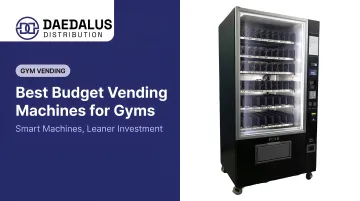
- Touchscreen, cashless, IoT-connected machines from Vendekin (distributed by Daedalus Distribution) offer built-in monitoring with U.S.-based support
Why Gyms Are a Smart Location for Budget Vending Machines
Gyms aren't just convenient vending locations — they're one of the best performing ones. Members follow predictable routines, visit consistently, and arrive with specific nutrition and hydration needs already in mind.
The 2025 Global Fitness Industry Report shows U.S. fitness memberships grew 5.6% in 2024, with 91% of operators expecting revenue gains and 83% expecting profitability gains in 2025. More members means more foot traffic — and more vending opportunities.
That growth translates directly into vending revenue. Here's what makes gyms one of the most reliable placement locations:
- High purchase intent — members arrive knowing they'll need water, a bar, or an energy drink
- Repeat traffic — consistent weekly visits create habitual purchasing patterns
- No staff required — machines run 24/7, generating revenue outside staffed hours
- Low competition at point of purchase — most gyms don't have a full-service café or retail counter
Revenue potential varies by gym size. Boutique gyms (300–500 members) typically see $400–$700/month per machine, mid-size gyms $700–$1,200/month, and high-traffic commercial gyms $1,200–$1,800+ depending on machine type and product mix.
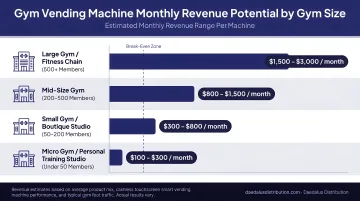
The machines below are evaluated against exactly these conditions — foot traffic volume, product compatibility, and return on a modest upfront investment.
Best Budget Vending Machines for Gyms
Each machine here was evaluated on upfront cost, gym-specific functionality, payment technology, and long-term reliability — not just the lowest sticker price. The list covers five distinct options, from compact combo units to dedicated beverage machines, so you can match the right choice to your gym's size and sales mix.
Vendekin All-Digital Vending Machine (via Daedalus Distribution)
Vendekin Technologies builds purpose-built smart vending machines designed for modern, high-traffic locations. Daedalus Distribution is the authorized U.S. master reseller, operating out of Summerville, SC, with a domestic parts and service center supporting operators nationwide.
Three models are available, each suited to different gym sizes:
- Omnivend Combo 10 — 10-inch touchscreen, compact footprint, ideal for boutique gyms under 300 members
- Omnivend Combo 22 — 22-inch touchscreen, higher-traffic capacity, suited for mid-size to commercial gyms
- Elevend Multivend 22 — 22-inch touchscreen with a built-in elevator dispensing system for fragile items like protein shakes, dairy, and supplements
Every Vendekin machine includes the Vendekin cloud platform at no additional license fee, covering real-time sales reporting, remote inventory tracking, inventory alerts, and machine-health monitoring.
| Details | |
|---|---|
| Price | Available on request at daedalusdistribution.com |
| Key Features | 10" or 22" touchscreen, built-in cashless payment (credit/debit, Apple Pay, Google Pay, tap-to-pay), remote monitoring, real-time sales data, no cash handling |
| Best Fit For | Mid-size to commercial gyms wanting a modern, low-maintenance digital unit with U.S.-based service support |
Seaga QB4000 Combo Vending Machine
Seaga is a U.S.-based manufacturer headquartered in Freeport, Illinois with a strong foothold in the budget vending segment. The QB4000 is their flagship combo unit: a compact snack-and-beverage machine suited for gyms that want variety without sacrificing floor space.
Official specs from Seaga show:
- 21 selections, with capacity for 77 chips/pastries, 140 candy items, and up to 120 beverages
- Dimensions: 73.5"H × 35"W × 34.5"D
- MDB and DEX payment protocol compatibility, supporting third-party cashless readers (Cantaloupe, Nayax)
- R290 refrigerant for energy-efficient cooling
- NAMA Fit Pick compatible for healthier product offerings
The QB4000 requires a separate card reader add-on for cashless payment rather than an integrated unit. Confirm compatibility with your chosen reader (Cantaloupe or Nayax) before purchasing.
| Details | |
|---|---|
| Price | ~$4,395 (reduced from $5,395 at A&M Equipment Sales) |
| Key Features | 21 selections, MDB/DEX protocol, R290 refrigeration, NAMA Fit Pick, cashless reader compatible |
| Best Fit For | Boutique or mid-size gyms needing a space-efficient combo machine with an accessible price point |
AMS 39 Glass-Front Combo Machine
Automated Merchandising Systems (AMS) is known for glass-front vending machines that increase product visibility , which typically lifts impulse purchases. The AMS 39 combo line offers 36 selections, split between snack/food and drink columns.
The glass front lets members see exactly what's available, which works well for gyms stocking branded protein bars, shaker bottles, and sports drinks where visual appeal matters. Adjustable columns can accommodate a mix of slim protein bars and standard drink cans side by side.
Key specs from current reseller listings:
- 36 selections (20 snack/food + 16 drink)
- 72"H × 39"W × 35"D
- 120VAC, 7 amps
- Optional Nayax Touch cashless reader
One important note: Current market pricing for the AMS 39 combo sits between $6,897–$7,295, which puts it above the $2,000–$5,000 budget range. It's worth including for its visibility advantages, but buyers should factor this into their budget planning.
| Details | |
|---|---|
| Price | ~$6,897–$7,295 (above typical budget range) |
| Key Features | Glass-front display, 36 selections, adjustable columns, optional Nayax cashless reader |
| Best Fit For | Gyms prioritizing product visibility to drive impulse purchases with a mixed snack and drink inventory |
CPI Merchant Ambient MEDIA2 (Snack Machine)
Crane Merchandising Systems merged into Crane Payment Innovations (CPI) in 2021, now operating under the Crane Convenience brand. Their Merchant Ambient MEDIA2 is a current-production snack-only machine with high capacity for volume locations.
Two configurations available:
- Merchant 4: 524-item capacity, 72"H × 33"W × 37.5"D
- Merchant 6: 796-item capacity, 72"H × 44"W × 37.5"D
The spiral delivery system is well-documented for vending diverse package types. CPI's product guidelines confirm it handles vertical and horizontal packages, including bars and small pouches , both common in gym vending.
Energy consumption is listed at 30 Wh/h, which is low for a machine of this capacity. MDB standard payment protocol is included, with integrated cashless payment support.
Pricing isn't published on CPI's official pages . Contact authorized dealers for current quotes.
| Details | |
|---|---|
| Price | Contact CPI dealers for current pricing |
| Key Features | 524–796 item capacity, 30 Wh/h energy use, MDB protocol, integrated cashless, flexible spiral delivery |
| Best Fit For | Larger gyms that already have a drink machine and want a high-capacity dedicated snack unit |
Royal Vendors Refrigerated Beverage Machine
Royal Vendors is a U.S.-based manufacturer of refrigerated beverage vending machines, and notably states that most equipment made for the U.S. and Canada has been ENERGY STAR qualified since April 2004 , which gives operators a reliable benchmark for comparing long-term energy costs.
Their GIII Plus series handles serious beverage volume:
- Configurations up to 804 cans
- 115V operation
- Multiple height configurations for cans and bottles
Royal Vendors machines are purpose-built for high-throughput cold beverage dispensing, making them a natural fit for cardio-heavy gyms, CrossFit boxes, and studios where drink sales dominate the product mix.
That focus makes sense given the category's performance. According to Automatic Merchandiser's 2025 State of the Industry report, cold beverages represent the largest vended category at 25% of all sales, the highest of any single product type.
Pricing and remote monitoring specs aren't published on Royal Vendors' official site. Contact authorized dealers for current pricing and feature confirmation.
| Details | |
|---|---|
| Price | Contact Royal Vendors dealers for current pricing |
| Key Features | Up to 804-can capacity, ENERGY STAR qualified, 115V operation, multiple configurations |
| Best Fit For | Cardio-focused gyms, CrossFit boxes, or studios where beverage sales dominate vending revenue |
What to Look for in a Budget Gym Vending Machine
Budget machines fail most often not because of cost, but because buyers overlook compatibility between machine features and gym operating conditions. The most common mistakes: buying cash-only machines, ignoring product size limits, and skipping remote monitoring entirely.
Cashless Payment Compatibility
Skip cashless support and you'll lose most of your sales. According to Cantaloupe's 2025 Micropayment Trends report, 77% of vending transactions in 2024 were cashless. NAMA's census data corroborates this, showing roughly 75% of active U.S. vending machines accepted non-cash payments in 2023.
A cash-only machine in a gym will miss the majority of potential transactions. Look for machines that support:
- Credit and debit card processing
- NFC/tap-to-pay (Apple Pay, Google Pay)
- Ideally, built-in readers rather than add-on hardware
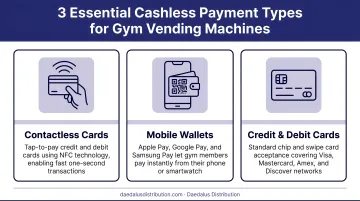
Vendekin machines from Daedalus Distribution include all of these payment methods as standard — no separate card reader required.
Product Capacity and Shelf Adjustability
Gym products vary widely in size. Standard beverage cans, slim protein bars, bulkier shaker bottles, and pouched supplements won't all fit in the same tray configuration without adjustments.
Look for:
- Height-adjustable trays or configurable spiral columns
- Confirmed compatibility with your specific product dimensions before purchasing
- Machines that won't jam on irregularly shaped items (test with your actual products when possible)
Remote Monitoring and Inventory Tracking
Empty slots during peak morning and evening hours mean lost revenue with no recovery — the sale simply doesn't happen. Remote monitoring lets operators check inventory and machine status without a physical visit, catching both stockouts and undetected error states before they compound.
Most entry-level digital machines now offer cloud-connected dashboards. The Vendekin platform — included with Daedalus Distribution machines at no additional fee — covers real-time inventory alerts, sales data reporting, and machine-health monitoring in one place.
Energy Efficiency and Operating Costs
According to DOE/FEMP guidance, a standard Class A refrigerated beverage machine runs around $144/year in electricity, while an ENERGY STAR model drops to roughly $134/year. That $10 gap is small for one machine — across a five-machine gym setup, it adds up to $50 annually with no operational change required.
When comparing machines, check the spec sheet for:
- ENERGY STAR certification or label
- Daily kWh consumption (aim for under 4 kWh/day for beverage machines)
- Low-power or sleep modes during off-peak hours
How We Selected These Budget Gym Vending Machines
Not every vending machine is built for the demands of a gym environment. Every machine on this list was assessed across four criteria specific to fitness facilities:
- Upfront cost — does it fit within the $2,000–$5,000 budget range, or offer clear value justifying a higher price?
- Gym-environment suitability — does it handle the product types, traffic volume, and operational demands of fitness facilities?
- Technology — cashless payment, remote monitoring, and modern interface quality
- Total cost of ownership — energy use, maintenance complexity, warranty coverage, and U.S. service availability
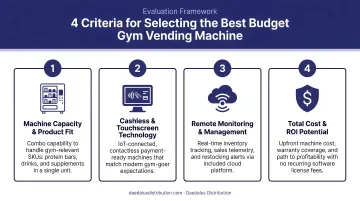
These criteria also reflect the most common (and costly) mistakes gym owners make when buying vending equipment:
- Buying the cheapest machine with no cashless payment and losing most potential sales
- Selecting oversized units for small studios with low foot traffic
- Choosing machines with no U.S. service support, leading to long repair delays and costly downtime
Conclusion
The right budget vending machine for a gym isn't just about the lowest upfront price. A machine that pays for itself in 3–6 months requires the right combination of capacity, payment technology, and reliable support.
Before selecting a machine, evaluate:
- Traffic volume — boutique vs. mid-size vs. commercial gym needs differ significantly
- Product mix — protein bars, shaker bottles, and canned beverages have different size requirements
- Floor space available — combo machines maximize variety per square foot
- Baseline requirements — remote monitoring and cashless payment are worth treating as standard, not optional
Once those criteria are clear, finding a machine that checks every box gets straightforward. Gym operators looking for touchscreen, cashless Vendekin machines — backed by a U.S.-based parts and service center — can explore options through Daedalus Distribution at daedalusdistribution.com, or reach the team directly at contact@daedalusdistribution.com or +1 843-490-2804.
Frequently Asked Questions
What is the best combo vending machine for a gym?
For most gyms, the Vendekin Omnivend Combo 22 (available through Daedalus Distribution) is a strong fit — it handles snacks and drinks in one unit while including built-in cashless payment and remote monitoring as standard. That combination of variety, compact footprint, and smart features makes it well-suited to high-traffic gym environments.
How much does a budget gym vending machine cost?
New budget gym vending machines typically range from $2,000 to $5,000. Used machines can reduce upfront cost but often lack modern cashless payment technology and come without warranty coverage — factors that can hurt both revenue and long-term reliability.
Should I buy or lease a vending machine for my gym?
Buying gives you full ownership and higher long-term margins. Leasing or partnering with a vending operator reduces your upfront cost but typically involves a revenue split — meaning you give up a percentage of every sale for the life of the arrangement.
What products sell best in gym vending machines?
Protein bars, bottled water, energy drinks, and electrolyte beverages consistently lead gym vending sales. Aligning your product mix with your gym's training style — cardio-heavy, strength-focused, or functional fitness — can boost monthly revenue.
How much can a gym vending machine earn per month?
Boutique gyms (300–500 members) typically see $400–$700/month, mid-size gyms $700–$1,200/month, and high-traffic commercial gyms $1,200–$1,800+ per machine, depending on machine type and product mix.
Do budget vending machines support cashless payments?
Not always. Some budget machines require a separate card reader add-on, while others include NFC and card processing built in. Confirm what's included before purchasing — cashless capability directly affects how much revenue the machine can generate.